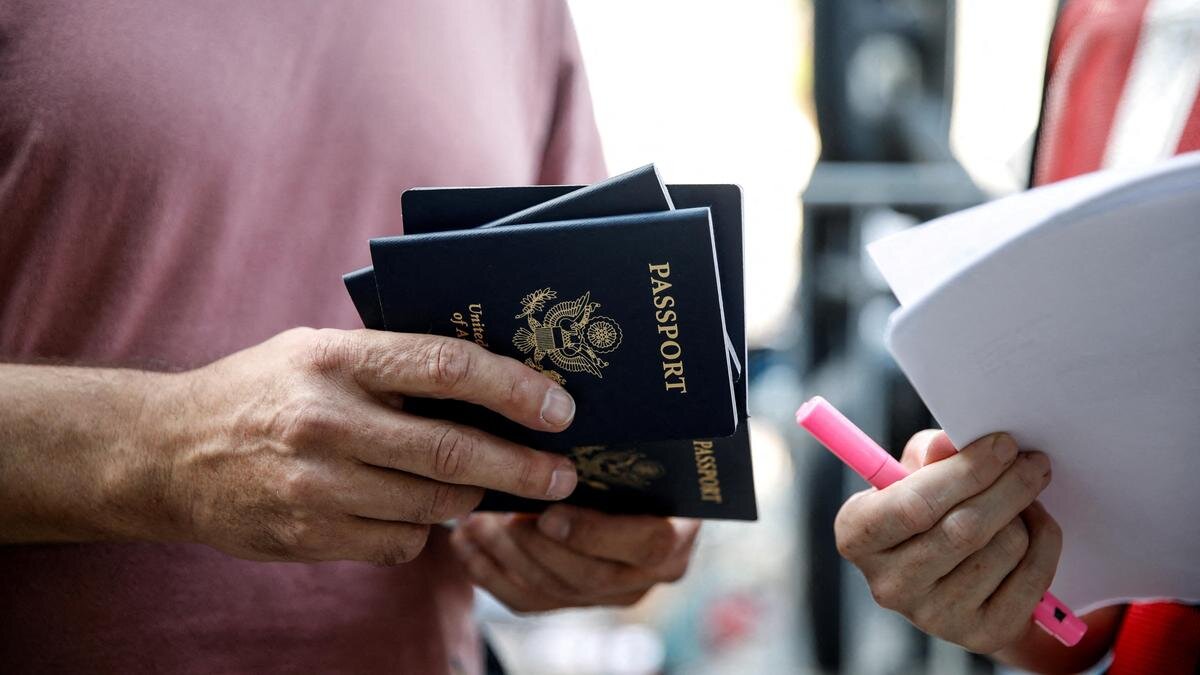
The nation’s highest court has sided with the Trump administration in a dispute over passport documentation for transgender and nonbinary Americans, permitting enforcement of restrictions whilst legal challenges proceed through lower courts.
Thursday’s Supreme Court decision represents the latest in a series of emergency rulings favouring the administration’s policy agenda since President Donald Trump began his second term. The order suspends a lower court’s requirement that the government continue its previous practice of allowing passport applicants to select male, female or X markers corresponding to their gender identity. Three liberal justices opposed the decision.
Since Trump returned to office, the Supreme Court has granted the government’s requests in nearly two dozen urgent cases spanning diverse policy areas. These include a separate matter prohibiting transgender individuals from military service, establishing a pattern of judicial deference to executive authority on issues affecting transgender Americans.
The unsigned order from the court’s conservative majority concluded the policy does not violate constitutional equality protections. Drawing an analogy to other passport information, the justices wrote that listing a passport holder’s sex assigned at birth parallels listing their birth country, both representing factual attestations rather than discriminatory classifications.
“In both cases, the Government is merely attesting to a historical fact without subjecting anyone to differential treatment,” the unsigned opinion stated, framing the documentation as neutral record-keeping rather than value judgement.
The court’s three liberal members rejected this reasoning, warning in their dissent that the policy exposes transgender people to heightened risks of violence, harassment and discriminatory treatment.
Justice Ketanji Brown Jackson authored a dissent emphasising the immediate harms the policy inflicts. “This Court has once again paved the way for the immediate infliction of injury without adequate, or really any, justification,” she wrote, connecting the policy directly to Trump’s executive order that described transgender identity using terms like “false” and “corrosive.”
Jackson’s dissent detailed troubling consequences already experienced by transgender and nonbinary plaintiffs who challenged the policy. Their accounts included sexual assaults, invasive strip-searches and accusations of document fraud at airport security checkpoints, situations that arose when their gender presentation conflicted with passport information.
The conservative majority justified its intervention by citing potential harm to government interests if the policy remained blocked. Passports fall within foreign affairs, an area where executive branch authority traditionally receives substantial judicial deference. The majority suggested that inability to enforce its chosen passport standards interferes with the executive’s foreign policy prerogatives.
The dissenting justices questioned this foreign affairs rationale, noting the unclear connection between individual identification documents and national diplomatic interests. The government had not articulated specific ways that allowing individuals to select accurate gender markers undermines foreign policy objectives.
The policy shift originated from a January executive order in which Trump declared the United States would “recognize two sexes, male and female,” determined by birth certificates and what the order termed “biological classification.” The State Department subsequently revised passport regulations to align with this directive.
The real-world impact emerged quickly. Transgender actor Hunter Schafer disclosed in February that her renewed passport arrived with a male gender marker despite her driver’s licence and previous passport reflecting female designation for years. Her experience illustrated the policy’s immediate effect on individuals who had long since updated their documentation.
Plaintiffs challenging the policy argue these passports create both inaccuracy and danger. For transgender individuals whose gender expression evolved from their sex assigned at birth, documents reflecting outdated information misrepresent their current reality whilst potentially exposing them to harmful scrutiny.
“Forcing transgender people to carry passports that out them against their will increases the risk that they will face harassment and violence,” stated Jon Davidson, senior counsel for the ACLU’s LGBTQ & HIV Project. “This is a heartbreaking setback for the freedom of all people to be themselves, and fuel on the fire the Trump administration is stoking against transgender people and their constitutional rights.”
The evolution of passport sex marker policies spans decades. Sex designations first appeared on U.S. passports during the mid-1970s. By the early 1990s, the federal government began permitting changes to sex markers, though originally requiring medical documentation to support such modifications, according to court filings from plaintiffs.
A significant liberalisation occurred in 2021 under President Joe Biden’s administration, a Democrat. That policy eliminated medical documentation requirements and introduced an X gender marker option for nonbinary individuals, changes that followed years of advocacy and litigation by LGBTQ rights organisations.
The Trump administration’s reversal of this approach prompted legal challenges from transgender and nonbinary individuals, some expressing fear about even submitting passport applications under the new restrictions. A federal judge responded by blocking the policy in June, and an appeals court declined to lift that block, prompting the administration to seek Supreme Court intervention.
Solicitor General D. John Sauer, representing the administration before the Supreme Court, invoked the court’s recent decision upholding state bans on transition-related health care for transgender minors. He characterised the Biden-era passport policy as perpetuating inaccuracies, arguing that sex assigned at birth represents objective biological reality whilst gender identity reflects subjective claims.
White House spokeswoman Anna Kelly celebrated Thursday’s Supreme Court order as validation of the administration’s approach. “This decision is a victory for common sense and President Trump, who was resoundingly elected to eliminate woke gender ideology from our federal government,” she stated, framing the policy as fulfilling campaign promises.
Attorney General Pam Bondi similarly praised the decision, asserting that recognition of two sexes constitutes a “simple truth” that Justice Department lawyers would continue defending through litigation.
The dispute reflects fundamental disagreements about the nature of sex and gender, the government’s role in recognising identity, and the balance between administrative standardisation and individual dignity. The conservative position treats sex as an immutable biological fact determined at birth, whilst opponents argue this view oversimplifies complex biological and psychological realities.
Medical and psychological professional organisations increasingly recognise distinctions between sex assigned at birth and gender identity, supporting policies that allow individuals to obtain identification documents reflecting their lived identity. These groups cite evidence that such recognition improves mental health outcomes and reduces discrimination.
The emergency docket mechanism through which this decision arrived permits rapid Supreme Court intervention in policy disputes, allowing or blocking enforcement before cases receive full consideration through normal appellate processes. Critics argue this approach produces consequential decisions without the thorough briefing, oral arguments and deliberation that characterise standard Supreme Court review.