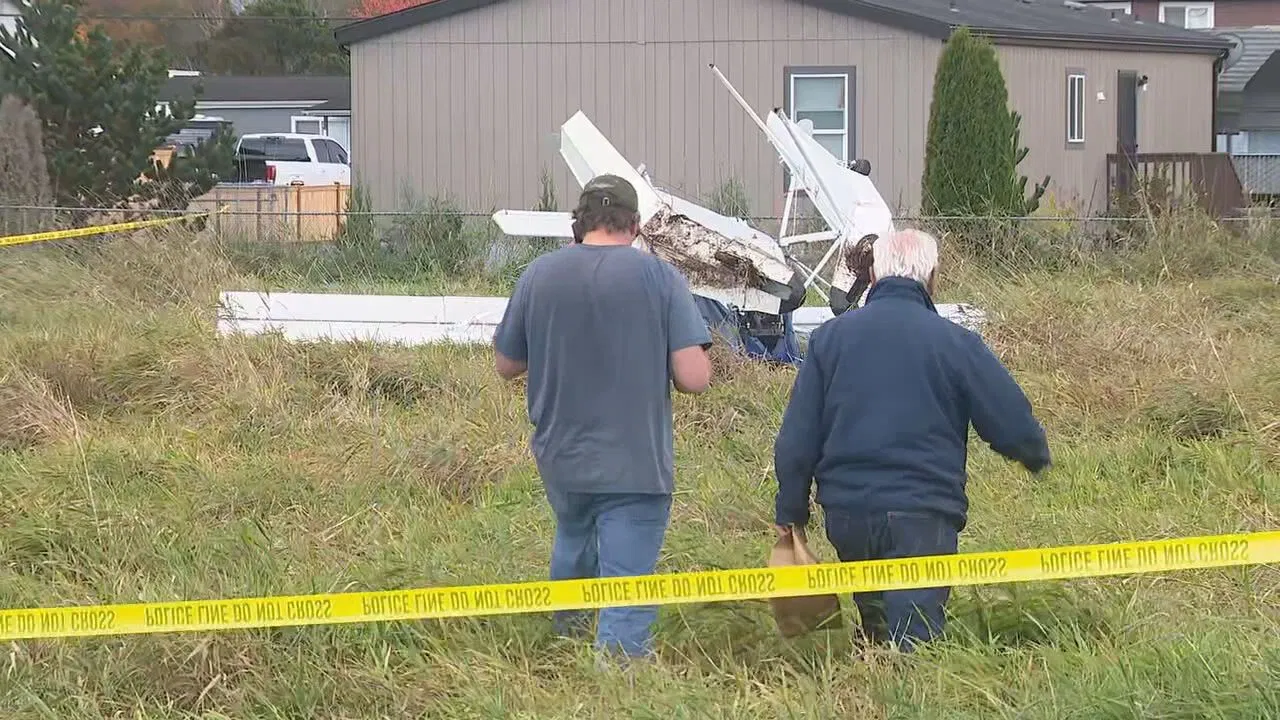
A small aircraft departing from Shady Acres Airport in Pierce County experienced a power failure Friday afternoon, forcing an emergency landing in an unoccupied field adjacent to a Pacific elementary school.
The aircraft, carrying a 43-year-old pilot and a 74-year-old passenger, had been bound for Auburn Airport when the mechanical failure occurred. The plane came to rest near Alpac Elementary in the 3100 block of Milwaukee Boulevard North, according to officials.
Pacific police and Valley Regional Fire responded to the scene and confirmed that both occupants emerged from the aircraft without injuries.
The plane came to rest in an inverted position. The Federal Aviation Administration and National Transportation Safety Board will conduct the investigation, Pacific police stated.
The emergency landing near an elementary school during afternoon hours raises questions about proximity risks, though the empty field location prevented what could have been a far more serious incident had the aircraft struck occupied structures or populated areas.
Small aircraft engine failures, whilst relatively uncommon due to rigorous maintenance requirements and pilot pre-flight inspections, occur with sufficient frequency that emergency landing procedures constitute essential pilot training components. Pilots practice simulated engine-out scenarios regularly to prepare for situations requiring immediate decisions about landing sites when powered flight becomes impossible.
The pilot’s apparent success in identifying and reaching a suitable emergency landing area reflects training effectiveness and quick decision-making under pressure. When engine power fails, pilots have limited time to assess available options, configure the aircraft for unpowered gliding, and execute an approach to the best available landing site within gliding range.
Empty fields represent ideal emergency landing locations from a safety perspective, offering relatively flat terrain without obstacles whilst minimising risks to people and property on the ground. Urban and suburban areas like Pacific present challenges for emergency landings due to dense development, but agricultural areas, parks, and school athletic fields sometimes provide viable options.
The proximity to Alpac Elementary raises concerns about what might have occurred had the emergency happened during peak school hours with students on outdoor playgrounds or athletic fields. School administrators, parents, and community members will likely have questions about aviation safety near educational facilities, though flight paths and emergency landing site selection remain largely beyond local control.
The absence of injuries to either the pilot or passenger constitutes a remarkably fortunate outcome given that the aircraft ended inverted. Small aircraft offer limited crash protection compared to automobiles, lacking crumple zones, airbags, and other safety features common in ground vehicles. That both occupants walked away suggests the aircraft maintained relatively controlled flight until ground contact and that structural integrity preserved survivable space despite overturning.
Aircraft inversions during emergency landings can result from various factors including uneven terrain, forward momentum combined with ground friction causing nose-over, or wing contact with obstacles during the landing roll. The specific sequence that led to this aircraft ending upside down will be examined during the investigation.
The ages of the two occupants, spanning three decades with the passenger being 74, suggests this may have been a recreational flight or possibly flight instruction, though the specific purpose remains undisclosed. General aviation serves diverse purposes including flight training, personal transportation, recreational flying, and business travel.
Shady Acres Airport, the departure point, represents one of numerous small general aviation airports dotting Pierce County and the broader Puget Sound region. These facilities serve private pilots, flight schools, and small aviation businesses whilst complementing larger commercial airports handling scheduled passenger service.
Auburn Airport, the intended destination, similarly serves general aviation rather than commercial airline operations. The flight distance between these two airports represents a relatively short hop typical of local area flights that might be undertaken for pilot proficiency maintenance, aircraft repositioning, or simply recreational flying.
The Federal Aviation Administration’s investigation will examine multiple factors including maintenance records, pilot qualifications and recent flight experience, weather conditions, fuel quality and quantity, and any mechanical factors that may have contributed to the power loss. The FAA maintains oversight of civil aviation safety through aircraft certification, pilot licensing, maintenance requirements, and operational regulations.
The National Transportation Safety Board conducts independent investigations of aviation accidents and incidents, determining probable causes and issuing safety recommendations aimed at preventing future occurrences. NTSB investigations can span months or even years for complex cases, though preliminary findings sometimes emerge relatively quickly.
Engine failures in small aircraft result from various causes including fuel system problems, ignition system failures, mechanical failures of internal engine components, and occasionally pilot error in fuel management. Modern aircraft engines prove generally reliable when properly maintained, though mechanical devices inevitably face failure risks.
Pacific police and Valley Regional Fire personnel responding to the scene would have established safety perimeters, checked on occupant wellbeing, assessed fire risks from fuel spillage, and secured the site pending investigator arrival. Aircraft accident scenes require careful preservation to allow thorough investigation of wreckage positions and ground impact evidence.
The inverted aircraft position creates challenges for investigators examining certain systems, though modern documentation methods including photography and 3D scanning allow detailed recording before any wreckage movement occurs.
Community members near the landing site may have witnessed the final moments of the emergency landing, with witness accounts potentially providing valuable information about aircraft altitude, engine sounds, and flight path during the approach. NTSB investigators typically seek witness statements as part of comprehensive accident investigations.
The outcome, whilst dramatic, represents successful application of pilot training and decision-making under emergency conditions. The contrast between what occurred and what might have happened had the pilot made different choices or had the aircraft struck occupied structures underscores both the inherent risks of aviation and the effectiveness of safety training and procedures.