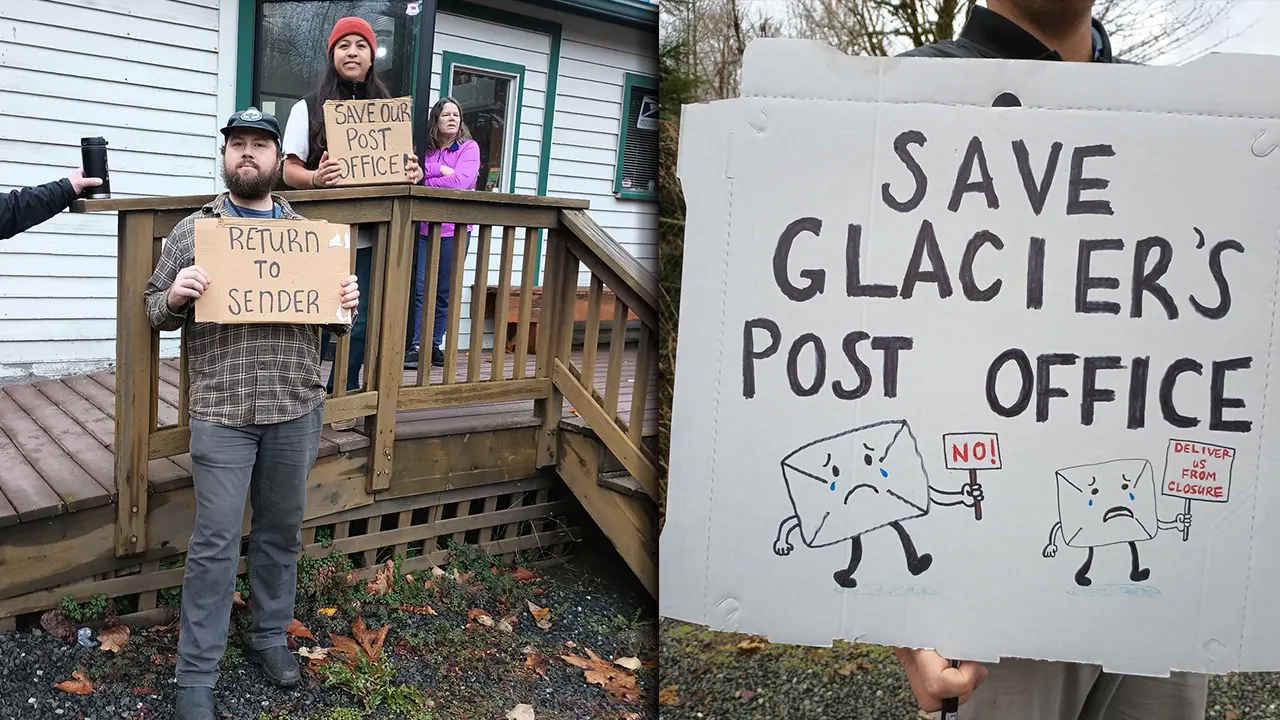
In the shadow of Mount Baker, the small town of Glacier is mounting a campaign to preserve its century-old post office as the U.S. Postal Service has halted outgoing mail acceptance, raising fears among residents that their only connection to essential deliveries could vanish.
“It’s like all of a sudden, it’s going to be gone and with no advanced notice, no nothing,” stated longtime resident Jan Eskola, who has lived in Glacier for 50 years. “I’m very concerned that they’re going to close the post office.”
For Eskola and her neighbours, closure would necessitate nearly an hour-long round trip to Deming merely to collect mail or send packages. “We have no home mail service,” she explained. “Anybody who lives up the highway, they have to come here.”
The Glacier Post Office functions as far more than a mail facility. It serves as the town’s social centre. The flagpole and handwritten sign outside mark a gathering place where residents exchange stories and maintain connections with one another.
“When the mail comes in, it’s a place where we all congregate and talk,” Eskola stated. “It’s our community connection.”
Inside, Ellen Baker from the Glacier Water District indicates rows of antique mailboxes, more than 200 still in active use.
The aging structure itself has served as the town’s hall for more than a century.
The Glacier Water District has owned the post office building since the 1970s, and Baker reports that during all that time it has never charged the Postal Service for use of the facility.
“For it to be here, it’s just gratis,” she explained. “We do it for the community.”
Despite this arrangement, USPS recently discontinued package deliveries to the location.
“I don’t know if there’s any packages left at this point because they stopped delivering last week,” Baker stated. “Christmas is right around the corner.”
She believes the service generates revenue that produces profit for USPS through postage, money orders and box rentals. The only paid worker is part-time, earning close to minimum wage.
USPS has not responded to requests for comment.
Baker expressed frustration that no one from USPS has offered clear explanation.
“The U.S. Postal Service did not investigate the impacts,” Baker argued.
The operational changes followed the recent death of the longtime clerk who had maintained the office for two hours each day. Without her, operations ceased almost immediately.
“They had attempted to close it in the past,” Baker recalled. “But there was public outcry.”
That outcry has commenced again. Locals gathered Monday afternoon outside the old town hall in protest, holding signs demanding the post office remain open.
Glacier’s residents contend their town is not declining but growing.
“I know we’re too small to have a gas station,” stated Mike Baxter. “But really there’s more full-time residents now than there ever was thirty years ago.”
Baxter, who lives with multiple sclerosis, argues travelling to another post office is not feasible for many, especially those with mobility limitations like him.
“It’s hard enough for me just to get up the ramp and in the box where it’s only ten feet away,” he said. “It seems like a slap in the face to Glacier.”
Baxter notes it is not just homeowners impacted; local businesses depend on the post office to ship and receive packages, particularly during the holidays.
The situation in Glacier exemplifies broader tensions between rural communities and federal agencies attempting to optimize operations through consolidation and closures. Small-town post offices nationwide face similar threats as USPS seeks to reduce costs amid declining mail volumes and persistent financial pressures.
The century-long history of Glacier’s post office represents continuity and stability in a community where few institutions have endured across generations. The building has witnessed the town’s evolution, serving residents through economic booms and busts, population fluctuations, and technological transformations that have reshaped communication and commerce.
The Glacier Water District’s decision to provide the building rent-free for five decades demonstrates extraordinary community commitment to maintaining postal services. Most property owners charge rent for commercial spaces, making the Water District’s gratis arrangement a substantial ongoing subsidy that has enabled continued postal operations that might otherwise have closed years ago based purely on revenue calculations.
The abrupt halt to package deliveries and outgoing mail acceptance, occurring without community notification or consultation, reflects the disconnect between federal bureaucratic decision-making and the lived realities of rural residents. Communities like Glacier lack the political clout or media visibility that might prompt reconsideration of closure decisions affecting larger populations.