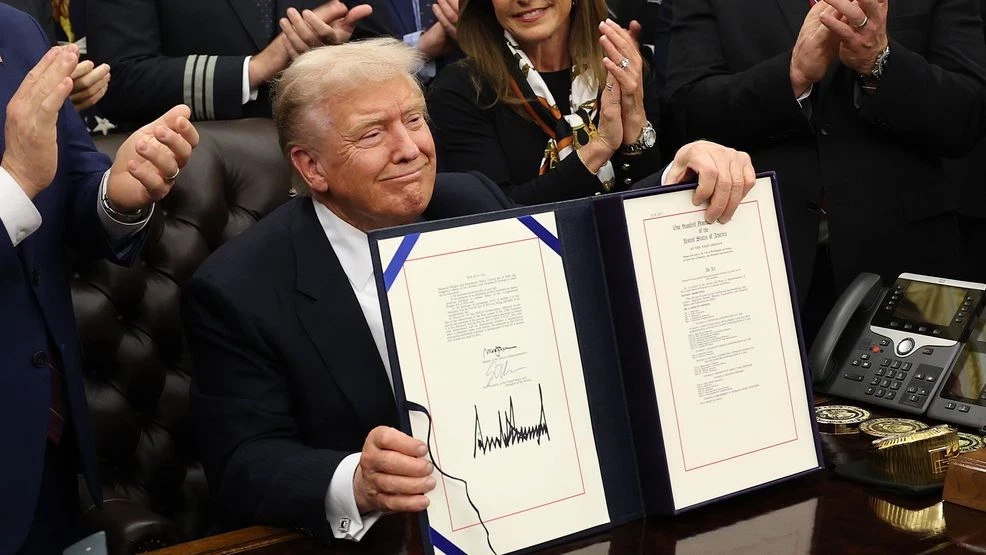
The longest government shutdown in American history reached its conclusion Wednesday night when President Donald Trump signed funding legislation passed by Congress, reopening federal operations after 43 days of disruption that affected millions of Americans.
The bill-signing ceremony in the Oval Office became a platform for Trump to assign blame for the protracted standoff, directing criticism at Democratic lawmakers whom he held responsible for the crisis.
“So I just want to tell the American people, you should not forget this,” Trump stated. “When we come up to midterms and other things, don’t forget what they’ve done to our country.”
Beyond celebrating the shutdown’s end, Trump used the moment to advocate for eliminating the Senate filibuster, a procedural rule requiring 60 votes to advance most legislation. He argued this structural change would prevent future shutdowns, though the temporary nature of the funding package, which expires 30 January, means Congress will face similar negotiations within weeks.
“Don’t forget we have another date coming up in the not-too-distant future. We can never let this happen again. So I say terminate the filibuster,” Trump urged.
Senate Majority Leader John Thune and other GOP senators have previously rejected this “nuclear option,” recognising that eliminating the filibuster would remove minority party protections that Republicans themselves might need in future political configurations.
The House passage of the funding bill Wednesday night by a 222 to 209 margin represented the final legislative hurdle before reopening government operations. The narrow partisan divide, with six Democrats crossing party lines to support the measure whilst two Republicans defected to vote against it, reflected the political tensions that had prolonged the shutdown.
“The shutdown is finally over thanks to House and Senate Republicans,” Speaker Mike Johnson declared following the vote. “Absolutely no question the Democrats were responsible for this.”
Johnson’s expedited handling of floor proceedings, declining to utilise his unlimited debate time, signalled urgency to conclude the crisis. “Let’s get the government open,” he stated simply, prioritising action over political theatre.
The House floor debate preceding the final vote devolved into bitter recriminations as both parties sought to establish public narratives about responsibility for the shutdown’s consequences. Democrats attacked Republicans for remaining out of session during the shutdown’s duration, characterising their absence as vacation whilst federal workers missed paychecks and essential services deteriorated.
“Where the hell have you been. Eight weeks of taxpayer-funded vacation for Republicans,” Rep. Jim McGovern, Democrat of Massachusetts, declared on the House floor, articulating frustration that resonated with constituents affected by the shutdown.
Republicans rejected this characterisation, arguing that members remained engaged in Washington or their districts throughout the shutdown period, working toward resolution whilst Democrats allegedly maintained unreasonable negotiating positions.
Rep. Tim Moore, Republican of North Carolina, expressed confidence before the vote that moderate Democrats would join Republicans in supporting the bill, driven by recognition that continued shutdown inflicted real harm on constituents.
“I just think it was wrong that my colleagues on the other side of the aisle played this game with this shutdown, knowing real people were getting hurt,” Moore stated. “I’m glad folks came to their senses on this thing. Let’s move forward and nobody needs to play this game, neither side needs to.”
Johnson’s pre-vote comments attempted to position the shutdown’s impacts squarely on Democratic shoulders, cataloguing the hardships Americans endured during the 43-day crisis.
“I just want to apologise to Americans who still have flight cancellations or delays. Those made to go hungry. Troops and federal employees wondering when their next paycheck is coming. All of that is on the Democrats,” Johnson stated.
Beyond simply funding government operations, the legislation includes a controversial provision allowing Senators to sue the Department of Justice regarding previous subpoenas, with potential awards up to $500,000 or more in damages. Johnson expressed surprise and anger about this provision’s inclusion, suggesting he was unaware it would appear in the final bill.
“I was surprised, I was shocked by it, I was angry about it,” Johnson told reporters, whilst indicating he did not believe Senate Majority Leader Thune acted with malicious intent in adding the provision.
Johnson committed to drafting separate legislation eliminating this provision, with a House vote anticipated next week. His comments suggested broader Republican opposition to the measure beyond his personal objections.
The Senate’s Monday night passage of the shutdown-ending deal by a 60 to 40 margin required support from eight Democrats who broke with their party despite vigorous opposition from Democratic leadership. The deal includes reversal of Trump administration mass firings of federal employees during the shutdown, guarantees backpay to affected workers, and establishes protections against similar future actions. It also ensures food stamp funding through fiscal year 2026.
The House Rules Committee’s Tuesday evening marathon session, extending past 1 a.m. Wednesday, featured unsuccessful Democratic attempts to force votes on Obamacare subsidy extensions expiring 31 December. House Minority Leader Hakeem Jeffries personally testified supporting his amendment extending subsidies three years, but these efforts failed along party lines.
The House’s absence from session since 19 September, whilst awaiting Senate action, became a focal point for Democratic criticism that Republicans prioritised political positioning over addressing the shutdown’s mounting human costs.
The shutdown’s impacts cascaded across American society during its 43-day duration. Transportation Secretary Sean Duffy announced FAA flight reductions at 40 major airports, with cuts starting at 4% and escalating toward 10% as air traffic controller absences increased. By Tuesday morning, more than 1,100 flights faced cancellation whilst approximately 600 experienced delays.