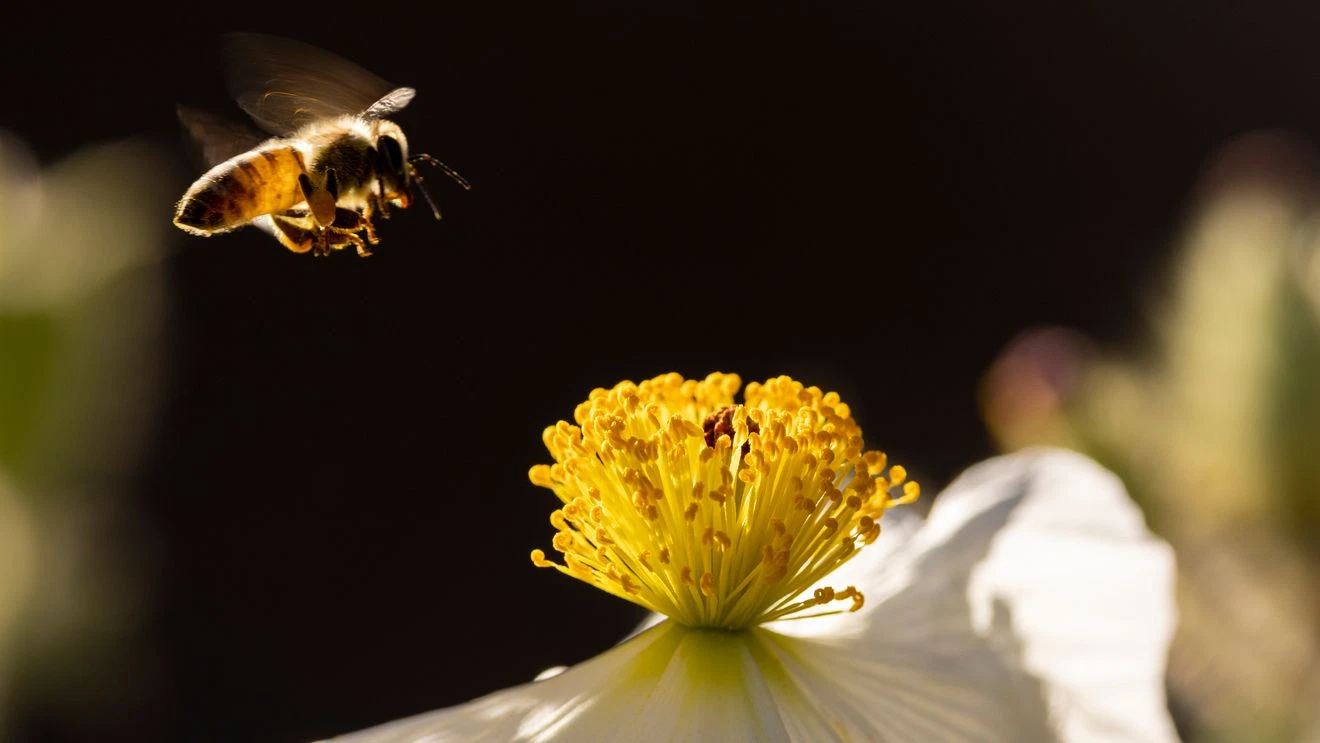
In the forgotten margins of Puget Sound, where abandoned golf courses decay and weeds flourish beneath power lines, wild bee populations are experiencing unexpected success, revealing profound insights about urban biodiversity and challenging assumptions about valuable wildlife habitat.
A comprehensive seven-year study by Washington State University researchers has documented remarkable pollinator diversity in these overlooked “marginal lands,” spaces that include an abandoned golf course, areas surrounding airports, and vegetation beneath electrical transmission corridors. These locations, dismissed by casual observers as degraded wastelands, have become critical sanctuaries for bee species, some never before recorded in Snohomish and King counties.
David Crowder, a professor in WSU’s Department of Entomology who served as the study’s corresponding author, expressed surprise at the biological richness researchers discovered in habitats typically considered ecologically valueless.
“Someone looking from the outside would say this is a junky old golf course that has been left to rot,” Crowder stated. “But it has 118 bee species in it, some that have never been seen before in our state.”
The study, published in the journal Ecology and Evolution, presents findings that upend conventional wisdom about bee habitat quality. These minimally maintained marginal lands support substantially more bee species than diversified farms, which recent surveys found host only 75 species despite intentional agricultural management that theoretically should benefit pollinators.
The research team’s systematic collection efforts yielded over 25,000 specimens from three sites across the Puget Sound region, enabling identification of 118 confirmed species. The massive sample size, accumulated through consistent surveying over seven years, provides statistical confidence in the findings whilst allowing detection of rare species that brief surveys would miss.
Taxonomic analysis revealed that nearly half of collected specimens belonged to the Halictidae family, commonly known as “sweat bees.” This family’s dominance reflects their adaptability to disturbed environments and diverse nesting strategies, including ground-nesting behaviours well-suited to the bare and sparsely vegetated soils common in abandoned or minimally managed urban spaces.
The findings illuminate the ecological value these urban “wastelands” provide, with data indicating they often support larger bee populations than carefully managed municipal parks. This counterintuitive result suggests that intensive park management practices, including regular mowing regimens, pesticide applications for weed and pest control, and ornamental plantings selected for aesthetic rather than ecological value, may actually degrade bee habitat compared to benign neglect that allows wildflowers and native vegetation to establish.
Crowder emphasised the ecological importance of diverse bee communities, noting that different species perform complementary roles in pollination services throughout the growing season. This functional diversity creates resilience in pollination systems, as various bee species emerge at different times, visit different flowers based on morphological specialisations, and operate under different weather conditions. The collective result ensures plants receive pollination across the full growing season despite individual species’ temporal or environmental limitations.
The discovery of species never previously recorded in Snohomish and King counties raises intriguing questions about regional bee biogeography and how survey effort affects our understanding of species distributions. These first-time detections could represent genuine range expansions driven by climate change or habitat alterations, previously overlooked populations that existed undetected due to insufficient survey effort in marginal habitats, or recent colonisations of newly available habitat as urban development creates novel landscape configurations.
The abandoned golf course’s transformation from recreational facility to bee biodiversity hotspot illustrates how human abandonment of intensively managed landscapes can paradoxically benefit wildlife. Golf courses under active management receive regular pesticide applications, intensive irrigation, frequent mowing to maintain playing surfaces, and vegetation control that eliminates the diverse flowering plants many bee species require. Abandonment terminates these management interventions, allowing spontaneous vegetation succession that creates structurally complex habitat with abundant floral resources.
The comparison revealing that marginal lands support more species than diversified farms challenges assumptions in agricultural ecology and pollinator conservation. Diversified farms, which grow multiple crop types rather than monocultures, are typically promoted as pollinator-friendly agricultural systems. The finding that even these relatively bee-friendly farms host only 75 species compared to 118 in abandoned urban spaces suggests agricultural management practices, even under diversified systems, fundamentally constrain bee diversity through factors like pesticide exposure, mechanical soil disturbance, limited nesting habitat, or insufficient floral resources during critical periods.