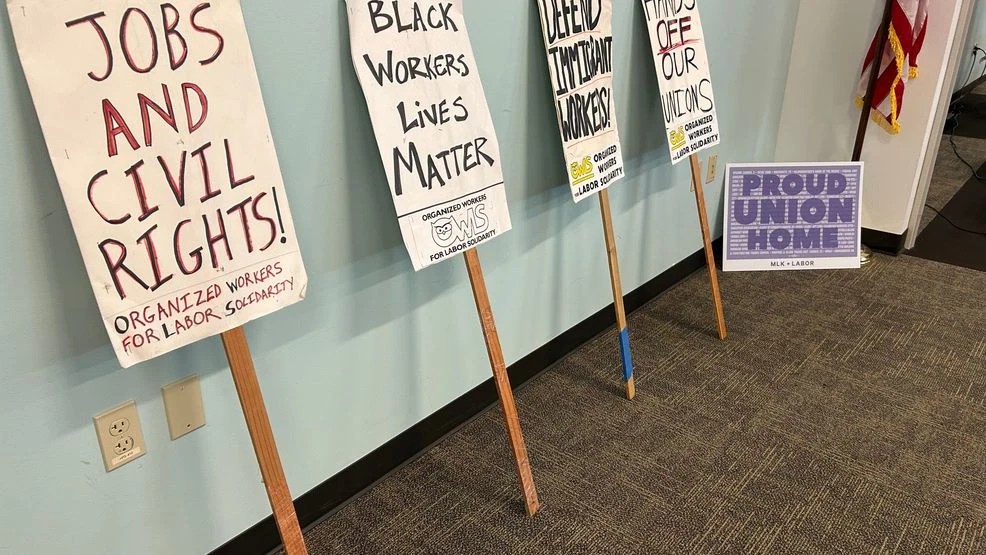
Dozens of local workers gathered at the Seattle Labor Temple on Saturday morning to discuss the potential for a coordinated work stoppage, evoking the historic 1919 Seattle General Strike as a model for collective action in response to current political and economic conditions.
Several groups organised a town hall to educate attendees about workers’ collective power and strategies for mobilising what organisers characterised as an “inevitable” general strike.
“People are already lobbying, people are already marching, we want to build so that we can take workers’ power and withhold it. Because that can stop things,” stated Annalisa Torres, an event organiser with Organised Workers for Labour Solidarity.
The 1919 Seattle General Strike saw 65,000 workers walk off the job for five days in a general work stoppage that included several unions demanding higher wages, representing one of the most significant labour actions in American history.
Torres and other town hall organisers indicated a similar movement today represents the most effective way workers can respond to policies from the Trump administration.
“I believe that people want to organise in their own name. They want to build something to make a change,” stated Gabriel Prawl with the A. Philip Randolph Institute’s Seattle Chapter.
Prawl indicated that areas including healthcare, food access, governmental assistance like SNAP benefits, and affordable wages are all under threat in the United States.
“Right now, we are not moving forward,” he stated. “Right now, we are going backward.”
The town hall was heavily attended by both union workers and other workers interested in unionising. Many shared a sentiment of searching for substantive action beyond protesting and voting.
Emma Allen, a local union member, stated she and other workers are also frustrated with unfulfilled promises from elected officials on both sides of the political spectrum.
“I think a lot of people are deciding the politicians really aren’t speaking or doing what we need them to do,” Allen continued, “whether they’re Democrat or Republican.”
The town hall follows Katie Wilson declaring victory in Seattle’s mayoral election. Wilson, a democratic socialist, has promoted a platform based on uplifting and supporting the working class.
“The working people of our city are tired,” Wilson stated in her victory speech Thursday.
Whilst Wilson has never previously held elected office, she co-founded the Transit Riders Union, which organises for better public transit in the greater Seattle region.
Allen indicated she feels hopeful about Mayor-Elect Wilson, citing that she appeared more open to community dialogue than Mayor Bruce Harrell. However, whilst Allen agrees with many of Wilson’s platforms, she is seeking more concrete details on Wilson’s initial change-making steps once she takes office.
“What she wants to do concretely? I’m not exactly clear,” Allen questioned. “How is she going to make things happen?”
The convening of workers to discuss general strike possibilities reflects a broader labour movement trend where traditional political engagement mechanisms including voting, lobbying, and protest are perceived as insufficient for advancing worker interests or resisting policy changes viewed as harmful to working-class populations.
The invocation of the 1919 Seattle General Strike provides historical legitimacy and tactical inspiration for contemporary organisers seeking to mobilise workers around collective action. That historic strike, whilst ultimately unsuccessful in achieving its immediate demands, demonstrated the economic leverage workers possess when they coordinate withdrawal of labour across industries simultaneously, shutting down essential city functions and forcing political and business leaders to negotiate.