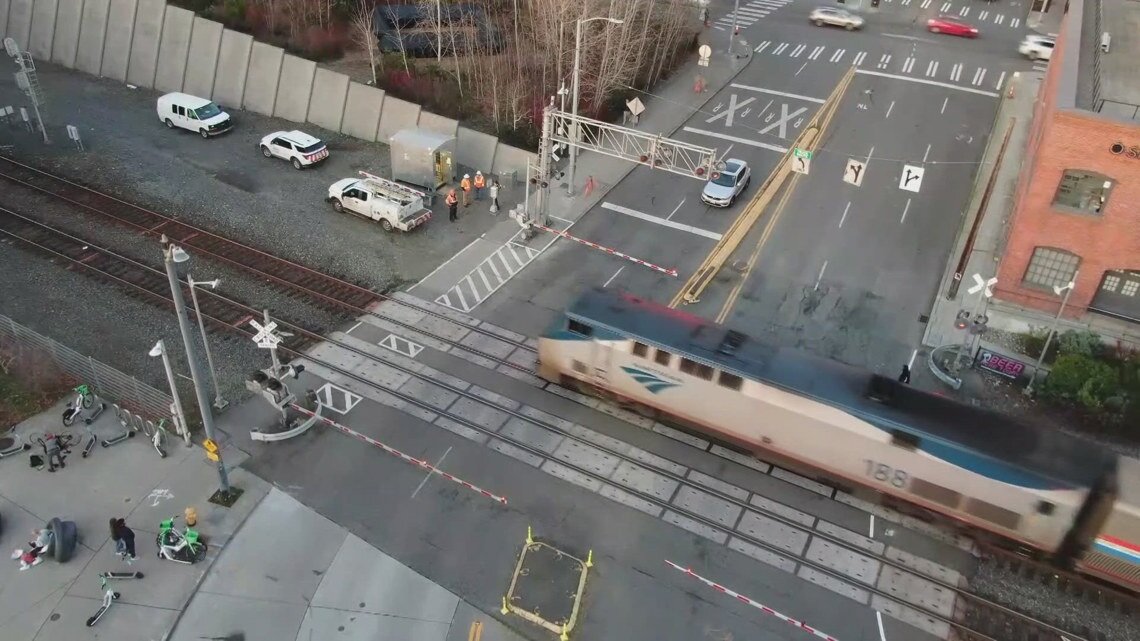
Attorneys for a man struck by a Link light rail train earlier this year allege issues with the crossing design and a malfunctioning alert system placed him in harm’s way, resulting in life-altering injuries including leg amputation.
The crash occurred in February at the intersection of South Orcas Street and Martin Luther King Jr. Way South.
Video from an onboard camera shows the southbound train approaching the intersection and then striking Byron Smith, who was in a wheelchair at the pedestrian island on the level crossing.
According to the lawsuit filed in US District Court in Seattle, Smith did not have sufficient time to cross the street, and a train alert system did not sound to warn Smith of the approaching train.
“At this particular crossing, it wasn’t working and they simply weren’t checking,” stated Cydney Webster with GLP Attorneys, the firm representing Smith. “It’s a very narrow area, and the train is coming fast.”
Webster indicated Smith had to have one of his legs amputated after the crash, and his mobility has been severely limited.
“His whole life changed; he is now completely limited to being in a wheelchair,” she stated. “This accident upended what he has been able to do.”
An investigation conducted by Sound Transit after the crash found that Orcas Street was one of 15 locations where warning equipment was not working properly. The post-crash investigation also revealed many of the crossings on MLK Jr. Way South did not conform to their intended design.
The lawsuit accuses King County, the City of Seattle, and Sound Transit of failing to implement recommendations from several safety studies that were conducted at the level crossings in South Seattle.
“Despite actual notice through years of pedestrian collisions and near misses, studies, public complaints and comments, collision/incident data, and hazard analyses and assessments, Defendants failed to design, construct, maintain and repair the Light Rail system in a manner that was reasonably safe for ordinary pedestrian travel at the crossing on MLK and Orcas Street,” the lawsuit states.
Smith’s attorneys indicated there are inadequate and misleading warning signs, a narrow pedestrian refuge, and failures to account for people in wheelchairs who cross.
“They made the choice to put the train at street level, they made that choice a long time ago, and with that comes the obligation to make it as safe as possible,” Webster stated.
Sound Transit indicated it could not comment on the pending litigation.
The lawsuit filed on behalf of Byron Smith following the February collision at South Orcas Street and Martin Luther King Jr. Way South raises fundamental questions about Sound Transit’s level crossing design choices, maintenance practices, and responsiveness to identified safety hazards that allegedly contributed to a catastrophic incident leaving a wheelchair user with permanent disabilities.
The February crash that resulted in Smith’s leg amputation and complete dependence on wheelchair mobility represents the most severe outcome of what the lawsuit characterises as a pattern of known safety deficiencies at level crossings along the MLK Jr. Way South corridor. The onboard video evidence showing the train striking Smith at the pedestrian island provides documentation of the incident that will likely serve as crucial evidence in establishing the sequence of events and evaluating whether Smith had reasonable opportunity to clear the crossing safely.
The allegation that the train alert system failed to sound represents a critical safety system failure, as audible warnings constitute primary defences against pedestrian-train collisions at level crossings. These alert systems are designed to provide advance notice of approaching trains, giving pedestrians sufficient time to either avoid entering the crossing or complete their passage before trains arrive. The failure of such systems removes a crucial layer of protection, particularly for pedestrians with disabilities who may require additional time to navigate crossings.
Webster’s characterisation of the crossing as “a very narrow area” with trains “coming fast” highlights design elements that compound risk when warning systems fail. Narrow pedestrian refuges or islands create situations where individuals caught mid-crossing when trains approach have limited space to position themselves safely, whilst high train speeds reduce the time available for pedestrians to react to approaching trains even when they receive warnings.