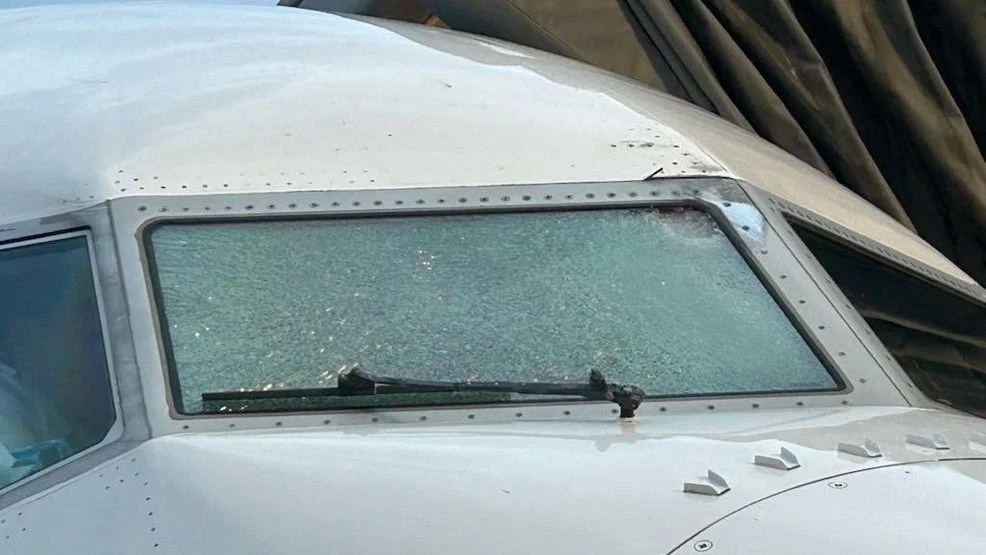
A United Airlines Boeing 737-8 was forced to divert to Salt Lake City last month after colliding with a weather balloon launched from Spokane, Washington, at 36,000 feet, an incident that shattered the cockpit windshield, showered the flight crew with glass fragments, and left the captain with minor injuries, according to a National Transportation Safety Board report released Thursday.
United Airlines Flight 1093 was traveling from Denver to Los Angeles on 16 October when the collision occurred at 6:43 a.m. Mountain Daylight Time near Moab, Utah. None of the 111 passengers and crew members aboard the aircraft, aside from the captain, sustained injuries in the incident.
The captain told investigators he had just spotted an object on the horizon when a loud bang reverberated through the cockpit and the first officer’s forward windshield exploded outward. The impact sent pieces of glass across the flight deck, cutting the captain’s right arm as debris scattered through the confined cockpit space.
The flight crew immediately declared an emergency, coordinated with air traffic control, and began descending from cruising altitude. After the first officer’s window overheated light illuminated on the instrument panel, the pilots completed the applicable emergency checklists and consulted with airline dispatch before diverting to Salt Lake City International Airport. The captain briefly bandaged his arm, then resumed flying duties for the descent and landing despite the injury.
The aircraft landed without further incident on runway 16L, taxiing to the gate under its own power whilst escorted by airport firefighters as a precautionary measure. Emergency medical crews treated the captain’s injuries at the gate following the aircraft’s arrival.
Investigators indicate preliminary data suggests the Boeing 737 likely collided with a high-altitude weather balloon operated by WindBorne Systems Inc., a San Francisco-based company that launches unmanned atmospheric research platforms to collect meteorological data. The company reported losing contact with one of its global sounding balloons at roughly the same time and location as the collision.
The balloon had been launched the previous day from Spokane, Washington, and had traveled hundreds of miles through Oregon and Nevada before drifting northeast into Utah airspace, following atmospheric wind patterns that carried it across multiple states during its roughly 24-hour flight.
The balloon’s final data transmission, received between 6:36 and 6:43 a.m. Mountain Daylight Time, placed the device at 35,936 feet altitude, closely matching the aircraft’s cruising altitude of 36,002 feet. The balloon was tracking northeast with winds of approximately 73 knots, putting it on a nearly head-on collision course with the southwestbound airliner.
A Notice to Air Missions had been issued for the balloon’s launch on 15 October but expired that afternoon, well before the collision occurred the following morning. This timing gap meant pilots and air traffic controllers had no active warning about the balloon’s presence in the airspace when Flight 1093 encountered it.
WindBorne Systems told investigators its weather balloons are constructed from thin plastic film with no rigid structural components that might cause significant damage in a collision. The company’s ballast system, which controls altitude by releasing weight, uses low-density silica rather than heavier materials. Despite the lightweight construction, the collision still generated sufficient force to shatter the reinforced cockpit windshield.
The aircraft’s damaged windshield, manufactured by PPG Aerospace, was certified to withstand impacts from a four-pound bird under Federal Aviation Administration testing standards. The multi-layered window assembly is designed so that even with a complete pane failure, cabin pressure can be maintained through the remaining layers, preventing rapid decompression that would endanger passengers and crew. The damaged windshield was removed and sent to the NTSB Materials Laboratory in Washington, DC, for detailed analysis to understand the failure mechanism.
Data recovered from the cockpit voice recorder and flight data recorder showed the Boeing 737 was cruising at a pressure altitude of 36,002 feet, tracking southwest at 233 degrees magnetic heading with a groundspeed of 395 knots at the moment of impact. The aircraft’s flight path was nearly head-on with the balloon’s reported northeast trajectory, maximising the relative closing speed between the two objects and likely contributing to the severity of the windshield damage.
The National Transportation Safety Board has assigned specialists in materials engineering, meteorology, aircraft performance, operations, and air traffic control to investigate the incident. The Federal Aviation Administration, Boeing, United Airlines, and WindBorne Systems have been invited to participate in the investigation as parties with relevant expertise and interest in the findings.
The investigation remains ongoing as specialists analyse physical evidence, flight data, weather balloon telemetry, and operational procedures to determine the complete sequence of events and identify any safety recommendations that might prevent similar incidents.