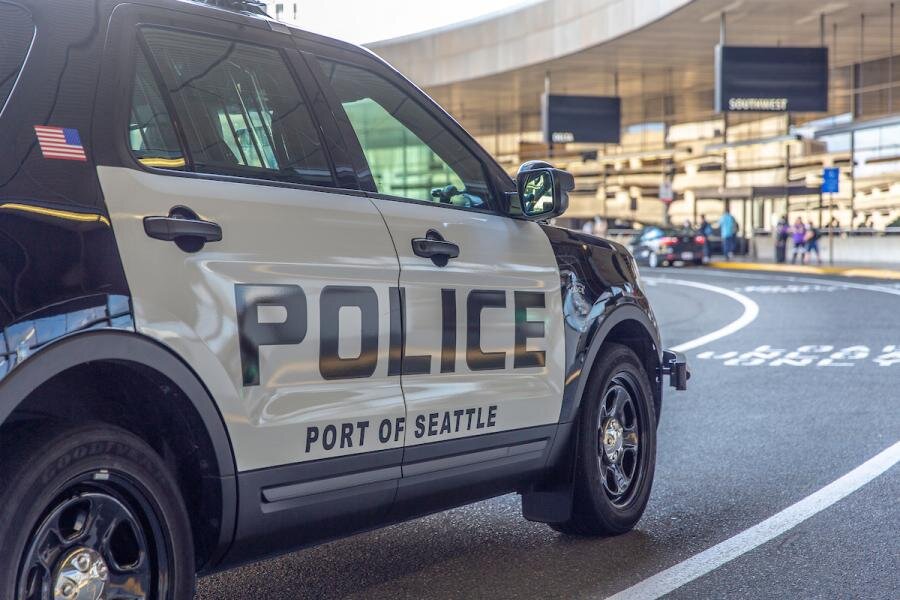
A man detained at Seattle-Tacoma International Airport earlier this month faces assault charges after allegedly spitting on a police officer during his arrest at a security checkpoint.
Court documents filed in King County Superior Court detail the November 7 incident that began when Port of Seattle police responded to TSA Checkpoint 3 around 5:56 p.m. following reports of an intoxicated individual harassing women in the screening area.
Officers arriving at the scene learned the man had attempted to push through a different checkpoint and was behaving aggressively toward other passengers. The responding officer noted in the probable cause document that the suspect exhibited a strong odor of alcohol and had bloodshot, watery eyes consistent with intoxication.
The man identified himself as a ticketed Alaska Airlines passenger traveling to California for treatment, according to the police report. However, a routine records check revealed multiple outstanding warrants complicating his situation.
The check disclosed a no-bail felony warrant issued by the Washington State Department of Corrections related to an assault case. Additionally, Thurston County had issued a misdemeanor warrant for failure to appear on a resisting arrest charge.
Dispatch confirmed the Department of Corrections warrant, prompting officers to proceed with the arrest. The suspect reportedly became combative during the process, repeatedly tensing his muscles while yelling profanity, threats, and directing slurs at the arresting officers.
Officers attempted to conduct a search near their patrol vehicle, but the suspect continued resisting by pulling away, pushing back, and dropping his weight to impede the procedure. During this struggle, investigators say the man deliberately turned his head and spat over his right shoulder, striking an officer directly in the face.
Authorities transported the suspect to jail on the Department of Corrections warrant. Prosecutors subsequently filed additional charges based on the incident at the airport.
The probable cause document concludes that spitting on the officer constitutes third-degree assault against a law enforcement officer. This charge reflects Washington state law that classifies intentionally exposing officers to bodily fluids as assault due to potential health risks.
Court records reveal the suspect’s extensive legal troubles beyond the airport incident. The active Department of Corrections felony warrant stems from a 2023 domestic violence case involving second-degree assault and second-degree kidnapping charges.
He also faces a pending DUI case in Puyallup, adding to the accumulation of criminal matters requiring resolution. The separate Thurston County misdemeanor warrant for failing to appear on a resisting arrest charge demonstrates a pattern of avoiding court proceedings.
Despite the multiple warrants and new assault allegation, the suspect was released following his first court appearance. This release decision reflects judicial discretion in balancing public safety concerns against constitutional rights to reasonable bail.
Prosecutors are requesting the court issue a summons requiring the defendant to appear for future hearings rather than holding him in custody pending trial. This approach assumes the suspect will comply with court orders despite his previous failure to appear in Thurston County.
The arraignment is scheduled for 9 a.m. on December 1, 2025, when the defendant will enter a plea to the assault charge. That hearing will also address conditions of release and establish a timeline for subsequent court proceedings.
The incident highlights challenges law enforcement faces when dealing with intoxicated individuals in secure areas of airports. TSA checkpoints require particular care because disruptions can affect hundreds of travelers and compromise security protocols.
Assaults on police officers, particularly involving bodily fluids, carry serious consequences due to health exposure risks. Officers face potential transmission of communicable diseases through saliva, requiring medical evaluation and sometimes preventive treatment following such incidents.
The officer who was spit on will likely undergo testing protocols to screen for any diseases transmitted through saliva exposure. These procedures represent standard practice following assaults involving bodily fluids, even when actual disease transmission is unlikely.
Airport police regularly encounter travelers whose judgment is impaired by alcohol or other substances. While most intoxicated passengers simply miss flights or require assistance, some become belligerent or pose security concerns requiring law enforcement intervention.
The combination of alcohol intoxication, outstanding warrants, and aggressive behavior created a situation requiring immediate response from Port of Seattle police. Their presence at the airport specifically addresses security matters and assists TSA with passenger issues beyond the screening agency’s authority.
The suspect’s claim of traveling for treatment, made while visibly intoxicated and facing multiple warrants, raises questions about his actual travel intentions. Alaska Airlines, like all carriers, reserves the right to deny boarding to passengers who appear intoxicated or pose safety concerns.
Whether the airline would have allowed him to board given his visible intoxication remains unclear, though the discovery of outstanding warrants made that question moot. Federal regulations prohibit airlines from transporting passengers who appear intoxicated to a degree that might endanger the aircraft or other passengers.