Waymo’s distinctive white, sensor-equipped vehicles began appearing on Seattle streets in September, marking the company’s return to the Pacific Northwest following brief Bellevue testing three years prior.
The Alphabet-owned company currently operates approximately a dozen vehicles through neighborhoods including Downtown, Capitol Hill, Queen Anne, the University District, and the Chinatown-International District. Human drivers remain behind the wheel collecting data on the city’s characteristically wet weather and hilly terrain.
The company has not established a timeline for launching fully autonomous service in Seattle. However, as the technology moves closer to integration into daily life here, a troubling incident in San Francisco has sparked national conversation that Seattle may soon confront.
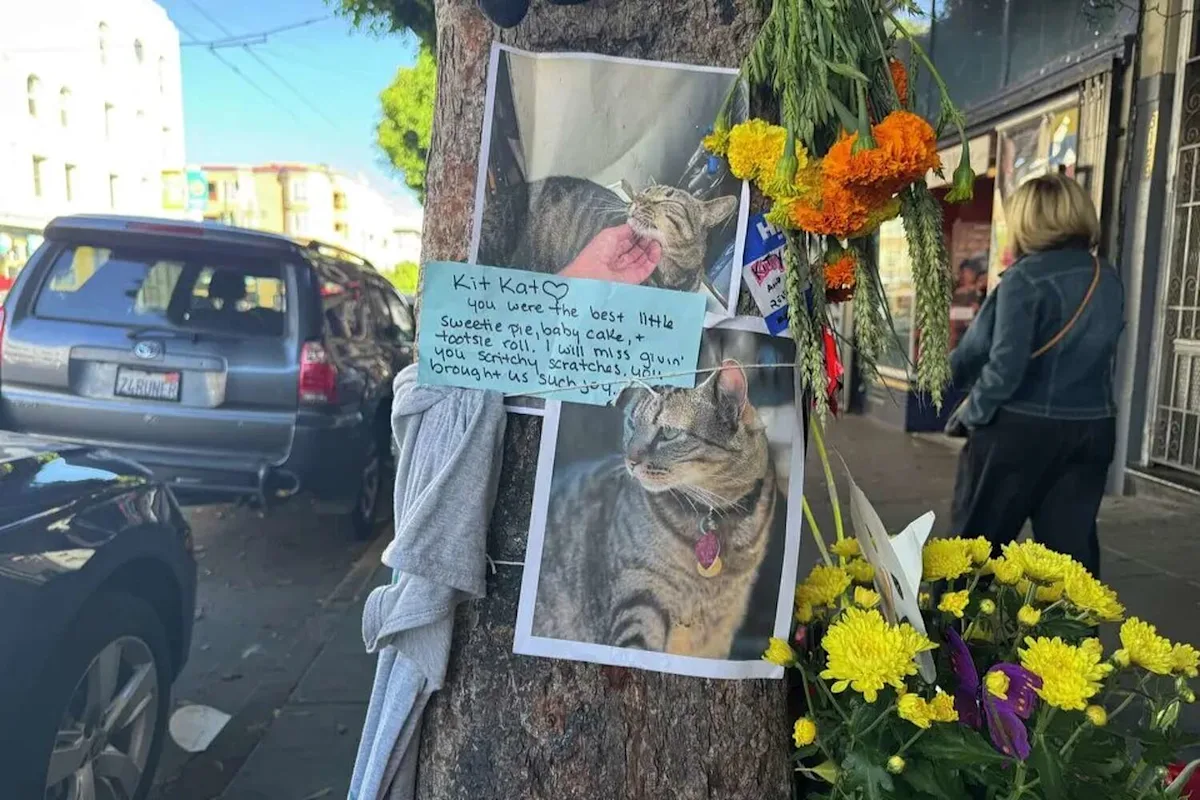
In late October, a neighborhood cat known as “KitKat” was struck and killed by an autonomous vehicle in San Francisco’s Mission District. The nine-year-old tabby was well known in the community, frequently seen resting outside Randa’s Market and interacting with regular customers.
Following the October 27 incident, residents created a makeshift memorial and staged public demonstrations demanding accountability and tighter regulation of robot cars operating in residential areas. What might otherwise have been dismissed as an isolated accident quickly became symbolic of larger concerns about whether autonomous vehicles are prepared for crowded American cities.
The timing proves particularly sensitive. As companies move aggressively to expand testing and deployment nationwide, federal safety data shows crashes involving vehicles equipped with autonomous systems continue occurring.
Since national reporting requirements were established, hundreds of incidents have been logged involving self-driving or semi-autonomous vehicles. Many resulted in minor damage. Some caused injuries. A smaller but concerning number led to deaths involving passengers, pedestrians, cyclists, and now animals.
Supporters of the technology argue that autonomous vehicles remain safer than human drivers when measured mile for mile. Studies cited by several manufacturers suggest self-driving cars are involved in fewer serious injury crashes than traditional vehicles. By that calculation, the technology appears not just promising but potentially life-saving.
However, to the public, statistics rarely carry the weight of lived experience. A single photograph of a dead cat outside a familiar corner store resonates more deeply than spreadsheets showing percentage improvements. And while most crashes involving autonomous vehicles may not be life-threatening, the reality that machines now make real-world decisions with real-world consequences unsettles many Americans.
Seattle now finds itself at the edge of that debate.
Unlike San Francisco, where Waymo already operates a commercial robotaxi service, Seattle has adopted what city officials describe as a “smart, safety-first approach” to autonomous vehicle deployment.
The Seattle Department of Transportation developed a permitting program in 2022 requiring companies to keep trained human drivers behind the wheel during testing, submit detailed safety plans, and coordinate with emergency responders. Currently, only Amazon-owned Zoox and NVIDIA hold testing permits in Seattle, though NVIDIA has suspended its testing operations.
Neither Seattle nor Washington State has yet created a regulatory framework for fully autonomous commercial operations. The state continues developing its approach to permitting driverless vehicles without human operators, leaving cities in a holding pattern as companies continue testing with safety drivers present.
This regulatory gap has not stopped Seattle officials from preparing. In 2024, the city established an Autonomous Vehicle Inclusive Planning Cohort, bringing together people of color, low-income residents, immigrants, people with disabilities, and environmental justice advocates to develop community-centered recommendations.
The group identified seven priorities for the city to address before autonomous vehicles become part of daily life: management and accountability, workforce protection, equity for marginalized communities, public safety data transparency, environmental impact assessment, attention to social effects on underserved areas, and community education.
“I think cities are, frankly, very keen to be more on top of autonomous vehicle deployments, especially the shared mobility ride-hail services, because of what we experienced with [transportation network companies] like Uber and Lyft,” said Armand Shahbazian, electric and automated mobility lead at Seattle DOT.
The city is also piloting technology that shares real-time 911 dispatch data with internet-connected vehicles to help them avoid emergency scenes, making Seattle among the first cities to attempt such integration.
As testing inevitably gives way to broader deployment, Seattle residents will soon face questions that communities in San Francisco, Phoenix, and Los Angeles already confront: What happens when a robot makes a mistake? Who is responsible when damage occurs? How much transparency should be required when accidents happen? And how safe is “safe enough” when artificial intelligence is involved?
The reaction in San Francisco offers a preview of what Seattle might expect. After KitKat’s death, San Francisco Supervisor Jackie Fielder introduced a resolution calling for state legislation that would allow local voters to decide whether driverless cars can operate in their neighborhoods.
“A human driver can be held accountable, can hop out, say sorry, can be tracked down by police if it’s a hit-and-run,” Fielder explained. “Here, there is no one to hold accountable.”
Unlike traditional vehicles, autonomous systems operate through software, invisible decision-making processes that most drivers and pedestrians never see. When things go wrong, accountability becomes murky. Is the fault in the code? The sensors? The artificial intelligence model? Or the company behind it?
The cat in San Francisco did not die because technology is evil. It died because technology is imperfect. That represents an important distinction, and one cities must take seriously.
Seattle remains in the testing phase. This is the moment when oversight structures get built or ignored, when transparency policies are demanded or deferred. The city can choose whether to treat autonomous driving as an experiment unfolding quietly in the background or as a transformation deserving public scrutiny and open regulation.
The city’s community-centered approach represents an attempt to learn from mistakes made elsewhere. However, questions remain about whether Seattle will have meaningful control over the technology once the state creates its regulatory framework.
State Representative Shelley Kloba, a lead lawmaker on autonomous vehicles in Washington, has emphasized the need for companies to demonstrate clear safety frameworks before deployment.
Concerns about job displacement are particularly acute in Seattle, where approximately 20,000 rideshare and taxi drivers already struggle to find sufficient passengers. Anna Minard, a spokesperson for the Drivers Union, noted that drivers worry about automation eliminating jobs at a time when the gig economy already leaves many workers struggling to make ends meet.
The lesson from San Francisco is not that autonomous vehicles should be banned outright. It is that no technology enters a city without consequences. Some are small. Others are deeply personal. And occasionally, one tragedy becomes a warning for many more communities yet to feel the impact.
For Seattle, the story is only beginning. The city has the advantage of watching other communities grapple with these questions first. Whether it uses that advantage to build stronger protections and clearer accountability remains to be seen.