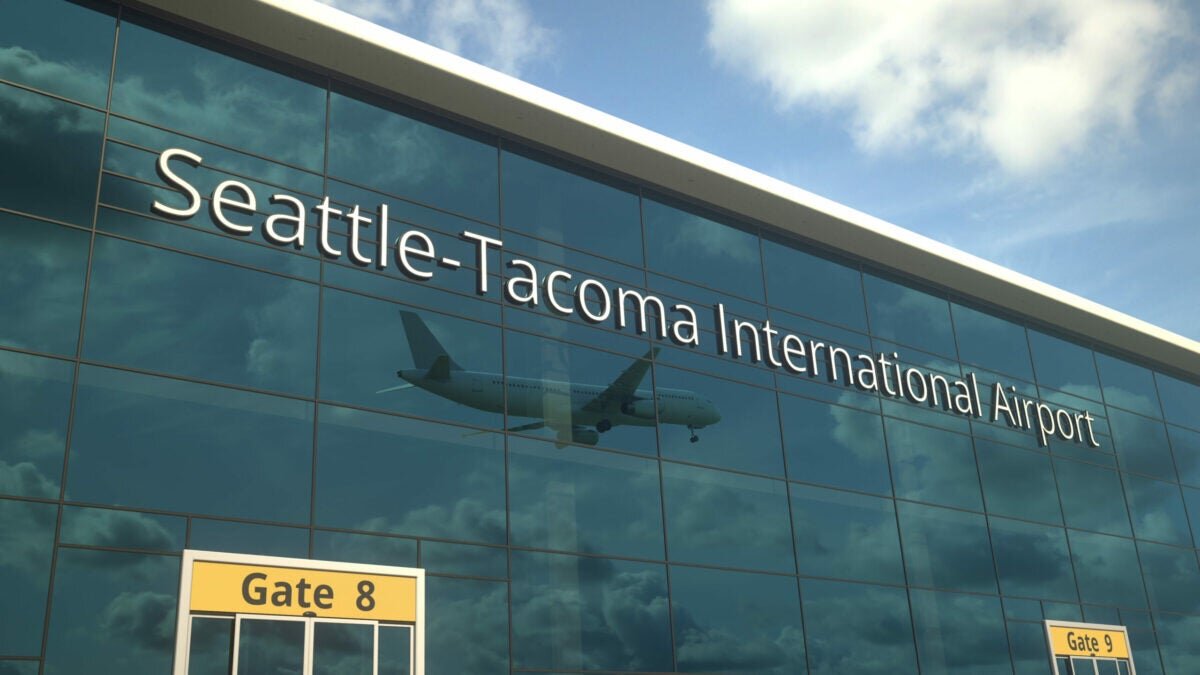
Three South King County municipalities are requesting a federal court overturn the Federal Aviation Administration’s approval of a substantial expansion plan at Seattle-Tacoma International Airport, contending the agency authorized the project despite considerable impacts on neighboring communities.
In a petition filed November 24 with the 9th U.S. Circuit Court of Appeals, the cities of Burien, Des Moines, and SeaTac seek judicial review of the FAA’s September decision issuing a Finding of No Significant Impact and Record of Decision for the airport’s Sustainable Airport Master Plan Near-Term Projects.
The petition disputes the FAA’s determination that 31 near-term projects, encompassing a new terminal, 19 additional gates, taxiway expansions, cargo facilities, fuel tank additions, roadway reconfigurations, and other large-scale construction, would not produce significant environmental or community impacts requiring a full Environmental Impact Statement.
The projects aim to enable the airport to handle 56 million annual passengers and expanding cargo volumes, upgrade aging airfield infrastructure, meet updated FAA design standards, and increase fuel storage capacity, according to the FAA’s environmental assessment.
While the FAA acknowledged the expansion would increase noise, traffic, greenhouse gas emissions, and air pollution compared with the “no-action” alternative, the agency concluded none of those impacts would reach significance thresholds under federal regulations.
The plan would enlarge the area inside the 65-decibel noise contour and add hundreds of additional homes and residents to the zone by 2032 and 2037. However, the FAA stated the growth would not trigger significant adverse noise impacts under regulatory standards.
The FAA also referenced mitigation measures the Port of Seattle would be required to implement, including stormwater upgrades, wetland compensation, transportation improvements, construction noise controls, habitat protections, and groundwater monitoring.
The cities did not specify their detailed arguments in the petition, which serves as formal notice of challenge. However, they have consistently raised concerns about increased aircraft noise, environmental impacts, and cumulative effects from continued Sea-Tac expansion over recent years.
The petition was filed on the final day of the statutory 60-day deadline for contesting FAA orders, demonstrating the cities’ determination to pursue legal challenges before the window closed.
A briefing schedule has not yet been established for the case, leaving the timeline for legal arguments uncertain.
The FAA’s decision permits the Port of Seattle to advance the near-term projects into design and construction phases, though portions of the plan still require additional permits, funding approvals, and coordination with federal and state agencies.
The legal challenge creates uncertainty about whether expansion can proceed as planned or whether courts will order additional environmental review. Federal judges have authority to halt projects or require agencies to complete more comprehensive assessments if they find regulatory violations.
The 65-decibel noise contour represents the threshold at which FAA considers residential areas incompatible with airport operations. Homes within this zone experience noise levels that interfere with speech, sleep, and daily activities according to federal standards.
Adding hundreds of homes to the noise impact zone raises questions about whether affected residents will receive mitigation such as sound insulation, relocation assistance, or other compensation. The Port of Seattle’s noise remediation programs have historically provided such assistance in qualifying areas.
The 56 million annual passenger projection represents substantial growth from current levels. Sea-Tac handled approximately 50 million passengers in 2019 before pandemic disruptions, meaning the expansion anticipates further increases beyond pre-pandemic traffic.
Cargo volume growth reflects Seattle’s position as a trade gateway to Asia and the increasing importance of air freight for e-commerce. Amazon and other companies rely heavily on air cargo capacity at Sea-Tac for their distribution networks.
The new terminal and additional gates address capacity constraints that have created congestion and delays during peak periods. Sea-Tac currently operates near physical limits during busy hours, forcing airlines to schedule around capacity restrictions.
Taxiway expansions improve aircraft movement efficiency and reduce delays caused by bottlenecks in ground operations. Current taxiway configurations sometimes force arriving aircraft to wait for gate space or departing planes to queue for takeoff clearance.
Fuel storage capacity increases ensure adequate supply for growing operations. Jet fuel delivery and storage infrastructure must scale with flight operations to prevent supply constraints during peak demand.
Roadway reconfigurations address surface transportation challenges as passenger and cargo volumes increase. Airport access roads, terminal curbs, and internal circulation routes require redesign to handle additional traffic.
The mitigation measures the FAA cited represent attempts to offset unavoidable impacts. Stormwater upgrades prevent increased runoff from polluting waterways. Wetland compensation replaces habitat lost to construction. Transportation improvements reduce congestion on surrounding roads.