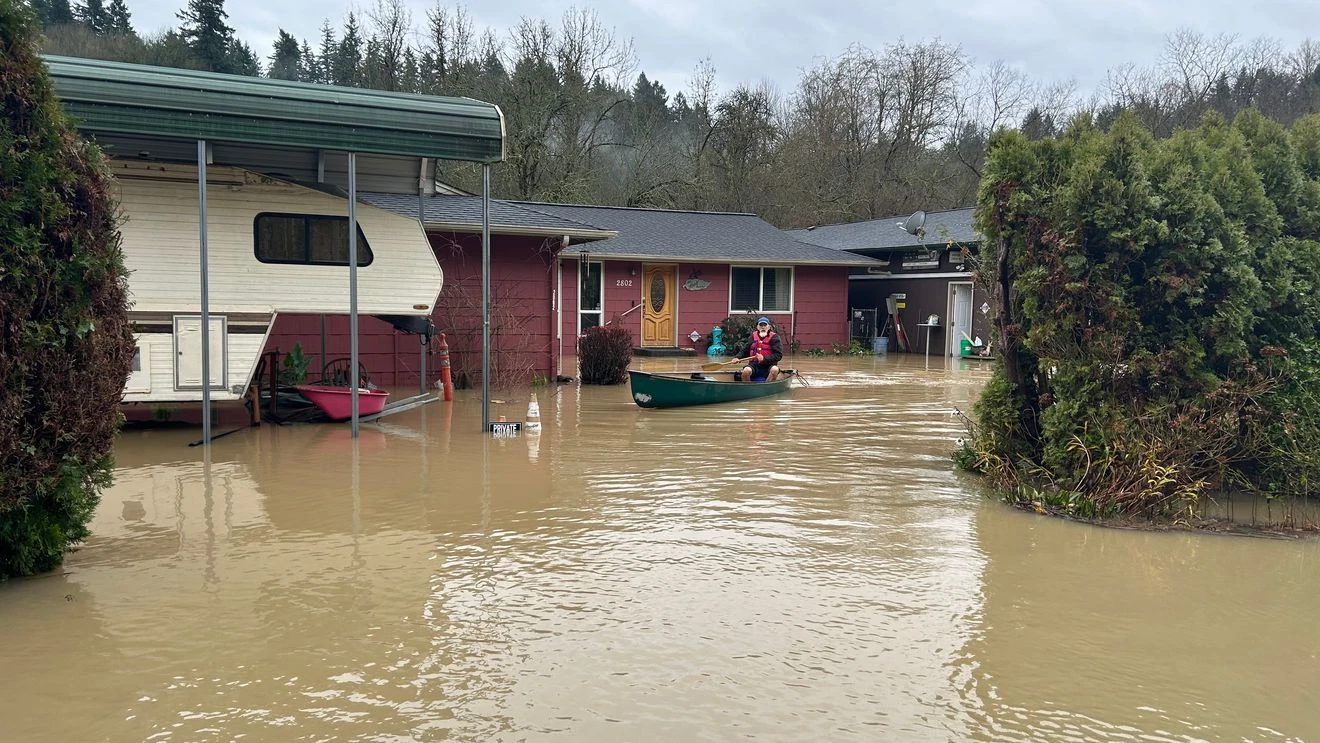
Richendia Evans packed up her family in a rush Sunday when the evacuation order came. Five grandchildren, including a six-week-old baby, needed to get out immediately as the Green River threatened to overflow into Auburn neighborhoods.
“Shock, to put it frankly, shock. I was literally in a state of shock,” Evans said, describing the moment she realized her family had to leave everything behind.
Three days later, Evans and more than 100 other displaced residents remain at the Red Cross shelter inside the Auburn Community and Events Center, uncertain when they’ll be able to return home. The children have adjusted better than the first night.
“It was rough the first night, but right now they’re calm, and they understand the situation. Now they’re understanding it better,” Evans said.
The Green River continued threatening Auburn through Tuesday evening, though King County officials reported some improvement in certain areas. Water levels dropped enough in parts of the city to allow officials to downgrade evacuation levels, though the area southeast of 277th and B Streets remains under the most urgent level 3 designation.
King County Emergency News explained the tiered system. Level 3 means “GO NOW” and prohibits reentry. Level 2, “GET SET,” allows some residents and businesses to return with extreme caution while remaining ready to evacuate again if conditions deteriorate.
“River and dam conditions remain dynamic, and water levels can rise quickly due to dam releases, rainfall, and levee conditions,” the county warned. “All residents, especially those near the Green and White rivers, should stay alert and prepared to evacuate at a moment’s notice.”
At 11:08 p.m. Tuesday, the Green River officially entered flood phase 3, bringing moderate flooding to rural lowland areas. Urban sections of the Green River Valley enjoy general protection from the levee system, though officials cautioned that flood conditions can change rapidly.
David Toms flew in from Maryland to volunteer with the Red Cross response. He’s one of hundreds of volunteers who came from out of state to help feed and shelter evacuees across the region.
Walking through the shelter, Toms sees the psychological toll the disaster has taken on families who fled with whatever they could grab.
“I think everybody’s kind of a bit traumatized,” Toms said. “This is a traumatic event, and people are dealing with this trauma, I think, as best they can. We’re providing food and shelter. That’s kind of all we can do to help them.”
The Red Cross now operates seven shelters across western Washington in communities dealing with flooding, including Auburn, Puyallup, Monroe, Mount Vernon, and Concrete. All locations provide emergency support services around the clock.
In Auburn, two shelters remain open. The Auburn Community and Event Center at 910 9th Street Southeast serves as the primary location, while Ray of Hope Shelter at 2806 Auburn Way North provides additional capacity.
Some Auburn residents got their first chance to assess damage Tuesday. At the Copper Gate apartments, receding water allowed people like Awal Bashar to return and survey what the flood left behind.
Bashar evacuated Sunday as water rose alarmingly fast around the complex.
“It was raining, and after like one or two days, this area is totally flooded,” Bashar said. “There was a lot of water.”
The floodwaters damaged several cars trapped in the parking lot. Water nearly reached first-floor apartments, stopping just short of entering units. Residents expressed relief that the damage wasn’t worse, though many vehicles sat ruined in standing water.
The flooding resulted from weeks of atmospheric river storms dumping unprecedented rainfall across western Washington. The Green River drains a massive watershed stretching from the Cascade Mountains, channeling all that mountain runoff through the Auburn valley.
The Howard Hanson Dam upstream provides flood control by storing water during peak flows, but the reservoir has limits. When storage reaches capacity, dam operators must release water downstream, potentially worsening flooding in Auburn even as the dam prevents catastrophic failure.
Officials monitoring the dam walked a delicate balance. Release too much water and Auburn floods. Don’t release enough and the dam itself faces danger.
The levee system protecting urban Auburn was built decades ago to handle typical Green River floods. But these aren’t typical conditions. Levees designed for historical flood patterns struggle with the extreme precipitation patterns climate scientists say are becoming more common.
Emergency managers stressed that even protected areas aren’t completely safe. Levees can fail, seep, or be overtopped during extreme events. The “generally protected” language in official statements acknowledges this uncertainty.
For families like Evans’s, the uncertainty compounds the stress. The six-week-old baby requires specialized care that’s challenging to provide in a shelter environment. Formula, diapers, quiet spaces for sleeping, all the routines that help infants thrive become complicated when you’re living in a community center.
The older grandchildren process the experience differently. They understand something serious happened but lack the context to grasp how unusual this situation is. For them, sleeping on cots in a big room with dozens of other families might seem almost like an adventure, at least initially.
But as days stretch on, the reality settles in. School disrupted. Toys left behind. Friends scattered to different shelters or evacuated to relatives’ homes. The routines that give children stability all upended.
Volunteers like Toms see this trauma play out constantly. A child crying for a favorite stuffed animal left at home. Parents trying to maintain normalcy while worrying about whether their house is underwater. Elderly residents concerned about medications and medical appointments.
The Red Cross provides the basics: meals, cots, blankets, toiletries. But they can’t provide what people really want, which is to go home and find everything just as they left it.
Some areas of Auburn began allowing limited reentry Tuesday evening, but officials emphasized caution. Just because water receded doesn’t mean homes are safe or habitable. Electrical systems exposed to water pose shock and fire hazards. Mold can begin growing within 24 hours in wet conditions. Structural damage may not be immediately visible.
Residents eager to return face difficult decisions about what comes next.