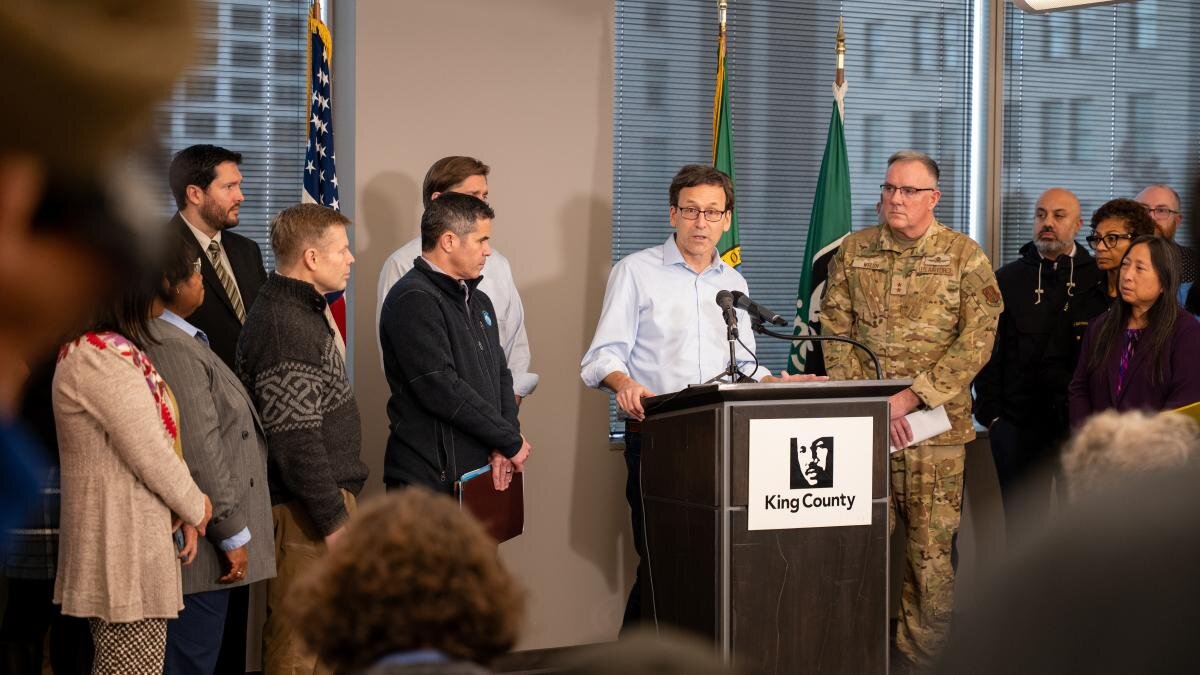
Washington Governor Bob Ferguson announced Tuesday he will amend the state emergency declaration that the Trump administration approved last week as damage assessments and response needs continue evolving following catastrophic flooding.
With millions of dollars in relief funding at stake and entire communities submerged in parts of Washington after consecutive atmospheric river events, the governor said he has identified crucial funding sources and made changes to the original declaration.
“We’ve currently identified $3.5 million that I can move without legislative action for short-term relief. We’re working to activate as many state resources as we can. We will provide more information to the public as soon as we have it,” Ferguson said Tuesday, December 16.
The amendments include changes to descriptions of specific impacts affecting the 14 counties listed in the original declaration. As standing water continues eroding earth, weakening roads, causing levee breaches, and increasing landslide risks, another atmospheric river was rolling into Washington.
High wind warnings were in effect from 4 p.m. Tuesday until 6 a.m. Wednesday. The high winds, combined with saturated ground, have the potential to cause fallen trees, widespread power outages, and additional impacts.
To support continued search and rescue operations, particularly in the Skagit County region, Washington State Task Force 1 was deployed Tuesday.
The $3.5 million Ferguson identified for immediate deployment provides crucial short-term relief while the state works through more extensive funding processes that require legislative approval. This quick-access funding allows emergency managers to address urgent needs without waiting for lengthy approval procedures.
The ability to move these funds without legislative action stems from executive emergency powers granted to governors during declared disasters. These authorities allow rapid response when lives and property remain at risk.
The amendments to the original declaration reflect how disaster situations evolve as floodwaters recede and the full extent of damage becomes clear. Initial assessments conducted during active flooding often underestimate total impacts that emerge in subsequent days.
The specific impact descriptions for the 14 affected counties needed updating as officials completed more thorough damage surveys. Roads that initially appeared intact may have suffered undermining that wasn’t visible until water levels dropped. Levees that held during peak flows may have developed weaknesses requiring immediate attention.
The erosion from standing water represents an ongoing threat even as rivers fall below flood stage. Water pooled in fields, along roadways, and in low-lying areas continues saturating soil and washing away supporting material beneath infrastructure.
Weakened roads pose significant safety hazards. Sections that look solid from the surface may have voids underneath where water washed away base material. Vehicles driving on such compromised roadways risk catastrophic pavement collapse.
Levee breaches mentioned in the amendments indicate some flood control structures failed during the event. These failures allow continued flooding even after river levels drop, as water trapped behind levees drains slowly or not at all.
The increased landslide potential stems from soil saturation that persists long after rain stops. Hillsides loaded with water can fail days or weeks after precipitation ends, particularly when additional rain or wind arrives.
The incoming atmospheric river Ferguson referenced threatens to compound existing damage. Ground already saturated cannot absorb additional rainfall, meaning even moderate precipitation produces immediate runoff and renewed flooding.
The high wind warning from Tuesday afternoon through Wednesday morning addressed a specific threat period when the atmospheric river’s strongest winds were forecast. Sustained winds of 30 to 40 mph with gusts exceeding 50 mph were anticipated.
The combination of high winds and saturated soil creates perfect conditions for toppling trees. Waterlogged ground cannot anchor root systems effectively, allowing even moderate winds to uproot trees that would normally withstand much stronger forces.
Fallen trees cause power outages by bringing down electrical lines. They also block roads, damage structures, and create hazards for emergency responders trying to reach people in need.
The deployment of Washington State Task Force 1 to Skagit County signals the severity of conditions there. This specialized unit handles complex rescue operations including swift water rescue, technical rope rescue, and structural collapse response.