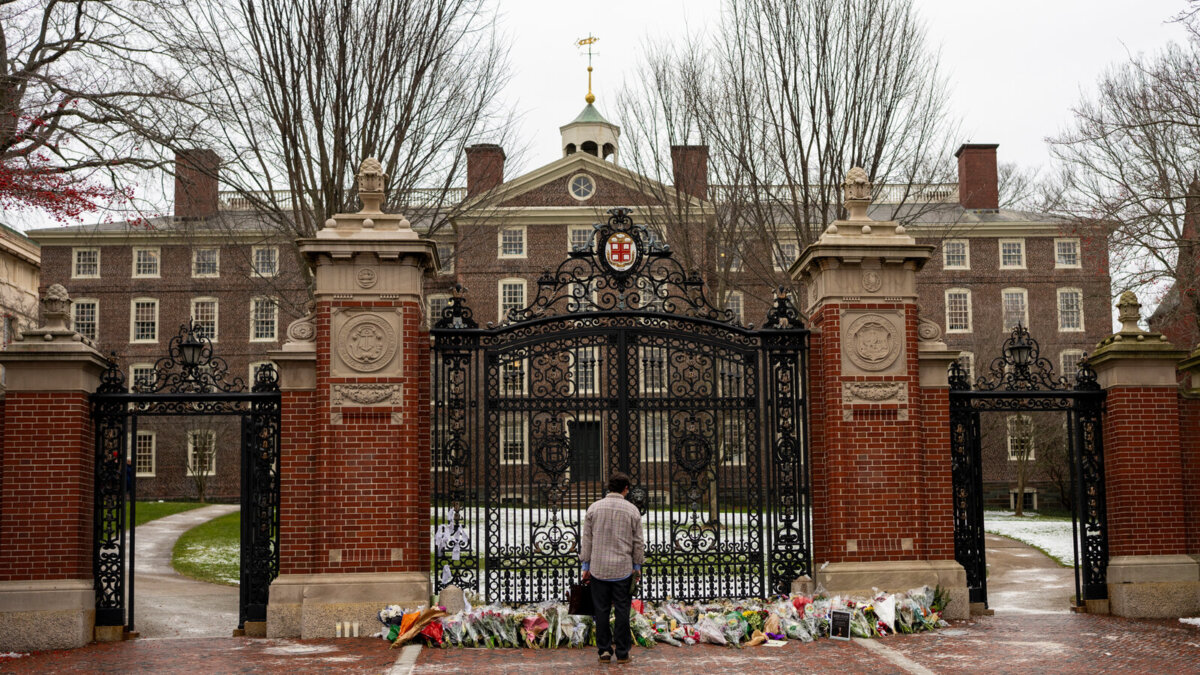
The U.S. Department of Education announced it will conduct a comprehensive review of Brown University following the deadly shooting on campus that left two students dead.
The Department’s Office of Federal Student Aid will determine whether Brown violated the Jeanne Clery Campus Safety Act, which requires institutions of higher education to meet certain campus safety and security-related requirements as a condition of receiving federal student aid.
According to the announcement, Brown’s campus surveillance and security system may not have met federal standards.
Students and staff reported the university’s emergency notifications about the active shooter were also delayed, raising concerns about the institution’s crisis response protocols.
“After two students were horrifically murdered at Brown University when a shooter opened fire in a campus building, the Department is initiating a review of Brown to determine if it has upheld its obligation under the law to vigilantly maintain campus security,” said U.S. Secretary of Education Linda McMahon. “Students deserve to feel safe at school, and every university across this nation must protect their students and be equipped with adequate resources to aid law enforcement. The Trump Administration will fight to ensure that recipients of federal funding are vigorously protecting students’ safety and following security procedures as required under federal law.”
The Office of Federal Student Aid requested that Brown University submit extensive documentation by January 30, 2026, including:
Copies of the original 2024 and 2025 Annual Security Reports and any revised versions produced for Clery Act compliance, along with credible evidence of distribution.
An “audit trail” showing all incidents of crime organized by offense classification for calendar years 2021 through 2024, and all arrests made by Brown University Public Safety and Emergency Management Department or other law enforcement agencies, plus all referrals for disciplinary action against students or employees for violations related to illegal possession, use, or distribution of weapons, drugs, or liquor.
A copy of the Public Safety Department’s activity, dispatch, and call log for calendar years 2021 through 2025.
A copy of the daily crime log for calendar years 2021 through 2025.
A list of all Timely Warnings and Emergency Notifications issued by the university during calendar years 2021 through 2025, with descriptions of the means or media used to disseminate the notices.
A copy of all of Brown’s policies and procedures related to timely warnings, emergency notifications, maintenance of daily crime logs, and emergency response and evacuation, plus any assessments of campus safety policies conducted since 2020.
A complete set of Public Safety’s standard operating procedures regarding dispatch, response to calls, report writing, arrests including citations, and protocols for active shooter scenarios.
Brown University President Christina Paxson announced the university will make immediate changes in response to the shooting.
A rapid response team will focus on prioritizing safety improvements in advance of the spring semester.
The university will also commission an external After-Action Review of the shooting, including an evaluation of campus safety leading up to the incident.
The federal review represents significant scrutiny of an Ivy League institution’s handling of campus security. Brown joins a small number of universities that have faced Clery Act investigations following violent incidents.
The Clery Act, named for Jeanne Clery who was raped and murdered in her Lehigh University dorm room in 1986, requires colleges and universities to disclose crime statistics, issue timely warnings about threats, and maintain public crime logs.
Violations of the Clery Act can result in fines up to $70,654 per violation and, in extreme cases, suspension from federal student aid programs, which would be financially catastrophic for any university.
The delayed emergency notifications reported by students and staff suggest Brown’s alert system failed during a critical moment when seconds matter. Active shooter situations require immediate warnings to allow people to shelter in place or evacuate.