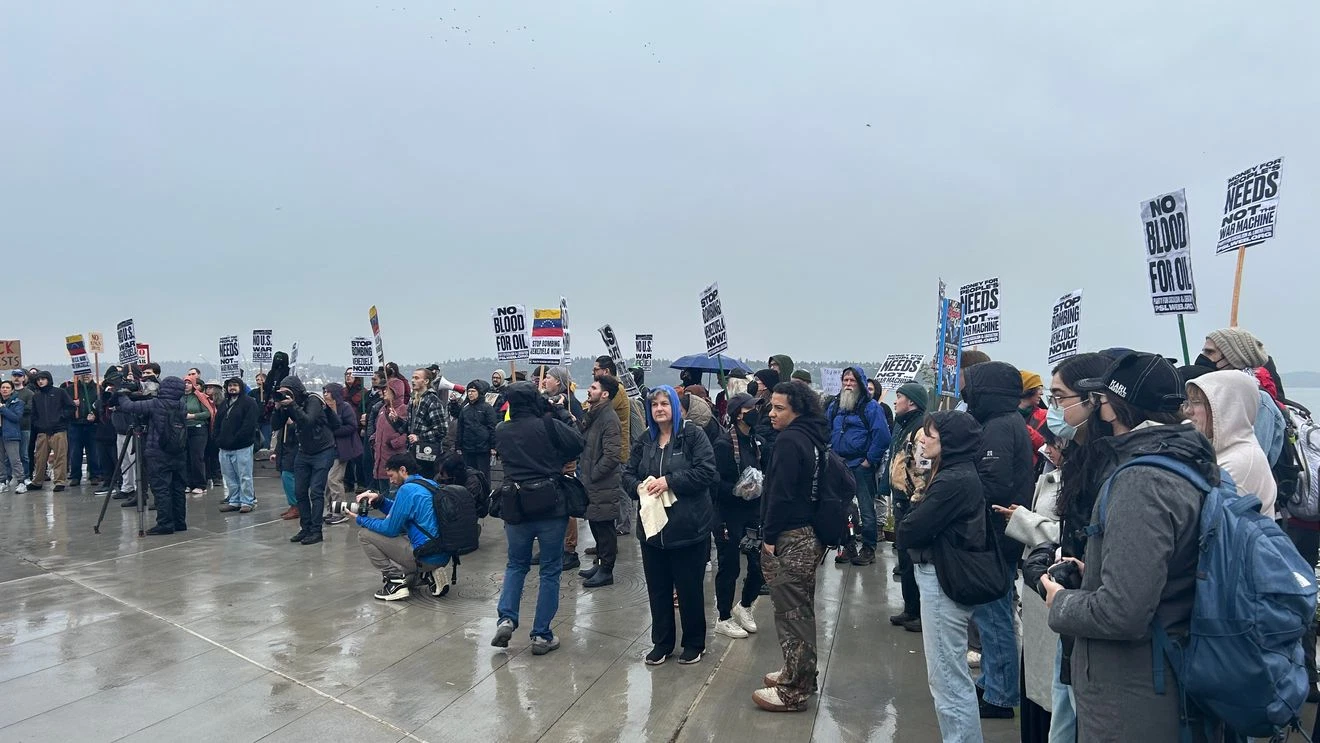
Hundreds of protesters gathered at Seattle’s waterfront on Saturday, chanting “The people united will never be defeated” in opposition to the U.S. military operation that captured Venezuelan President Nicolás Maduro and brought him to New York to face criminal charges.
The demonstration came as Venezuelans in South Florida and other cities celebrated Maduro’s removal, creating a stark divide between those who view the overnight military strike as justified action against a dictator and those who see it as illegal intervention motivated by oil.
“What are we the world’s policemen? We decide who lives, who dies?” Dale Hoffman questioned on Saturday amongst the Seattle protesters.
The military operation that resulted in at least seven explosions across Caracas, Venezuela’s capital, has drawn sharp criticism from some Americans, including people in Western Washington who gathered to oppose what they characterised as an unlawful invasion.
Whilst waving signs and following call-and-repeat chants, many in the crowd argued the Trump administration’s military action violated constitutional requirements.
“By law, you can’t do that,” said Beatriz Hofmann. “You have to talk to Congress.”
Several Washington lawmakers agreed with this assessment.
Rep. Pramila Jayapal and Rep. Emily Randall released statements denouncing the U.S. actions.
“The world is watching as Trump illegally stokes the fires of war for his own personal gain,” Randall stated.
Meanwhile, Washington State Republican Party Chair Jim Walsh defended the administration’s operation and claimed the situation “called for it.”
“Mr. Maduro is a criminal,” Walsh added. “He is a gangster and a drug dealer and a thug.”
President Donald Trump announced Saturday that U.S. forces conducted “Operation Absolute Resolve,” a military strike planned for months that resulted in helicopters landing at Maduro’s compound in Caracas at 2:01 a.m. local time Saturday. Maduro and his wife Cilia Flores were taken into U.S. custody and flown to New York to face narco-terrorism and drug trafficking charges.
Trump said the U.S. will temporarily “run” Venezuela until a “proper transition” to new leadership can occur, though he provided few details about how that would work.
Whilst Hofmann recognised that many Venezuelans, including some in America, are celebrating the potential end to Maduro’s regime, she claimed President Trump used the struggles Venezuelans face to his advantage in this operation.
“To me, this was very strategically done by the White House because they knew that there are a lot of frustrated Venezuelans who need help,” she explained. “A way to look like you’re doing the right thing, but you’re not doing it the right way.”
Many people also said they oppose the possibility of another war and Trump’s plans to tap Venezuela’s oil reserves, which the president expressed in a press conference Saturday morning.
Additionally, some Latino Americans shared the fear that these actions won’t stop with Venezuela.
“If we continue fighting or bombing other countries,” Henry Tehutli said, “maybe the next country is going to be mine, Mexico.”
Iffy Abshir, a Somali immigrant, Rainier Beach High graduate, and Minnesota resident, spoke after the protest and called the whole situation “kind of demoralising” and “painful” for immigrant communities watching U.S. military intervention.
As uncertainty unfolds for the future of Venezuela, protesters maintain their demands for accountability in U.S. leaders.
“Is Maduro a dictator? Yes. Is Trump a dictator? Yes,” Hofmann claimed. “And two wrongs don’t make a right.”
The Seattle protest was one of more than 100 demonstrations scheduled across the United States on Saturday, with major gatherings in Los Angeles, Chicago, Boston, Philadelphia, and Washington, D.C.