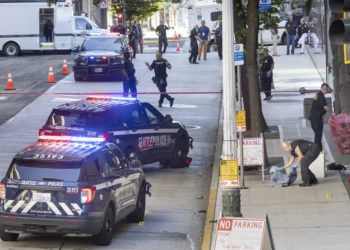
A U.S. Customs and Border Protection agent shot and wounded two people in Portland on Thursday afternoon, an incident federal officials frame as self-defense against a driver who tried to run over agents, but which Portland’s mayor and governor characterize as evidence that expanded immigration enforcement has become dangerous and unaccountable. The shooting occurred less than 24 hours after ICE agents killed 37-year-old Renee Good in Minneapolis, creating a rapid escalation in tensions between sanctuary cities and federal authorities that’s now producing violent confrontations in multiple jurisdictions within days of each other.
The Department of Homeland Security says agents pulled over a vehicle near the Adventist Health clinic on Southeast Main Street around 2:20 p.m. When agents identified themselves, according to DHS, “the driver weaponized his vehicle and attempted to run over the law enforcement agents. Fearing for his life and safety, an agent fired a defensive shot.” The passenger, DHS claims, was from Venezuela, in the country illegally, and affiliated with the transnational Tren de Aragua prostitution ring. DHS also alleges the passenger had been involved in a prior Portland shooting.
The driver fled with the wounded passenger, traveling more than 2.5 miles to Northeast 146th Avenue and East Burnside before calling for help at 2:24 p.m. Both the man and woman were found with apparent gunshot wounds and taken to hospitals. Their conditions weren’t immediately known, though Portland City Council President Elana Pirtle-Guiney said as far as she knew they were still alive Thursday evening.
Portland Mayor Keith Wilson immediately called for the Trump administration to end ICE operations in the city until an independent investigation could be completed. At a news conference flanked by city councilors, county commissioners, the county sheriff, police chief, state lawmakers, faith leaders, and Governor Tina Kotek, Wilson framed the shooting as emblematic of broader problems with federal enforcement tactics. “When the administration talks about using full force, we are seeing what it means on our streets. The consequences are not abstract. They are felt in hospital rooms and living rooms, in the quiet moments when families try to make sense of what happened, what is happening,” Wilson said. “We know what the federal government said happened here. There was a time when we could take them at their word. That time has long passed.”
That last statement, “that time has long passed,” represents a fundamental break in how Portland officials view federal immigration enforcement. They’re not simply disagreeing with policy or objecting to specific tactics. They’re stating explicitly that federal claims about what happened in enforcement incidents can no longer be trusted. That’s a remarkable position for a city mayor and state governor to take regarding federal law enforcement, but it reflects the impact of the Minneapolis shooting one day earlier, where DHS initially claimed Good tried to run over agents before Minneapolis officials reviewed video and called that characterization false.
Governor Kotek echoed Wilson’s demand for independent investigation and transparency. “The priority right now is a full, completed investigation, not more detentions,” she said. “My message to the federal government is this, we demand transparency. We demand your cooperation with Portland police and the Multnomah County DA, because we need to investigate this incident efficiently and effectively so we can rebuild trust with our nation’s government.” That phrase “rebuild trust” acknowledges what Wilson stated more bluntly: trust is broken, not intact.
Portland City Councilor Sameer Kanal was more explicit in his criticism, directly echoing Minneapolis Mayor Jacob Frey’s response to the Good killing. “You are hearing and you are seeing attempts to justify the unjustifiable, to completely defend the indefensible from our federal government,” Kanal told protesters gathered outside City Hall. “It’s unacceptable. We’re going to stand against it. We see through your bullshit.” His reference to people “in hospitals and in detention” connected the two wounded individuals with Good’s death and broader immigration enforcement patterns.
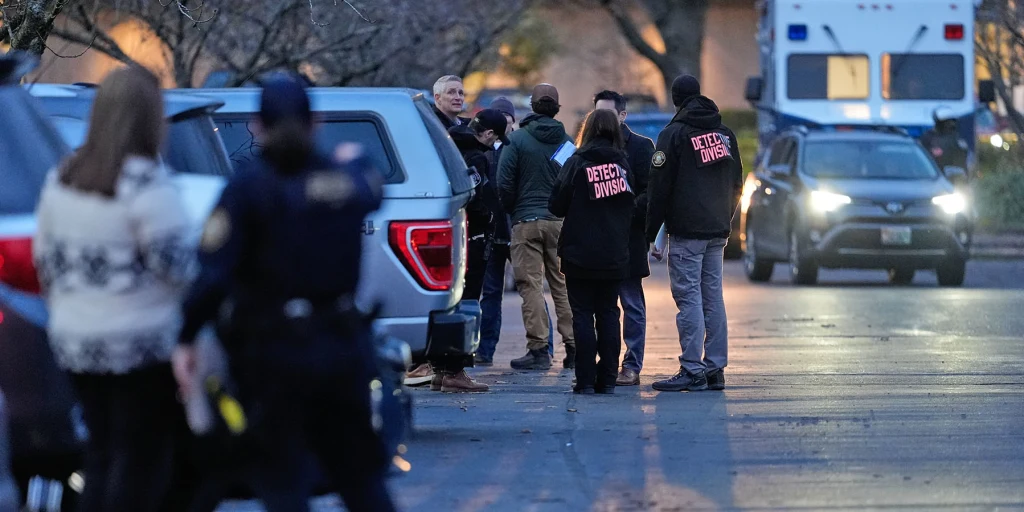
The FBI is investigating the shooting, collecting evidence from both the scene near the clinic and the location where the wounded people were found. At the clinic, FBI agents focused on a black Hyundai with both front doors open and front-end damage parked in the lot. How that vehicle connects to the shooting wasn’t clear Thursday night. Residents near where the wounded people stopped described seeing a man bleeding after getting out of a red Toyota truck. A tow truck removed the truck around 6:35 p.m.
State Senator Christine Drazan, a Republican from Canby running for governor against Kotek, accused Oregon’s political leaders of “rushing to judgment and treating dangerous criminals like victims.” She emphasized wanting “law enforcement to arrest transnational Tren de Aragua gang members and take them off our streets, end human trafficking, and make our communities safer.” Her statement highlights the political divide over immigration enforcement, with Republicans generally supporting aggressive federal operations that Democrats characterize as dangerous overreach.
That divide reflects competing narratives about what’s happening. Federal officials describe enforcement operations targeting dangerous gang members, with violence occurring only when suspects attack agents. Local officials describe federal agents conducting raids that terrorize communities, kill citizens and non-citizens alike, and operate without accountability or transparency. Both sides point to the same incidents as evidence for their interpretation.
For Portland, which has positioned itself as a sanctuary city limiting local cooperation with immigration enforcement, federal agents conducting operations that result in shootings represents exactly what city officials feared when they opposed expanded ICE presence. The shooting occurred during a city council meeting, forcing councilors to suddenly adjourn and rush to the mayor’s office. When they reconvened, Pirtle-Guiney delivered news of the shooting to a room where protesters were already present demonstrating against federal immigration actions.
That timing, protesters already in the council chambers when the shooting was announced, reflects how quickly immigration enforcement has become Portland’s dominant political issue. The protesters weren’t there coincidentally. They were demonstrating against federal actions when news broke of a federal shooting in their own city, creating an immediate connection between what they were protesting and what was happening on Portland streets.
Late Thursday night, a large group gathered at the ICE facility in South Portland, which has been a protest site since June. Portland police and state troopers responded, with police using public address systems to order dispersal. Several people were taken into custody. U.S. Senator Jeff Merkley urged protesters to remain peaceful, writing on X: “Trump wants to generate riots. Don’t take the bait.”
That warning reveals Democratic officials’ concern that violent protests could justify exactly the kind of federal crackdown they’re trying to prevent. If protests turn destructive, federal authorities gain political justification for more aggressive enforcement and expanded federal presence in resistant cities. Merkley’s framing, “Trump wants to generate riots,” suggests he views the enforcement escalation as deliberately provocative, designed to elicit reactions that can be used to justify further federal intervention.
The shooting’s proximity to the Minneapolis killing, less than 24 hours earlier, creates a pattern that sanctuary cities are interpreting as systematic rather than coincidental. Two cities, two days, two shootings by federal immigration agents. Portland officials explicitly connected the incidents, with Kanal expressing solidarity with Good’s family and the Minneapolis community. That solidarity reflects recognition that what’s happening in Minneapolis and Portland could happen in Seattle, San Francisco, Chicago, or any other sanctuary city that opposes Trump administration immigration policies.
For Seattle, watching events in Portland unfold just three hours south, the implications are direct. If federal agents are conducting operations in Portland that city officials characterize as dangerous and unjustified, operations resulting in shootings that trigger mayoral demands for federal withdrawal and gubernatorial calls for independent investigation, there’s no reason similar operations couldn’t occur here. Seattle has comparable sanctuary policies, similar political leadership opposed to aggressive immigration enforcement, and comparable immigrant communities that federal authorities might target.
The DHS characterization of the passenger as a Tren de Aragua gang member involved in a prior Portland shooting is meant to justify the enforcement action. If federal agents are targeting dangerous criminals involved in human trafficking and violent crime, that creates different optics than if they’re simply conducting immigration raids. But Portland officials’ fundamental distrust of federal claims, Wilson’s statement that “we can no longer take them at their word,” means those justifications don’t have the credibility they might have had in previous administrations.
What emerges from Thursday’s shooting is a rapid deterioration in the relationship between sanctuary cities and federal immigration enforcement. Within 24 hours, agents killed someone in Minneapolis and shot two people in Portland. Mayors in both cities publicly demanded federal agents leave. A governor called for independent investigation and accused the federal government of breaking trust. City councilors called federal justifications “bullshit.” Protesters gathered in multiple cities. The FBI is investigating at least one incident.
Whether the CBP agent’s use of force was justified depends on facts not yet established. Did the driver actually try to run over agents, as DHS claims? Is the passenger actually affiliated with Tren de Aragua, as alleged? Were there alternatives to shooting that agents didn’t pursue? Those questions require investigation that Portland officials explicitly don’t trust federal authorities to conduct honestly, which is why they’re demanding independent oversight and transparency.
For now, what’s certain is that expanded federal immigration enforcement is producing shootings in sanctuary cities at a pace that’s accelerating conflict between local and federal authorities. Two incidents in two days have generated mayoral demands for federal withdrawal, gubernatorial calls for investigation, councilor accusations of federal dishonesty, and protests that required police intervention. That’s a crisis trajectory, not a sustainable enforcement strategy. Whether it escalates further or de-escalates depends on decisions both federal and local authorities make in coming days, but the pattern established across Minneapolis and Portland suggests escalation is the current direction.