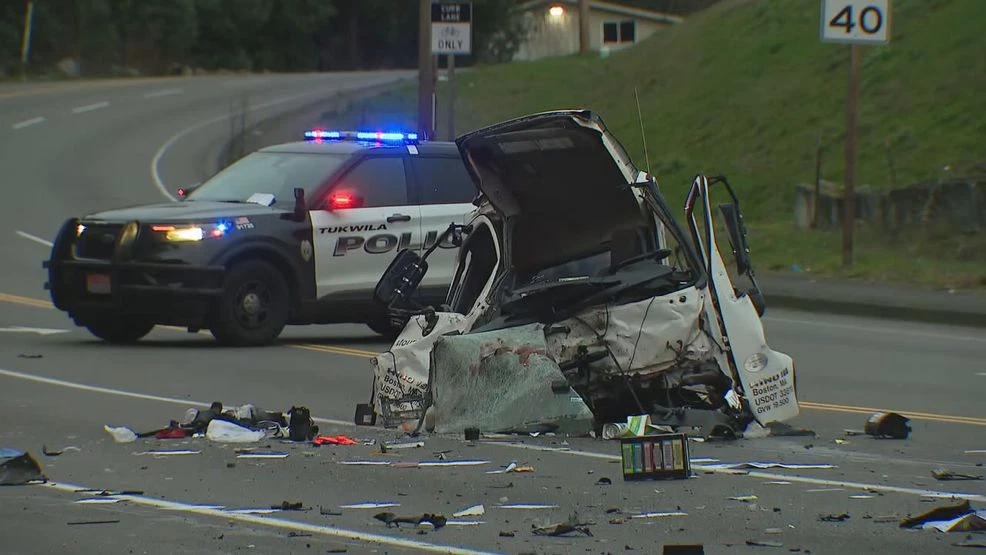
A collision between a semi-truck and a box truck left one driver critically injured and forced a lengthy road closure Friday at South 200th Street and Orillia Road South in Tukwila, according to police. The male driver of the box truck was taken to a hospital in critical condition with life-threatening injuries, while the male driver of the semi-truck suffered non-life-threatening injuries. The roadway was expected to remain closed for five to six hours while Tukwila police investigated the collision, disrupting traffic in an industrial corridor that serves as a critical link between Interstate 5, State Route 99, and the Puget Sound’s freight distribution network.
The location matters because South 200th Street and Orillia Road South sit in the heart of Tukwila’s industrial zone, surrounded by warehouses, distribution centers, and freight facilities that depend on truck access. This area handles constant commercial vehicle traffic moving goods between SeaTac Airport cargo facilities, Port of Seattle operations, and regional distribution networks. When a major intersection in this corridor closes for six hours, it doesn’t just inconvenience individual drivers, it disrupts supply chains and forces dozens or hundreds of commercial vehicles to reroute through residential neighborhoods or already congested arterials not designed for heavy truck traffic.
Police said no preliminary information was immediately available about what led to the crash, which is standard language for active investigations where evidence is still being collected and witness statements are being taken. But the severity of injuries to the box truck driver, critical condition with life-threatening injuries, suggests a high-energy collision rather than a low-speed fender bender. Box trucks, the kind used for local deliveries and moving services, offer far less protection than semi-trucks with their reinforced cabs. When the two vehicle types collide, the box truck driver typically suffers worse injuries due to the mass differential and structural differences.
The physics of truck collisions are unforgiving. A loaded semi-truck can weigh 80,000 pounds, while a box truck typically weighs 10,000 to 26,000 pounds depending on size and cargo. In a collision between vehicles with that mass difference, the lighter vehicle experiences far greater force. If the semi-truck struck the box truck, physics dictated the box truck driver would absorb more impact. If the box truck struck the semi-truck, perhaps running a red light or failing to yield, the box truck would still crumple more severely on impact.
The five to six hour closure estimate reflects the complexity of investigating commercial vehicle crashes. Police need to document the scene through photographs and measurements before vehicles can be moved. They need to interview both drivers, if the box truck driver’s condition permits, and any witnesses. They need to examine both vehicles for mechanical failures that might have contributed, like brake problems or steering malfunctions. They need to check electronic logging devices that track commercial drivers’ hours to determine if fatigue was a factor. They need to review any available surveillance footage from nearby businesses. Each step takes time, and rushing the investigation means potentially missing evidence that could determine fault or identify contributing factors.
For Tukwila, this crash is one of many that occur in the city’s industrial areas where freight traffic mixes with passenger vehicles on roads that weren’t designed for current traffic volumes. Tukwila’s location between Seattle and SeaTac Airport, with I-5 running through its center and major arterials connecting the freeway to industrial zones, makes it a freight chokepoint. Thousands of commercial vehicles move through the city daily, creating constant collision risk at intersections where trucks make wide turns, visibility is limited by parked trucks, and drivers accustomed to highway speeds must navigate stop lights and crossing traffic.
The crash also highlights risks faced by commercial drivers who spend their workdays navigating urban freight corridors. The box truck driver fighting for his life in a hospital represents one of thousands of people whose jobs require driving through congested industrial areas where large vehicles operate in close proximity. Commercial driving is consistently among the most dangerous occupations in America, with truck drivers experiencing injury and fatality rates well above average across all professions. Most days, these drivers navigate their routes safely despite constant risks. But when collisions occur at intersections where trucks are accelerating, decelerating, or turning, the results can be catastrophic.
The directive for drivers to avoid the area and seek alternate routes creates its own problems. When a major intersection closes in Tukwila’s industrial zone, traffic diverts to parallel roads like 188th Street or 212th Street, both of which run through more residential areas. Those residential streets experience sudden increases in commercial vehicle traffic they weren’t designed to handle, creating noise, safety concerns, and potential damage to road surfaces not built for heavy trucks. GPS routing algorithms push drivers onto those alternate routes automatically, but the algorithms don’t account for whether residential streets can safely accommodate 18-wheelers making turns designed for suburban intersections.
For businesses in the affected area, a six-hour closure means delayed deliveries, missed pickups, and disrupted operations. Warehouses expecting truck arrivals must reschedule. Distribution centers can’t ship products on time. Freight companies face delays that cascade through their networks, affecting deliveries across the region. The economic cost of a single intersection closure in a freight corridor extends far beyond the immediate vicinity, creating ripple effects through supply chains that depend on just-in-time logistics.
The fact that both drivers were male reflects the demographic reality of commercial trucking, which remains overwhelmingly male-dominated despite efforts to recruit more women into the profession. That gender imbalance matters for workforce development and for understanding the specific occupational hazards that affect the industry’s workers, but it doesn’t change the immediate reality of one driver critically injured and another hurt in a collision that shut down a vital freight corridor for hours.
What caused this crash won’t be known until Tukwila police complete their investigation. Possible factors include driver error like running a red light or failing to yield, mechanical failure like brake problems, visibility issues at an intersection where large vehicles can block sight lines, distraction from phones or other devices, impairment from substances or fatigue, or simply unfortunate timing where two vehicles arrived at the same space simultaneously. Each cause would suggest different prevention measures, from traffic signal timing changes to stricter enforcement of commercial driver hours to intersection redesign that improves visibility.
For Seattle-area residents who don’t regularly travel through Tukwila’s industrial zones, this crash is easy to dismiss as a distant incident affecting commercial drivers and freight operations that seem disconnected from daily life. But the freight network that moves goods from ports and airports to distribution centers to retail stores depends on those industrial corridors remaining open and safe. When crashes shut down key intersections for hours, when drivers are hospitalized with life-threatening injuries, when trucks must reroute through inappropriate streets, the costs accumulate across the entire regional economy.
The box truck driver’s critical condition means his family is likely at a hospital waiting to learn whether he’ll survive injuries sustained while doing his job. The semi-truck driver, despite non-life-threatening injuries, still experienced a traumatic collision that could have lasting physical and psychological effects. Both drivers likely replayed the moments before impact dozens of times already, trying to understand what happened and whether anything could have prevented it. Those personal dimensions of the crash, the human costs beyond economic disruption and traffic delays, are what matter most even as they’re easiest to overlook in discussions of freight corridors and industrial zones.
Tukwila police will eventually release findings about what caused the collision. Those findings might lead to changes in traffic control at that intersection, or enforcement priorities for commercial vehicle violations, or nothing at all if the crash is determined to be an unavoidable accident. The roadway will reopen after evidence is collected and vehicles are towed. Traffic will return to normal patterns. Freight will continue moving through Tukwila’s industrial corridors. But for the box truck driver fighting for his life and his family waiting at the hospital, this Friday collision at South 200th Street and Orillia Road South represents a catastrophic event that may have permanently altered their lives.