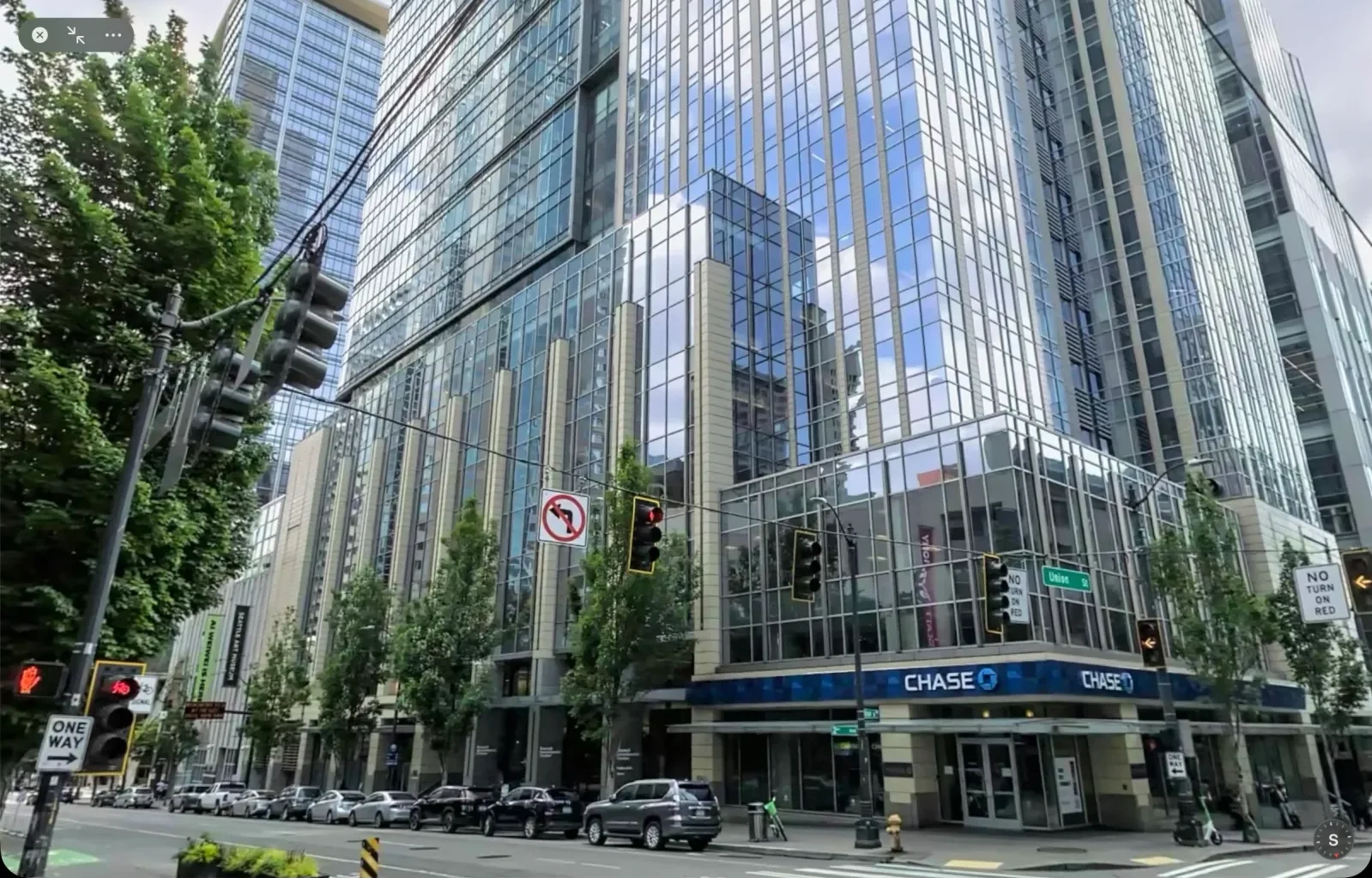
One of Seattle’s tallest skyscrapers has been renamed JPMorganChase Center as the banking giant expands its technology presence in the city, adding 40,000 square feet to now occupy 128,000 square feet at the 42-floor tower at 1301 Second Avenue formerly known as Russell Investments Center. JPMorganChase is relocating its Seattle Tech Center from 1201 Third Avenue to the newly expanded space while growing its local tech workforce to 400 employees up from 380 last year, focusing on cybersecurity, cloud technologies, artificial intelligence, and machine learning under leadership of Mamtha Banerjee. The expansion comes as downtown Seattle hit another record high vacancy rate of 34.7% in Q4 2024, with hybrid work continuing to weigh on commercial real estate, creating stark contrast between JPMorganChase’s five-day in-office mandate driving expansion while other tenants like Zillow, which scaled down after committing to remote work, have vacated floors they once filled.
The renaming of prominent downtown Seattle skyscraper reflects JPMorganChase’s strategic decision to establish strong physical brand presence in the city while other companies are reducing their office footprints. Building naming rights typically cost millions annually, making such commitments signals of long-term investment in locations rather than temporary office space leasing. For JPMorganChase, putting their name on a 42-floor tower visible across downtown Seattle communicates that the city is significant hub for the company’s operations, particularly technology development, rather than just satellite office.
The 850 total JPMorganChase employees in Seattle represent relatively small portion of the company’s 320,000 global workforce, but the tech-focused nature of the Seattle office gives it outsized strategic importance. The 400 tech workers, representing nearly half of Seattle headcount, work on critical infrastructure including cybersecurity protecting the bank’s massive financial operations, cloud technologies enabling digital banking services, and artificial intelligence and machine learning applications for fraud detection, customer service, trading algorithms, and operational efficiency. Those specializations align with Seattle’s tech ecosystem strengths, making the city logical location for talent recruitment.
Mamtha Banerjee’s leadership of the Seattle Tech Center, described as computer scientist, business leader, and Seattle startup veteran, suggests JPMorganChase intentionally hired someone with deep local connections who understands how to attract and retain talent in Seattle’s competitive tech labor market. Startup veterans bring entrepreneurial culture and innovation mindset that traditional banks sometimes struggle to cultivate, potentially making JPMorganChase’s Seattle operation more attractive to tech workers who might otherwise choose pure tech companies over financial services firms.
The Seattle Tech Center’s opening in 2018 “to tap into the region’s talent pool” reflects widespread phenomenon of companies from various industries establishing Seattle offices primarily for recruiting purposes. The city’s concentration of engineering talent trained at or recruited by Amazon, Microsoft, and smaller tech companies creates deep labor pool that other companies want to access. Whether JPMorganChase successfully competes for that talent against tech giants offering potentially higher compensation, more cutting-edge projects, or better work-life balance depends on how they position themselves and what they offer beyond salary.
The five-day in-office policy JPMorganChase implemented last year positions the company as outlier in Seattle’s tech scene where hybrid and remote work remain common. CEO Jamie Dimon has been vocal advocate for office return, arguing that in-person collaboration drives innovation and productivity while remote work creates challenges for training junior employees and maintaining culture. Whether that stance proves correct or whether it disadvantages JPMorganChase in recruiting compared to companies offering flexibility remains contested question, with different studies and companies reaching opposite conclusions about remote work’s impact on productivity and innovation.
The contrast with Zillow, which “once filled several floors” of the same building but “scaled down after committing to remote work during the pandemic,” with “more than 70% of the Zillow’s workforce” now remote, illustrates the divergence in corporate strategies about office use. Both companies are headquartered in Seattle, both employ significant tech workforces, but they’ve reached opposite conclusions about whether physical office presence is necessary or beneficial. That Zillow vacated space JPMorganChase is now filling suggests real estate market has shifted from shortage of desirable space to surplus allowing companies with different philosophies to find space matching their needs.
The 34.7% downtown Seattle vacancy rate in Q4 2024, described as “another record high,” reflects structural changes to office demand that extend beyond pandemic emergency response to potentially permanent shift in how work is organized. When one-third of downtown office space sits vacant, it affects not just building owners and landlords but entire downtown ecosystem including restaurants, shops, transit, and city tax revenues that depend on daytime workers. Whether vacancy rates stabilize at elevated levels or eventually decline as companies make final decisions about office policies affects downtown Seattle’s economic health and urban form.
For building owner and other tenants including Perkins Coie, JPMorganChase’s expansion and five-day occupancy requirement provides stability that counters broader market weakness. Having a major tenant expanding and putting their name on the building while implementing mandatory office attendance means those 850 employees will reliably occupy space rather than sitting empty on remote work days. That benefits retail tenants on ground floors, building services, and overall building value compared to properties where tenants maintain space but use it inconsistently.
Russell Investments’ move last year from 1301 Second Avenue to nearby Rainier Square suggests companies are not abandoning downtown but rather optimizing their footprints and potentially consolidating into newer, more attractive spaces. Rainier Square, which opened in 2020 and is Seattle’s second-tallest building, offers modern amenities and floor plans that older towers can’t match. Whether the former Russell Investments Center can attract new tenants to replace Russell and Zillow’s vacated space, or whether JPMorganChase’s expansion only partially fills space left by departing tenants, affects the building’s occupancy and financial performance.
The $1.5 million in grants to five Seattle-area nonprofits, announced Wednesday alongside the office expansion news, represents corporate community investment that often accompanies major real estate decisions. Business Impact NW, Friends of Little Saigon, Rainier Valley Community Development Fund, Seattle University’s RAMP-up, and Capitol Hill EcoDistrict program serve diverse communities across Seattle, suggesting JPMorganChase wants to position itself as supporting broad range of city’s neighborhoods and populations rather than just occupying downtown office space. Whether that philanthropy is primarily public relations accompanying real estate news or reflects genuine long-term community investment commitment becomes clear through sustained giving over years.
The 2,220 JPMorganChase employees across 150 branches and corporate offices in Washington State indicate the company’s retail banking presence extends far beyond the Seattle Tech Center’s specialized workforce. Branch employees serving consumers and small businesses represent traditional banking operations while tech center employees build systems supporting both retail banking and institutional financial services. That combination of retail and technology operations gives JPMorganChase different profile in Seattle compared to tech companies without consumer-facing branches.
For Seattle’s competition with other cities for corporate investment and high-wage employment, JPMorganChase’s expansion and visible naming rights represent win in environment where companies are consolidating offices and some are leaving expensive coastal cities for lower-cost locations. When major financial services firm not only maintains but expands Seattle presence, hiring additional tech workers and committing to physical office space through building naming, it validates Seattle’s continued attractiveness despite high costs, regulatory environment, and social challenges that some companies and individuals cite when relocating.
The focus on cybersecurity, cloud technologies, AI, and machine learning at the Seattle Tech Center aligns with JPMorganChase’s broader strategy of competing with fintech startups and tech giants entering financial services. Traditional banks faced existential questions about whether they could innovate fast enough to compete with technologically-native companies unburdened by legacy systems and regulations. By establishing tech centers in innovation hubs like Seattle, banks attempt to infuse tech culture and talent into organizations historically dominated by finance professionals. Whether that cross-pollination successfully produces innovation or whether cultural differences between banking and tech create friction affects the strategy’s success.
The timing of the expansion and renaming, occurring while many companies continue reducing office footprints, suggests JPMorganChase views current market conditions as opportunity rather than threat. With vacancy rates high and rents potentially negotiable, expanding office space and negotiating naming rights might be more affordable than during tighter markets. Whether that calculation proves correct depends on whether office demand rebounds or whether high vacancy becomes permanent feature requiring further market adjustments.
For the 400 tech workers being relocated from 1201 Third Avenue to 1301 Second Avenue, the move represents relatively minor geographic shift within downtown Seattle, roughly four blocks, but potentially significant change in building quality, amenities, floor layouts, and commute patterns depending on where individuals live and how they reach the office. Whether the new space represents upgrade with better technology infrastructure, meeting rooms, and collaborative spaces, or simply different configuration addressing changed workforce needs, affects employee satisfaction and potentially retention.
The growth from 380 to 400 tech employees year-over-year, while modest in absolute terms, represents 5% expansion at a time when many tech companies have been conducting layoffs or implementing hiring freezes. That continued growth suggests JPMorganChase views its Seattle tech investments as successful and scalable, likely planning further expansion if talent acquisition and project needs warrant. Whether growth accelerates, maintains steady pace, or plateaus depends on both company strategy and Seattle’s ability to continue supplying qualified tech talent in competitive labor market.
For downtown Seattle’s future, JPMorganChase’s expansion and naming rights represent important vote of confidence from major employer implementing strict return-to-office policy. If high-profile companies demonstrate success with full-time office occupancy, it might influence other companies reconsidering their remote work policies or office commitments. Alternatively, if JPMorganChase struggles to recruit and retain talent because of five-day requirement while competitors offer flexibility, it might validate remote work advocates’ positions. That natural experiment, playing out across multiple companies and years, will help determine sustainable balance between office and remote work.
The renamed JPMorganChase Center stands as visible marker of the company’s Seattle presence and commitment to in-person work, contrasting with the 34.7% vacancy rate surrounding it that reflects broader uncertainty about downtown office districts’ futures. Whether the building name will still be JPMorganChase Center in ten years, or whether changing market conditions will lead to another renaming as companies’ fortunes and strategies shift, remains uncertain. For now, the renamed skyscraper represents JPMorganChase’s bet that Seattle tech talent, downtown office presence, and in-person collaboration will drive innovation and business success despite the trend toward remote and hybrid work that has left much of downtown’s office space sitting empty.