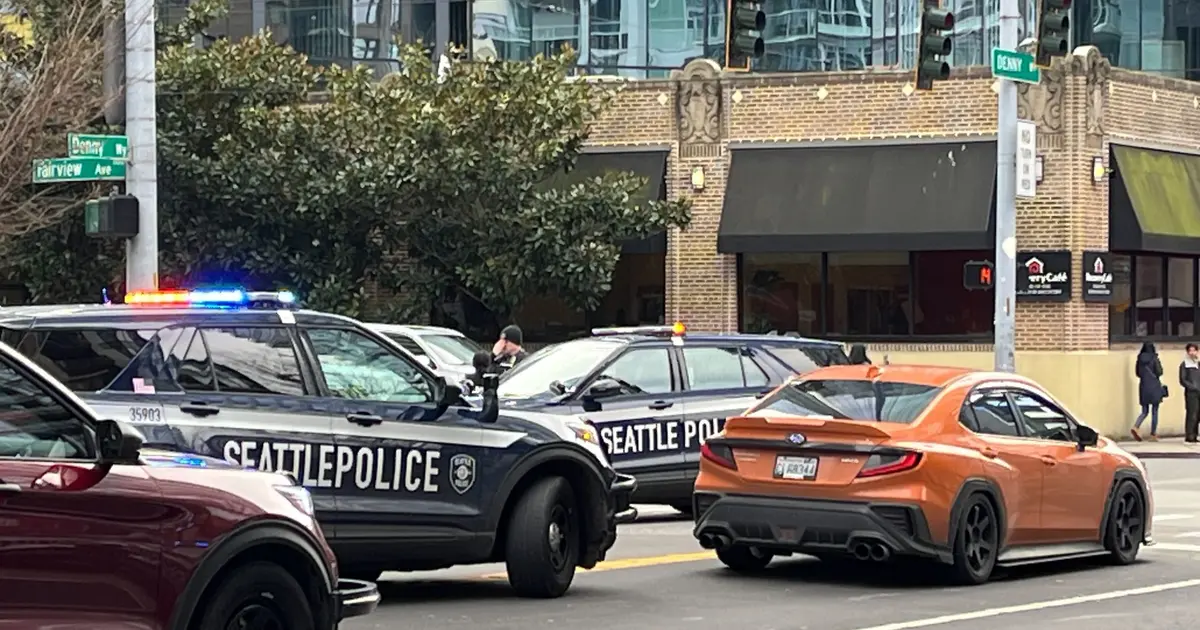
Washington State Patrol and Seattle Police Department are investigating separate shootings that stemmed from incidents on I-5 Wednesday around noon, with a 43-year-old man shot in the back while driving northbound at the West Seattle Bridge being treated at Harborview Medical Center in stable condition. The victim’s girlfriend called 911, and officers found him at Denny Way and Fairview Avenue in South Lake Union after he drove from the shooting location. WSP Trooper Rick Johnson said the shooter was in a dark blue van that was “tailgating him aggressively” before pulling alongside and shooting the victim once. Around the same time, another individual with a gunshot wound walked into Harborview but was not cooperative with Seattle police, though by Wednesday evening detectives had not definitively linked the two incidents. The violence highlights ongoing highway shooting problems in King County, with WSP reporting 44 shootings along I-5 in 2024 and 39 in 2025, prompting commuters to express concern about random violence during routine drives.
The West Seattle Bridge location where the initial incident occurred places the shooting in heavy traffic area where I-5 northbound approaches downtown Seattle. That stretch experiences congestion during midday hours as well as peak commute times, creating conditions where aggressive driving and road rage can escalate quickly. The victim was tailgated aggressively according to his account, then the blue van pulled alongside and the driver shot him once in the back. That sequence suggests either targeted attack by someone who followed the victim onto the highway, or road rage incident that escalated from aggressive driving to deadly violence within moments.
The fact that the victim drove from the shooting location near West Seattle Bridge to South Lake Union, several miles away at Denny and Fairview, while shot in the back demonstrates either that he didn’t immediately realize the severity of his injury, that he was attempting to reach safety before stopping, or that adrenaline allowed him to continue driving despite the wound. His girlfriend calling 911 rather than the victim himself suggests he may have been in shock or unable to safely use his phone while driving and dealing with gunshot injury.
Denny Way being completely closed briefly as details were gathered and the orange Subaru towed for evidence created significant downtown traffic disruption during midday. The intersection of Denny and Fairview sits in South Lake Union near Amazon offices, restaurants, and residential buildings, making road closure affect thousands of workers and residents. The decision to tow the vehicle rather than simply documenting the scene and releasing it indicates police believe the Subaru may contain evidence like bullet trajectory information, blood spatter patterns, or other forensic details relevant to the investigation.
The second individual who walked into Harborview with gunshot wound but was uncooperative with police creates investigative complication. Without victim cooperation providing details about where, when, and how the shooting occurred, detectives can’t easily determine if this incident is related to the I-5 shooting or represents entirely separate crime. Victims sometimes refuse to cooperate with police because they’re involved in criminal activity themselves, fear retaliation, distrust law enforcement, or want to handle matters through unofficial channels. Whatever the reason, lack of cooperation prevents police from investigating and potentially solving the crime.
Trooper Johnson’s statement that “our detectives have not linked the two gunshot victims to one incident at this point. This may be the case, but they don’t have information yet, but are actively working on a lot of angles and information” reflects investigative caution. Initial suspicion that incidents might be connected is reasonable given timing and general location, but without evidence definitively linking them, treating them as separate investigations prevents tunnel vision that might miss alternative explanations. Whether they’re ultimately connected or coincidentally occurred around the same time on the same highway remains unclear pending further investigation.
The description of the shooter’s vehicle as “dark blue van” provides limited information for public assistance. Vans of various types are common on highways, and without more specific details like make, model, license plate, or distinguishing features, witnesses would have difficulty identifying the suspect vehicle. Whether the victim or other witnesses can provide additional details that would allow investigators to narrow the search affects likelihood of identifying and apprehending the shooter.
Clint Martin’s response, avoiding the area after hearing about the shooting on the radio and explaining “I just stay in the right lane and just mind my own business,” reflects defensive driving strategy many commuters adopt to reduce road rage risks. His observation that “I’m going to get there at the same time regardless, it’s not going to make a difference” acknowledges that aggressive driving rarely produces meaningful time savings while increasing crash and confrontation risks. His daily Port Orchard to Seattle commute means extensive I-5 experience where he’s witnessed aggressive driving and learned to avoid engaging with it.
Hannah Wong’s reaction, finding it “very scary to think about that happening, or happening to me, or to anybody I know, or anybody at all, you’re just driving to work, and you experience something that could be life threatening,” captures how random highway violence creates anxiety for drivers who can’t easily control their exposure to risk. Unlike walking in high-crime neighborhoods where people can choose routes and times to minimize danger, highway commuters have limited alternatives and can’t avoid being surrounded by other vehicles whose drivers might be armed and volatile.
Jenna Zimmerman’s comment that it was “jarring to hear that violence on the highway is not uncommon for Washington State Patrol” reflects gap between public awareness and actual frequency of highway shootings. The statistics WSP provided, 44 shootings on I-5 in King County in 2024 and 39 in 2025, represent roughly one shooting every eight to nine days. That frequency suggests highway shootings are regular occurrence rather than rare events, though most commuters aren’t aware of this pattern because individual incidents receive limited media coverage unless they result in serious injuries or unusual circumstances.
The slight decline from 44 shootings in 2024 to 39 in 2025 provides minimal reassurance. Whether the decrease reflects effective enforcement, random variation, or early-year data that might increase as the year progresses is unclear. Even 39 shootings across one year on one highway in one county represents concerning level of armed violence affecting thousands of commuters who travel I-5 daily without experiencing shootings but who face non-zero risk of becoming victims.
The road rage element suggested by aggressive tailgating raises questions about shooter motivations and whether victim did anything to provoke the attack or was simply in front of an unstable person who responded to perceived slight with lethal violence. Road rage incidents can escalate from minor traffic maneuvers like lane changes, slow driving in passing lanes, or failing to allow merging, with volatile individuals responding disproportionately to actions that most drivers would ignore or handle with frustration but not violence.
The fact that traffic was heavy when the incident occurred means dozens or potentially hundreds of other drivers were nearby and might have witnessed the shooting, seen the blue van before or after the attack, or observed behavior that would help investigators. Whether WSP receives useful witness reports depends on whether people recognized what they were seeing as shooting versus other incident, whether they felt comfortable getting involved by contacting police, and whether they can provide details that aren’t available from the victim’s account.
For Harborview Medical Center, receiving two gunshot victims within short time period creates trauma care demands and raises questions about whether the hospital was on alert for additional victims if the incidents were related. Level I trauma centers like Harborview routinely handle gunshot wounds, but clustering of incidents creates operational challenges and sometimes triggers lockdown procedures if there’s concern that violence might follow victims to the hospital.
The evidence collection from the orange Subaru will likely include documenting bullet trajectory to determine angle and position of shooter relative to victim, collecting any bullet fragments or casings, photographing and sampling bloodstains, and examining vehicle for any other evidence of the attack. Whether investigators recover bullet from the victim’s body or vehicle affects ballistic analysis that could link weapon to other crimes if the gun has been used in previous shootings.
The intersection of Denny and Fairview as endpoint rather than shooting location means the actual crime scene on I-5 near West Seattle Bridge would also require processing. Highway crime scenes are challenging because traffic can’t be stopped for extended periods without creating massive backups, evidence on roadway can be contaminated or destroyed by passing vehicles, and witnesses are scattered and difficult to locate after they’ve driven away from the area.
The driver’s ability to continue operating vehicle after being shot in the back raises questions about bullet trajectory, whether it struck vital organs or major blood vessels, and whether he received first aid from his girlfriend or others before paramedics arrived. Back wounds can be life-threatening if bullet damages spine, kidneys, or major vessels, or relatively minor if it passes through soft tissue without hitting critical structures. The fact that he reached stable condition by Wednesday evening suggests the wound, while serious, wasn’t immediately life-threatening.
The strategic response some commuters described, staying right, avoiding aggressive drivers, maintaining composure, reflects defensive driving principles that reduce but don’t eliminate highway violence risks. Even cautious drivers can become victims if they happen to be in front of someone experiencing road rage or mental health crisis who responds to minor perceived slights with violence. The randomness of such attacks, where victims often did nothing more than exist in the wrong vehicle at the wrong time near the wrong person, creates anxiety that’s difficult to manage through behavior changes.
For WSP, investigating highway shootings presents challenges including identifying suspects from brief witness descriptions, locating vehicles that immediately disperse after incidents, and distinguishing between targeted attacks and random violence. The dark blue van description from this incident provides starting point, but without license plate or more specific vehicle information, finding the suspect requires either additional witness reports, traffic camera footage, or forensic evidence linking weapon or vehicle to the crime.
The question of whether the two gunshot victims were injured in related or separate incidents remains open, with detectives “actively working on a lot of angles and information” according to Trooper Johnson. If the incidents are connected, it suggests either multiple shooters in the blue van who shot two different victims, or that the uncooperative victim was somehow involved in the same incident as the cooperative victim but has reasons for not wanting to explain the circumstances to police. If they’re unrelated, it represents concerning coincidence that two separate highway shootings occurred within similar timeframe and location.
The broader pattern of dozens of annual highway shootings on I-5 in King County reflects several factors including high traffic volume creating frequent opportunities for interactions between drivers, urban stress and frustration that can trigger violence, relatively easy access to firearms in vehicles, and possibly cultural factors around aggressive driving and armed response to perceived disrespect. Whether any interventions like increased police presence, public awareness campaigns, or stricter gun laws would reduce highway shooting rates is debated, with different stakeholders proposing different solutions based on their views about root causes.
For the 43-year-old victim recovering at Harborview, the physical healing from the gunshot wound will be accompanied by psychological processing of the traumatic experience of being shot while driving. Many shooting victims experience PTSD, anxiety about driving or specific locations, and lasting impacts on sense of safety and trust. Whether he can identify the shooter, whether police can locate and prosecute the person responsible, and whether he receives adequate support for trauma recovery all affect his long-term outcomes beyond the physical wound healing.
Wednesday’s I-5 shootings, whether one coordinated incident or two separate attacks, join the grim statistics of dozens of annual highway shootings that most King County commuters remain unaware of until violence strikes close to their own experiences. Whether the pattern of regular highway violence prompts meaningful responses from law enforcement, policymakers, and the public, or simply becomes normalized background risk of urban highway travel, affects whether future victims can be prevented or whether shootings continue at current rates as routine hazard of the region’s transportation infrastructure.