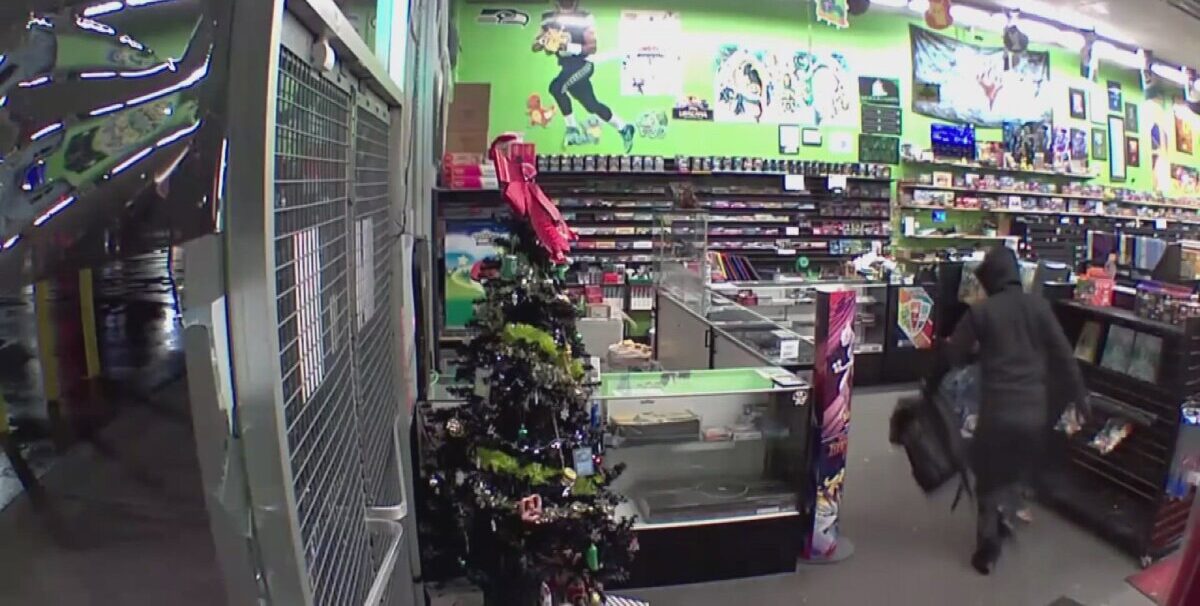
A week after someone broke into MuGu Games in Everett and stole over $30,000 worth of Pokémon cards, no arrests have been made according to Everett police. The break-in occurred just before 1 a.m. Thursday, January 8, caught on security cameras showing a person dressed in all black smashing an outside glass window to enter the store, then smashing a glass case with a hatchet and grabbing thousands of dollars’ worth of cards. “They stole about 20 graded cards and a stack of probably 50 or 60 raw cards,” said owner Michael Doran. Replacing the glass window and case is estimated to cost around $5,000, and Doran has installed metal bars behind windows to prevent future break-ins. This is not the first break-in Doran has dealt with in roughly 12 years at the same Everett location, with the store experiencing armed robbery, four break-ins, and several snatch-and-grabs in the last six years.
Doran claims some Pokémon cards sell for over $100,000 each, and the loss is hurting the business. Since the thief wiped one glass case clean, the store hasn’t been able to sell single Pokémon cards. “We sell $500 to a couple thousand dollars worth of singles a day,” he explained. While most graded Pokémon cards have serial numbers, raw cards do not, which Doran believes allows people to resell stolen cards online without being traced. The Everett Police Department confirmed at least one detective is working on the active investigation with no other updates. Despite previous break-ins, Doran remains hopeful the suspect will be found, saying “I’d like to see actual justice for businesses in Everett.” In just over one week, similar Pokémon card thefts have been reported across the U.S., including several in California, with over $100,000 worth stolen from a New York store most recently.
The claim that some Pokémon cards sell for over $100,000 each reflects the explosive growth in trading card values driven by nostalgia, speculation, and investment interest treating rare cards as alternative assets comparable to art or collectibles. First edition holographic Charizard cards from 1999 Base Set in pristine graded condition have sold for six figures at auction, with other rare cards from early sets commanding similar prices. Whether the $30,000 in stolen cards included such ultra-premium examples or consisted primarily of mid-range valuable cards worth hundreds to thousands each affects the loss severity and whether this represents targeted theft of known high-value inventory or opportunistic grab of whatever was accessible.
The distinction between graded and raw cards matters for both value and traceability. Graded cards have been professionally authenticated and condition-assessed by companies like PSA, BGS, or CGC, sealed in protective cases with serial numbers allowing tracking. Those serial numbers mean stolen graded cards can potentially be identified if they surface for resale through legitimate channels, though private sales or international markets might evade detection. Raw cards lacking such documentation are functionally untraceable, making them ideal targets for thieves who can immediately flip them through online marketplaces, card shows, or private buyers with minimal risk of identification.
The 20 graded cards and 50 to 60 raw cards stolen represent selective targeting rather than sweeping the entire inventory. The thief apparently knew what to take, focusing on a single high-value case rather than randomly grabbing merchandise. Whether the suspect had inside knowledge of which case contained the most valuable cards, conducted reconnaissance before the break-in, or simply targeted the most visible premium display affects investigation direction and whether this represents random crime of opportunity or calculated theft by someone familiar with the store and collectibles market.
The use of a hatchet to smash the glass case demonstrates premeditation and willingness to cause damage beyond what’s necessary to access merchandise. Bringing tools specifically for breaking glass indicates planning rather than impulsive crime. Whether the hatchet was chosen to quickly penetrate security glass that might resist other methods, or simply because it was available to the suspect, affects profiling and potential leads. The violence of smashing glass with a hatchet rather than using quieter methods also suggests either lack of concern about noise drawing attention or calculated risk that 1 a.m. timing and quick escape would prevent intervention regardless of noise.
The pattern of one armed robbery, four break-ins, and several snatch-and-grabs over six years at the same location indicates either that MuGu Games faces particular targeting due to its inventory’s value and liquidity, that the Everett location suffers from inadequate police response and prosecution creating perception of low risk for criminals, or both. Doran’s consideration of relocating when renewing his lease suggests the crime burden has reached levels threatening business viability. Whether other nearby businesses face similar crime rates or whether collectibles shops specifically attract disproportionate theft affects whether this represents neighborhood problem or industry vulnerability.
The $5,000 cost to replace broken glass on top of $30,000 in stolen inventory represents substantial loss for small retail business that might operate on thin margins. Whether insurance covers the theft and damage, minus deductible, or whether Doran bears the full loss affects financial impact. The installation of metal bars represents additional security investment that might prevent future smash-and-grab attempts but creates less welcoming storefront appearance potentially deterring legitimate customers. The cumulative cost of repeated crime incidents including insurance deductibles, security upgrades, lost inventory, and lost sales during recovery periods might exceed total profits over the six-year period.
The claim of selling $500 to several thousand dollars worth of single cards daily suggests annual revenue from singles alone could range from roughly $180,000 to over $700,000 depending on whether daily sales are at low or high end of range and how consistently cards sell. The inability to sell singles following theft because display case is empty represents ongoing daily revenue loss compounding the initial theft loss. Whether Doran can quickly restock high-value singles to resume sales or whether building inventory requires time and capital he might not have affects whether revenue recovers quickly or remains suppressed for extended period.
The national pattern of similar Pokémon card thefts across the U.S., including several in California and over $100,000 stolen from a New York store in the same week-plus timeframe, suggests either coordinated criminal network targeting collectibles shops, copycat crimes inspired by media coverage of successful thefts, or simply that Pokémon cards have become recognized among criminals as high-value, easily fenced merchandise comparable to jewelry or electronics. Whether law enforcement agencies across jurisdictions are coordinating investigations to identify patterns or suspects, or whether each incident is treated as isolated local crime, affects likelihood of solving cases and preventing future thefts.
The fact that no arrests have been made a week after break-in with security video of suspect suggests either that video quality is insufficient for identification, that suspect isn’t known to police from prior contact, or that investigation hasn’t progressed to identifying suspect despite evidence. Modern facial recognition technology and database searches can sometimes identify suspects from security footage, but effectiveness depends on video resolution, whether suspect’s face is clearly visible despite all-black clothing, and whether suspect has prior arrests creating database records. If suspect is from outside Everett and specifically traveled to commit theft, local identification becomes more difficult.
The Everett Police Department assigning at least one detective to the case indicates it’s being taken seriously despite property crime often receiving lower priority than violent offenses. Whether detective has other cases competing for attention or can focus primarily on the Pokémon theft affects investigation pace and thoroughness. The lack of updates a week later suggests either that investigation hasn’t developed significant leads, or that police are withholding information to avoid compromising ongoing work. Whether suspect left forensic evidence like fingerprints, DNA, or tool marks that could link to other crimes affects investigation prospects.
Doran’s statement that he’d “like to see actual justice for businesses in Everett” reflects frustration not just with this specific incident but with broader pattern where repeated victimization doesn’t result in suspects being caught and prosecuted. Whether that reflects inadequate police resources, prosecutorial priorities that decline to pursue property crimes aggressively, or revolving door justice system where even arrested suspects receive minimal consequences affects business owner perception that crime is tolerated. The political tension between business owners demanding aggressive enforcement and criminal justice reform advocates emphasizing alternatives to incarceration plays out in small business victimization.
The online resale market for collectibles creates both opportunity for legitimate trading and mechanism for laundering stolen merchandise. Platforms like eBay, TCGPlayer, Facebook Marketplace, and others enable anonymous sellers to list cards to nationwide or global buyers who have no way to verify whether merchandise is stolen. While graded cards with serial numbers can potentially be flagged if reported stolen, raw cards are completely untraceable once separated from original packaging or documentation. Whether online marketplaces cooperate with law enforcement to identify suspicious seller patterns or high-value listings matching recent thefts affects whether stolen goods can be traced and recovered.
The comparison to jewelry stores or other retailers handling high-value portable merchandise shows that collectibles shops face similar security challenges requiring investment in alarms, cameras, secure display cases, and potentially armed security that cuts into already thin retail margins. Whether collectibles industry develops best practices and shared intelligence about theft patterns, suspect descriptions, and prevention strategies, similar to jewelers’ mutual protection associations, affects whether individual shops can reduce vulnerability through collective action.
For Pokémon card collectors and investors, the theft wave creates market uncertainty about authentication and provenance. Buyers purchasing high-value cards need confidence they’re acquiring legitimate merchandise, not stolen goods that could be seized if traced. Whether stolen cards flooding secondary markets depresses prices or whether theft-driven scarcity increases values for remaining documented inventory depends on market dynamics. The lack of comprehensive provenance tracking for raw cards means buyers essentially have no way to verify cards aren’t stolen unless they trust the seller’s reputation.
The broader trend of trading cards evolving from children’s toys to serious collectibles and investments creates this entire category of crime. When cards that cost pennies to produce can sell for tens or hundreds of thousands based on rarity, condition, and nostalgia, they become targets for theft comparable to precious metals or gemstones. Whether the collectibles bubble continues inflating making thefts more attractive and common, or whether market corrections reduce values and therefore theft incentives, affects long-term crime trends.
For Doran and MuGu Games, the immediate challenge is recovering from $35,000 loss between stolen inventory and repairs, restocking to resume selling singles and recapture daily revenue, and deciding whether additional security measures beyond metal bars are necessary or whether location change makes more sense. The consideration of relocating when signing lease suggests he’s seriously evaluating whether crime risk makes current location unsustainable despite 12 years of business there. Whether Everett can address property crime in ways that make businesses feel safe operating there, or whether crime pressures push retailers to other cities or online-only models, affects the local economy and commercial district viability.
The national wave of Pokémon card thefts, from Everett’s $30,000 loss to New York’s over $100,000 theft and multiple California incidents, demonstrates that valuable collectibles create criminal opportunities that law enforcement struggles to prevent and solve. Whether coordinated investigation can identify suspects or networks responsible for multiple thefts, whether market mechanisms can reduce stolen goods’ liquidity making them harder to sell, or whether shops ultimately reduce inventory of ultra-high-value items to minimize theft exposure, affects how the collectibles industry adapts to becoming crime target comparable to traditional high-value retail like jewelry and electronics.