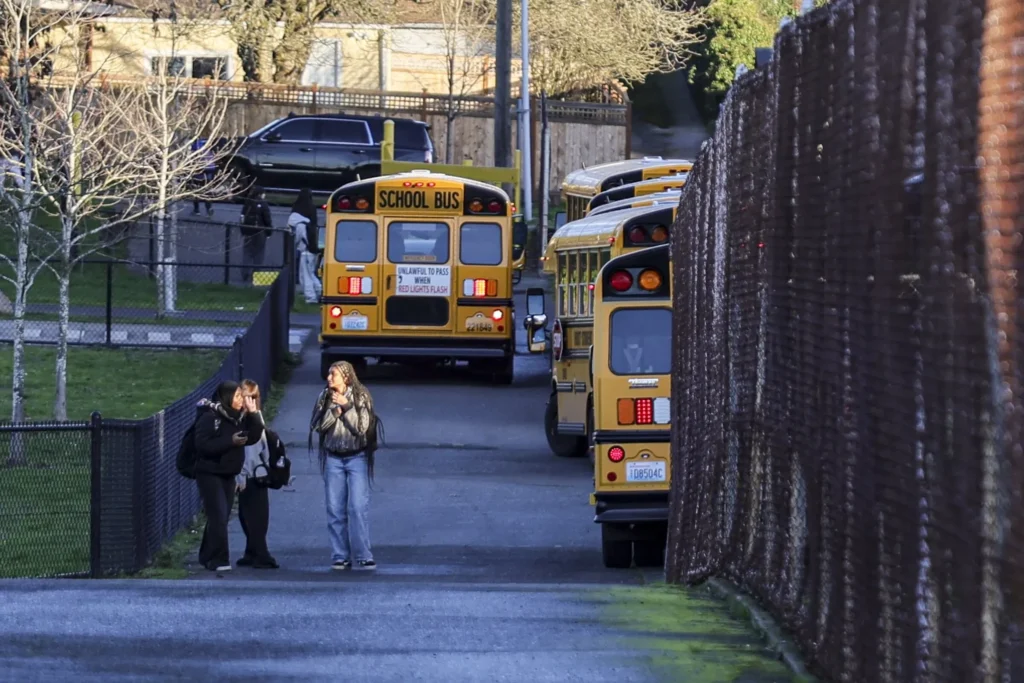
Six South Seattle public schools enacted shelter-in-place protocols Tuesday after receiving unconfirmed reports of possible Immigration and Customs Enforcement activity in nearby neighborhoods. Seattle Public Schools said the precautionary measures followed community reports of law or immigration enforcement activity around multiple campuses. District safety and security staff were on site throughout the day and did not observe any ICE presence, according to a district statement.
“I was pretty scared for my classmates, you know, because what if some of them got taken away?” Cleveland STEM High School student Evan Truong said. One group outside the campus handed out whistles for people to use in case they see an ICE agent. “They were just scared, and the information that was passed around was kind of inconsistent,” Malaya Movement Seattle Chairperson Meesh Vergara said. “There’s a lot of uncertainty. We just want consistent communication from Seattle Public Schools.”
Aki Kurose Middle School lifted its shelter-in-place at noon, while Cleveland STEM High School ended the protocol after lunch. The remaining schools lifted measures at regular dismissal. District officials emphasized that no ICE activity was confirmed at any school sites. Schools affected included Mercer International Middle School, Aki Kurose Middle School, Cleveland STEM High School, Maple Elementary School, Dearborn Park International School, and Beacon Hill International School.
The response to unconfirmed reports demonstrates how fear of immigration enforcement creates disruption even when actual ICE activity never materializes. Whether the initial reports represented genuine sightings of federal agents, rumors amplified through social media, or misidentification of other law enforcement affects assessment of whether shelter-in-place was appropriate precaution or overreaction to unsubstantiated claims. The district’s inability to confirm ICE presence despite safety staff monitoring suggests either that reports were false or that any federal activity occurred away from school grounds.
The shelter-in-place protocol keeping students inside buildings while continuing regular class schedules represents middle ground between normal operations and emergency lockdown. Whether the measure actually protected students from potential immigration enforcement or simply created anxiety and missed instruction time depends on whether ICE was actually operating nearby. The fact that some schools lifted protocols at noon and after lunch while others waited until dismissal suggests varying threat assessments or simply different comfort levels with resuming normal operations.
The distribution of whistles outside Cleveland STEM High School to use “in case they see an ICE agent” reflects community organizing to monitor and potentially interfere with federal immigration enforcement. Whether such intervention tactics are legal, whether they effectively protect immigrants from detention, or whether they could result in obstruction charges against those interfering with federal officers affects both practical value and risk to community members employing them.

The “inconsistent” information Vergara described passing through the community illustrates how rapidly rumors spread through immigrant communities already anxious about enforcement threats. Whether Seattle Public Schools has protocols for verifying reports before implementing disruptive measures, or whether they err on side of caution implementing shelter-in-place based on unconfirmed community reports, affects balance between responsiveness and operational stability.
Seattle police clarifying they have no role in federal civil immigration enforcement and encouraging people to call 911 when they see suspicious activity creates tension where police simultaneously distance themselves from ICE while asking community to report activity that might include federal agents conducting lawful enforcement. Whether immigrant communities trust SPD enough to report concerns, whether officers can distinguish between lawful federal operations and suspicious activity, and whether 911 calls about ICE create records useful for accountability or simply generate false alarms affects practical value of the guidance.
King County Councilmember Rhonda Lewis’s statement about working with local and state leaders to ensure kids get to and from school “safely and securely” suggests potential policy responses including safe passage zones or enhanced monitoring, though the limits of local authority over federal immigration enforcement constrain what county officials can actually accomplish beyond symbolic gestures and information sharing.