Jeff Bezos’ Blue Origin space venture wrote a new chapter in space history today by sending the first wheelchair user beyond Earth’s atmosphere.
“It was the coolest experience,” said Michaela “Michi” Benthaus, a German-born aerospace and mechatronics engineer at the European Space Agency who sustained a spinal cord injury in a mountain biking accident in 2018.
Blue Origin’s suborbital New Shepard rocket ship lifted off from the company’s Launch Site One in West Texas at 8:15 a.m. Central Time.
An initial launch attempt had been scrubbed Thursday because the flight team “observed an issue with our built-in checks prior to flight,” Blue Origin said. The company didn’t provide further details about the problem, but today’s countdown proceeded without complications.
This marked the 37th New Shepard mission and the 16th to carry humans on a brief journey above the 100-kilometer altitude level that marks the internationally accepted boundary of space. Eighty-six people, including Bezos himself, have now flown on New Shepard, with six having made multiple trips.
Benthaus was one of six crew members on today’s mission, known as NS-37. In a 2023 interview published by the Technical University of Munich, she said she set her mind on becoming an astronaut when she was 10 years old.
When Benthaus lost the use of her legs, she initially thought her flight into space “was never going to happen.” But in 2022, her hopes received a major boost when she experienced a zero-gravity flight arranged through AstroAccess, a project dedicated to paving the way for spacefliers with disabilities. Last year, she commanded an analog space mission conducted at the Lunares Research Station in Poland.
Now the 33-year-old has blazed a new trail for space accessibility. “You should never give up on your dreams,” she said after today’s flight.
Blue Origin CEO Dave Limp said the mission marked “another step toward making spaceflight accessible for everyone.” Phil Joyce, Blue Origin’s senior vice president for the New Shepard program, said “Michi’s flight is particularly meaningful, demonstrating that space is for everyone, and we are proud to help her achieve this dream.”
Kent, Washington-based Blue Origin has been working for several years to improve accessibility at its launch facility in Texas, including adding an elevator to the seven-story launch tower. A business resource group named New Hawking, in honor of the late wheelchair-using physicist Stephen Hawking, helped lead these efforts.
Blue Origin says it has previously flown people who are hard of hearing, have limited mobility or limb differences, have low vision, or are legally blind.
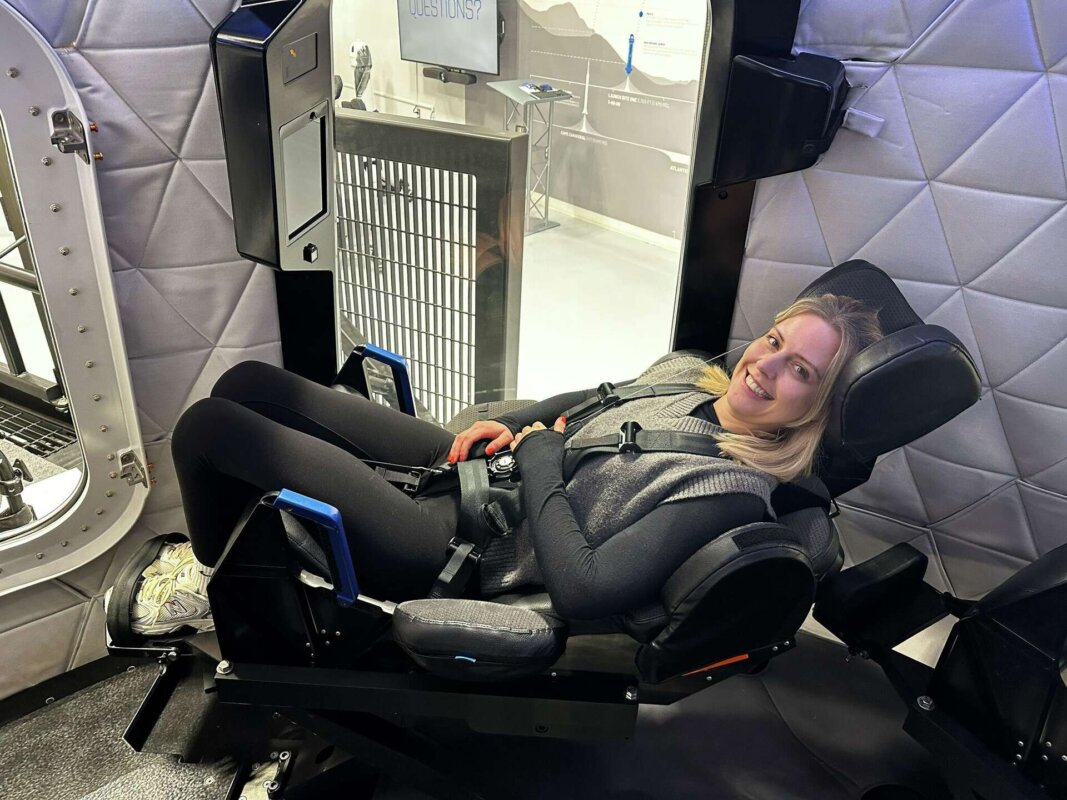
Blue Origin didn’t need to make significant modifications in the New Shepard crew capsule for today’s flight. However, launch commentator Joel Eby said the mission team made “a few ground system improvements,” such as providing a bench that Benthaus could use to get into and out of the capsule with assistance.
During their 10-minute flight, Benthaus and the rest of the crew rose to an altitude of 106 kilometers. They experienced a few minutes of zero gravity and views of Earth’s curved horizon against the blackness of space.
At the end of the mission, the booster made an autonomous landing not far from the launch pad, while the crew capsule descended to a parachute-assisted touchdown in the West Texas desert.
Afterward, Benthaus said she enjoyed the experience. “I tried to turn upside-down,” she said, describing her time floating in microgravity.
Benthaus’ crewmates included Joey Hyde, a physicist and quantitative investor who recently retired from his career at Citadel; Hans Koenigsmann, a German-American aerospace engineer whose career has been dedicated to advancing reusable spacecraft, most notably as an early SpaceX team member; Neal Milch, a business executive who serves as chair of the Board of Trustees at the Jackson Laboratory; Adonis Pouroulis, an entrepreneur and mining engineer with more than 30 years of experience; and Jason Stansell, a computer scientist and self-proclaimed space nerd from West Texas.
Koenigsmann played a supporting role in arranging Benthaus’ flight and occasionally helped her get around. After landing, he said the spaceflight was “actually more intense than I thought.”