Newly released police videos show the sequence of events when 24-year-old Alexander Eugene Smith threw a Washington State Patrol trooper to the ground and stole her patrol car on Christmas Day while walking on I-5 in Seattle. Smith told investigators he had smoked methamphetamine before the incident, which began with troopers attempting to persuade him to leave the freeway and escalated into a violent confrontation that required a high-speed chase ending with a PIT maneuver in Lynnwood. The videos, obtained by KOMO News through a public records request, reveal how quickly encounters with people in mental health or substance use crises on freeways can spiral from de-escalation attempts into dangerous pursuits that shut down major highways.
The footage shows troopers initially talking with Smith in the center lanes of I-5 near 85th Street. Smith indicated he wanted to walk to his home in Stanwood, roughly 60 miles north, and the trooper explained he couldn’t walk on the freeway. After several minutes of discussion, troopers convinced Smith to walk to the right shoulder and then off the freeway to the Northgate light rail station. That negotiation appeared successful, a textbook de-escalation where patient communication persuaded someone in crisis to leave a dangerous situation voluntarily.
But troopers followed Smith as he walked northbound, and when he stopped at the off-ramp to Northgate, he sat on the guardrail for several minutes. Troopers offered him a blanket and again pleaded with him to leave the freeway. That extended interaction, troopers staying with Smith rather than simply watching him exit, reflects protocols designed to ensure people in crisis actually reach safety rather than wandering back onto the roadway. The offer of a blanket on Christmas Day, with temperatures likely below freezing, shows troopers attempting to address immediate needs while guiding Smith off the freeway.
Then Smith suddenly bolted across the off-ramp and ran back into traffic, crossing all lanes of I-5. Responding troopers scrambled to stop traffic as Smith ran between cars. That moment, when someone who appeared to be cooperating suddenly reverses course and runs into traffic, represents exactly the kind of unpredictable behavior that makes freeway encounters with people in crisis so dangerous. Drivers on I-5 traveling at highway speeds have seconds to react when someone runs in front of them. Troopers attempting to stop traffic to prevent Smith from being hit must position their vehicles to block lanes while avoiding causing crashes themselves.
A Washington State Patrol lieutenant approached Smith and told him to stop. The video then shows Smith violently pulling the lieutenant from the patrol car, getting in the driver’s seat, and speeding off in the stolen cruiser. That escalation from pedestrian crisis to violent assault and vehicle theft happened within seconds, faster than backup could respond or bystanders could process what was occurring. The lieutenant was left on the freeway while Smith drove away in a fully equipped patrol car containing weapons, communications equipment, and computer systems with access to law enforcement databases.
The lieutenant stopped a driver and asked them to call 911. That detail reveals the immediate problem created when a trooper loses their vehicle and radio. Without communication equipment, the lieutenant couldn’t coordinate response or warn other units about the stolen vehicle’s direction. The need to flag down a civilian driver and request they call 911 meant critical seconds passed before other law enforcement knew what had happened and where the stolen patrol car was heading.
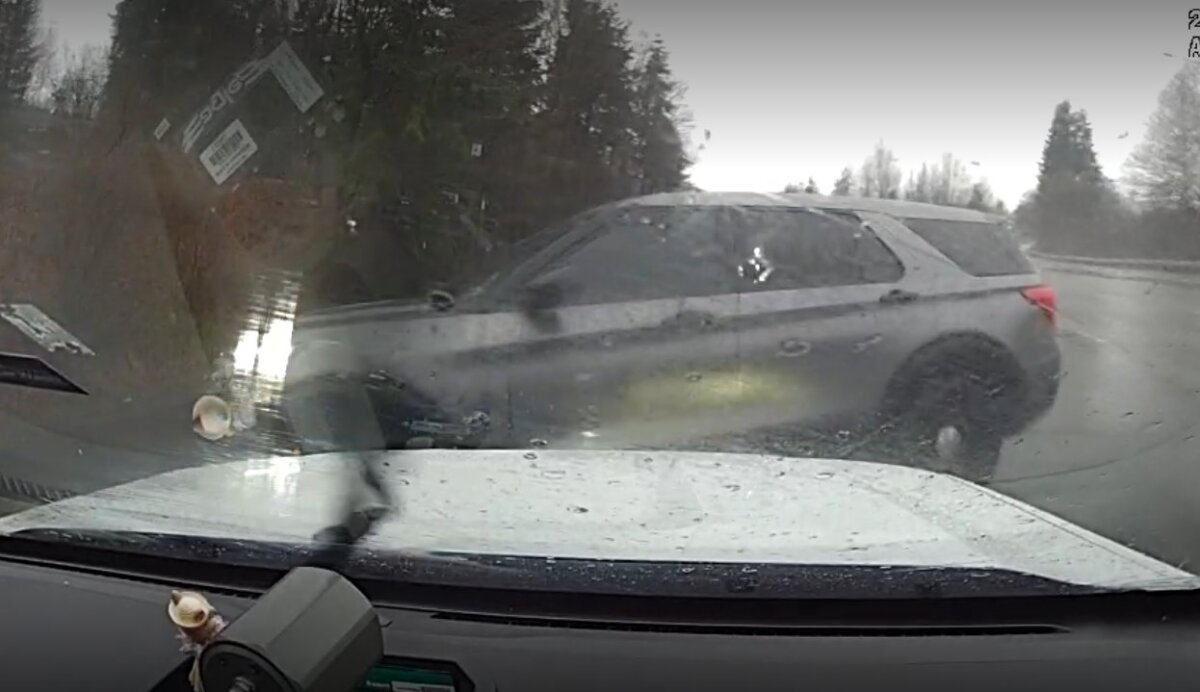
Other troopers chased the stolen patrol car north into Lynnwood, where it flipped around and went southbound on I-5. That reversal, heading south back toward Seattle on a freeway Smith had just traveled north, suggests either confusion about direction or deliberate evasion. A southbound pursuit on I-5 during Christmas Day would have required clearing traffic across multiple lanes as speeds likely exceeded safe limits for conditions. Another trooper used a PIT maneuver, precision immobilization technique, to spin out the patrol car, then rammed the driver’s door. That aggressive intervention, ramming a stolen patrol car to end a pursuit, reflects the urgency of stopping someone who had already demonstrated willingness to use violence and was driving a vehicle containing weapons.
Smith was pulled from the car and arrested. King County prosecutors charged him with robbery in the second degree and attempting to elude a police vehicle. He has been ordered to undergo a competency evaluation and is due in court later this month. That competency evaluation will determine whether Smith understands the charges against him and can assist in his defense, a standard procedure when someone’s behavior suggests possible mental illness or incapacity.
For Seattle and Puget Sound communities, this incident highlights the intersection of mental health crisis, substance use, and public safety on the region’s major transportation corridors. I-5 through Seattle experiences frequent incidents of people walking on the freeway, sometimes from homelessness and mental illness, sometimes from substance use, sometimes from suicidal ideation. Each incident requires trooper response, traffic management, and attempted intervention that can last minutes or hours depending on how the person responds to contact.
The Christmas Day timing is significant. Mental health and substance use crises don’t pause for holidays, but many support services reduce operations or close entirely. Someone experiencing a crisis on Christmas Day has fewer resources available for voluntary assistance, meaning law enforcement becomes the default first responder even when the underlying issue is medical or psychiatric rather than criminal. Smith’s admission that he had smoked methamphetamine before the incident indicates substance-induced behavior that might have been addressed through medical intervention if such resources were available at that time and place.
The videos show troopers employing patience and de-escalation techniques that initially appeared to work. They didn’t immediately arrest Smith for being on the freeway. They negotiated with him, explained why he couldn’t walk to Stanwood on I-5, convinced him to move to the shoulder, offered him a blanket, and repeatedly encouraged him to leave safely. That approach reflects training in crisis intervention and recognition that arresting someone for walking on the freeway doesn’t solve the underlying problem that put them there.
But de-escalation has limits, particularly when someone is under the influence of methamphetamine and exhibiting unpredictable behavior. The sudden reversal when Smith bolted back into traffic after appearing to cooperate shows how quickly these situations can deteriorate despite officers’ best efforts. And once Smith assaulted the lieutenant and stole the patrol car, the situation transformed from a mental health crisis into an active threat requiring immediate and aggressive response.
The use of a PIT maneuver followed by ramming the driver’s door demonstrates the tactics law enforcement employs to end dangerous pursuits. PIT maneuvers work by causing the fleeing vehicle to spin out, losing forward momentum. Ramming the driver’s door after the spin prevents the driver from recovering control and continuing to flee. These tactics carry risks of injury to the suspect and officers, but they’re considered necessary when someone is driving recklessly in a way that threatens others on the roadway.
For the lieutenant who was assaulted and had her patrol car stolen, the incident represents both physical danger and violation of the trust that exists when someone in crisis appears to be cooperating. She was attempting to help Smith when he violently attacked her. That betrayal of officers’ attempts to assist rather than simply arrest people in crisis can affect how future encounters are approached, potentially making officers more cautious about extended contact with people exhibiting erratic behavior.
The charges Smith faces, robbery in the second degree and attempting to elude, reflect the violent nature of the vehicle theft and the subsequent pursuit. Robbery involves taking property through force or threat of force, which is exactly what occurred when Smith pulled the lieutenant from her vehicle. Attempting to elude covers the chase that followed, which endangered other drivers on I-5 and required aggressive tactics to end.
The competency evaluation will determine whether Smith can proceed to trial or requires treatment before prosecution continues. If found incompetent, he would be committed to a state psychiatric facility for restoration of competency, a process that can take months or years depending on the severity of mental illness or incapacity. If found competent, he faces prosecution for crimes that could result in years of imprisonment.
What the videos don’t answer is what intervention might have prevented this escalation. Should there be mental health professionals accompanying troopers on freeway crisis calls? Should there be faster access to involuntary commitment for people exhibiting dangerous behavior while in crisis? Should there be better systems for getting people under the influence of methamphetamine into treatment rather than leaving them to navigate the city until crisis occurs? These are policy questions that Seattle and Washington wrestle with constantly, balancing civil liberties, resource constraints, and public safety.
For now, the Christmas Day incident stands as documentation of how quickly mental health and substance use crises on freeways can escalate from conversation to violence to high-speed pursuit. The troopers involved attempted de-escalation and showed patience in their initial contact with Smith. But when those efforts failed and Smith turned violent, the response required was immediate, aggressive, and dangerous. That cycle, attempt de-escalation, experience violence, deploy force to resolve, repeats itself on Seattle area freeways regularly, with each incident carrying risk of injury or death to the person in crisis, officers responding, and drivers caught in the middle.