The US Coast Guard has awarded a contract to overhaul Pier 36 to support three incoming polar security cutters, a class of heavy icebreakers designed for Arctic and Antarctic operations, whilst simultaneously pursuing acquisition of up to 54 acres of Seattle waterfront from the Port of Seattle.
Planning documents reveal the Coast Guard has begun major upgrades at its Seattle base as part of a broader initiative to strengthen US maritime capabilities in polar regions.
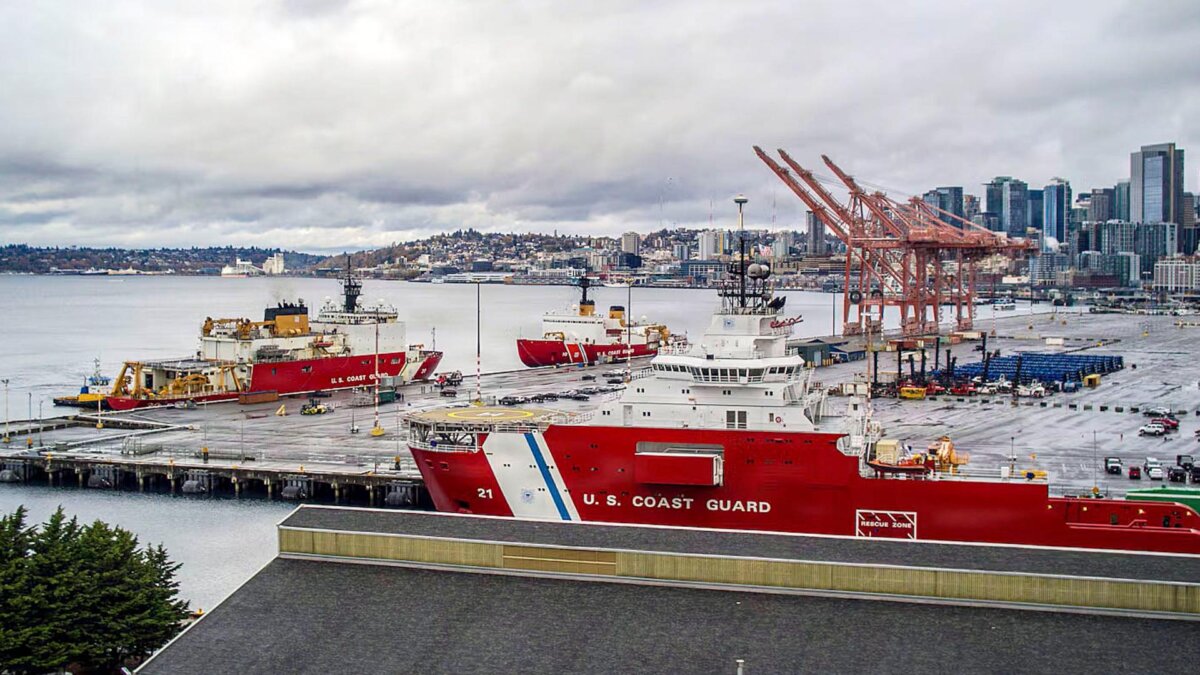
The approved project includes dredging the basin at Pier 36 and constructing two upgraded berths capable of supporting the deep-draft ships.
“Seattle is the designated homeport for the Coast Guard’s new Polar Security Cutters,” a spokesperson stated. “Those cutters have a deeper draft than the Service’s legacy heavy icebreakers, so the dredging project deepens the basin and upgrades Piers 36 and 37 to deliver a homeport for those three new PSCs.”
The work is part of a broader initiative to enhance US maritime strength.
A senior Pentagon official told reporters recently that climate change, increased activity by adversaries including Russia, and degrading US infrastructure are forcing the department to rethink how to maintain Arctic security and ensure troops are well-equipped and protected.
“I think it’s fair to say that Russia has built up in the Arctic for the last 20 years, and Russia is a regional superpower in the Arctic,” a NATO military official stated in September.
Three legacy Polar icebreakers, USCGC Healy, USCGC Polar Star, and USCGC Storis, were scheduled to be in Elliott Bay on Thursday for a media event.
“This work at Base Seattle is critical to supporting future operations to establish US maritime dominance, conduct Coast Guard missions in the high latitudes and advance national security interests,” the Coast Guard stated. “The recently enacted One Big Beautiful Bill Act makes a historic investment in the Coast Guard’s polar icebreaking fleet by providing $4.3 billion to continue construction of the PSC fleet.”
Simultaneously, the Coast Guard expects to issue a decision on its design for a long-planned expansion of its Elliott Bay campus by April 2026, a spokesperson indicated. Its preferred option would involve purchasing as much as 54 acres of Port-controlled land, much of it in and around Terminal 46, the large stretch of waterfront immediately west of T-Mobile Park and Lumen Field.
Officials stressed that the polar base work and the potential Terminal 46 acquisition are technically separate efforts.
According to a final environmental impact statement, the agency is evaluating the acquisition of 27 to 54 acres, including the 1.1-acre Belknap property and 26 to 53 acres at Terminal 46.
If the acquisition moves forward, the expansion “considers the possible addition of major cutter mooring locations and support facilities, whilst also modernising the existing, aging campus,” a spokesperson indicated.
The environmental impact review outlines several alternatives to acquiring Terminal 46, including expansion onto other industrial parcels and a no-action scenario.
The Port previously granted the Coast Guard access to a smaller section of Terminal 46 now in use. The Northwest Seaport Alliance (NWSPA), which manages marine cargo operations for the Seattle and Tacoma ports, acknowledged the Coast Guard’s current proposal.
“The NWSA intends to continue to use terminals 30 and 46 for cargo activities to generate economic benefits for the region and its maritime workforce and seeks to preserve the NWSA’s flexibility with a preference for a long-term cargo tenant at Terminal 46 that utilises two berths at the facility,” a 2023 resolution about the previous proposal reads.