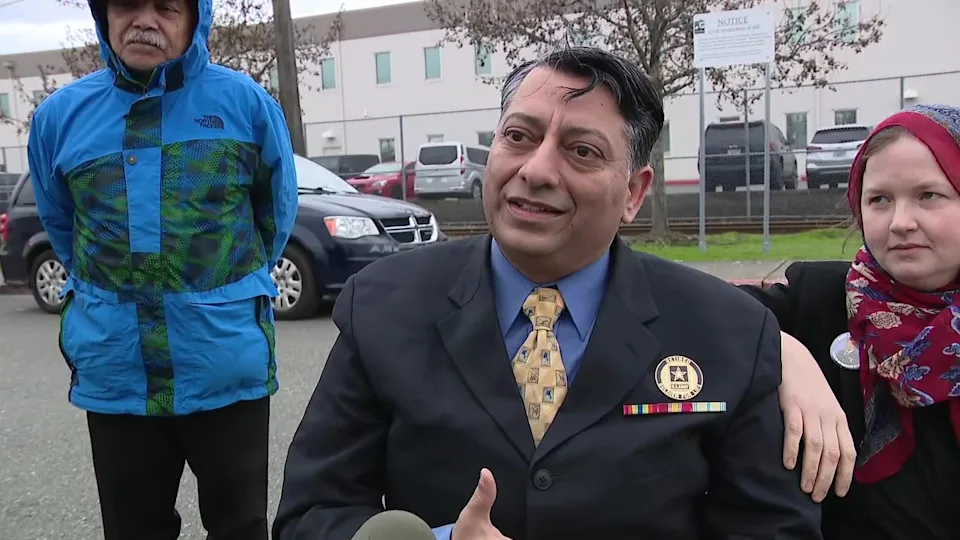
Muhammad Zahid Chaudhry wheeled himself out of the Northwest Detention Center in Tacoma Monday afternoon, a free man after four months and two days behind bars.
His wife Melissa was waiting outside, exactly where she’d been fighting to bring him home since immigration officials took him into custody on August 21.
“Our family gets to be whole again,” Melissa said, her voice breaking. “And the very first sentence out of the government attorney’s mouth was an apology. She said, ‘We apologize to the petitioner and we apologize to the court.'”
That apology came during a hearing before U.S. District Court Judge David Estudillo, who ordered Chaudhry’s immediate release from the detention facility where he’d been held since summer.
Chaudhry, a disabled Army veteran who uses a wheelchair due to injuries sustained on active duty, never expected to spend four months in immigration detention.
“I am a patriotic American soldier. I thought that it would never happen, that this kind of erroneous thing, that four months, two days in this kind of detention, would never happen, should never happen to any disabled decorated American veteran,” Chaudhry said.
The circumstances of his detention read like a bureaucratic nightmare. Chaudhry, a green card holder, went to the USCIS office in Tukwila on August 21 for his citizenship interview. He was trying to become a U.S. citizen, to formalize his status in the country he’d served in uniform.
Instead, immigration officials arrested him at the appointment and sent him to the Northwest Detention Center, where he remained separated from his wife and two young children for the next four months.
The Department of Homeland Security claimed Chaudhry hid his criminal history from the U.S. government and falsely claimed he was deployed to Iraq during his military service.
Melissa Chaudhry called those allegations a smear campaign against her husband.
“He has no criminal record in America,” she said. “He uses a wheelchair because he was injured on active duty. He has also served as a firefighter and a paramedic, and he’s served his community every way he can since.”
The details of what criminal history DHS referenced or what evidence they had about the Iraq deployment claim haven’t been made public. But the government attorney’s apology in court suggests officials came to recognize the detention couldn’t be justified.
Federal attorneys don’t apologize to defendants and judges unless something went seriously wrong. An apology in open court represents an acknowledgment of error significant enough to warrant that public statement.
Chaudhry’s reference to being “witch-hunted and prosecuted for that for 26 years” suggests a longer history with immigration authorities, though the specifics of those earlier encounters remain unclear.
“It’s a good day for justice in America when an honorable and decorated disabled American veteran stands to protect innocent Americans, and he’s been witch-hunted and prosecuted for that for 26 years,” Chaudhry said.
What is clear is that a man who served in the Army, sustained injuries that put him in a wheelchair, and then continued serving his community as a firefighter and paramedic spent August through December in an immigration detention facility.
His children started the school year without their father. Halloween, Thanksgiving, and the run-up to Christmas all happened while dad was locked up in Tacoma, unable to come home.
The Northwest Detention Center, operated by the private prison company GEO Group under contract with ICE, houses hundreds of immigrants awaiting deportation proceedings or resolution of their cases. It’s not designed as a long-term care facility for people with disabilities requiring wheelchairs.
The first thing Chaudhry wants to do now that he’s free is simple and profound: “Spend time with my two kids and my wife.”
Imraan Siddiqi, Executive Director of the Washington State Chapter of the Council on American-Islamic Relations, praised Judge Estudillo’s decision while acknowledging the release may not be permanent.
“In a time of grave injustice, today’s news provided much needed hope to our community,” Siddiqi said. “We applaud the court’s decision, and hope that this is only the first step in ensuring Zahid is freed permanently.”
That caveat matters. Judge Estudillo ordered Chaudhry released from detention, but the underlying immigration case may continue. Release from custody doesn’t necessarily mean the end of deportation proceedings or guarantee of citizenship.
Chaudhry walked into a government office in August seeking to formalize his American citizenship. He walked out in December, four months older, after a federal judge had to intervene to free him.
Whether the government will continue pursuing whatever case they had against him, or whether the apology in court signals they’re dropping the matter entirely, remains to be seen.
For now, he’s home with his family, finally able to spend time with the two kids who needed their dad.