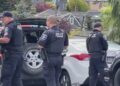
A tragic accident occurred on Carnation-Duvall Road Northeast and Fay Road Northeast (SR 203) on Saturday, where a tree fell onto a vehicle, killing one person and leaving another seriously injured, according to investigators.
The falling tree triggered a two-vehicle crash that shut down both directions of Carnation-Duvall Road for more than three hours, according to the Washington State Patrol.
Troopers report that a Subaru Forester was traveling southbound just north of Fay Road Northeast when a tree fell onto it, shattering on impact and scattering debris across the roadway.
The Subaru, after being struck by the falling tree, continued forward and came to rest against a guardrail, blocking the southbound lane, according to WSP.
Eastside Fire & Rescue crews responded to the scene of the single-vehicle collision around 2:30 p.m.
“We were able to remove the doors, using the Jaws [of life], removed the drivers door, and make access. There was also a roof rack on top of the car, so we weren’t able to get into the top,” explained Battalion Chief Seth Merritt.
Inside the SUV, they found a 44-year-old woman from Duvall had died due to the impact. She was not wearing a seatbelt, according to WSP.
The driver of the Subaru, a 49-year-old man from Skykomish, suffered life-threatening injuries and was rushed to nearby Stillwater Elementary School, a location Merritt explained has been designated as a helicopter landing site.
“Airlift came in picked him up able to take him to Harborview, it solves the problem out in these rural areas, there’s no quick way to get from Highway 203 to Harborview,” he said.
At the same moment, a truck traveling on the northbound lanes with four people on board, including the driver, struck the debris and came to rest blocking the highway’s northbound lane, investigators said.
“At least one other vehicle was up on top of a large section of tree, that was stuck and not able to move,” Merritt explained.
Everyone in the truck, two adults and two children from Woodway, survived the crash and were unharmed, according to WSP.
Despite windy conditions in western Washington during recent days, Merritt says there were no strong gusts in that area at the time of the accident. Instead, he attributes the tree fall to rainfall the valley experienced during the past week.
“What we do see, is that as the ground gets saturated, the amount of moisture that we get, these trees get weakened, their roots systems get weakened, and they come over. It could be with no wind,” he said.
The incident highlights dangers posed by saturated soil conditions following heavy rainfall. Trees with compromised root systems can fall without warning even in calm weather, creating sudden hazards for motorists on rural highways.
The three-hour road closure affected traffic flow on a major route connecting communities in the Snoqualmie Valley. Carnation-Duvall Road serves as an important corridor for residents commuting between rural areas and more populated regions.
The use of Stillwater Elementary School as a helicopter landing zone demonstrates emergency response planning for rural areas where ground transport to major medical facilities takes considerable time. The airlift to Harborview Medical Center provided critical care access that would have been delayed by ambulance transport.
The seatbelt factor in the fatality underscores ongoing safety concerns about restraint use. While the tree impact caused the collision, the absence of a seatbelt likely contributed to the severity of injuries sustained by the passenger.
The Jaws of Life extraction demonstrates the complexity of the rescue operation. The roof rack prevented top access, forcing firefighters to work through the doors to reach trapped occupants.
The truck’s collision with debris illustrates how falling tree incidents can create secondary crashes. The initial tree fall scattered material across both lanes, creating obstacles for oncoming traffic in the opposite direction.
The fact that the truck occupants, including two children, emerged unharmed despite striking debris represents fortunate circumstances given the severity of the primary collision. Their survival contrasts sharply with the fatal outcome in the Subaru.
The recent rainfall saturation explanation aligns with typical Pacific Northwest winter conditions. Western Washington experiences prolonged wet periods that saturate soil, reducing the anchoring capacity of tree root systems.
The timing on a Saturday afternoon suggests the roadway likely carried recreational traffic in addition to local commuters. The Snoqualmie Valley attracts outdoor enthusiasts heading to hiking trails, ski areas, and rural destinations.
Emergency responders’ familiarity with the helicopter landing protocol indicates established procedures for rural medical emergencies. The designation of school grounds for this purpose provides open space suitable for helicopter operations.
The driver’s life-threatening injuries required immediate advanced trauma care available at Harborview Medical Center, a Level I trauma facility serving the region. The severity suggests major blunt force trauma from the tree impact.