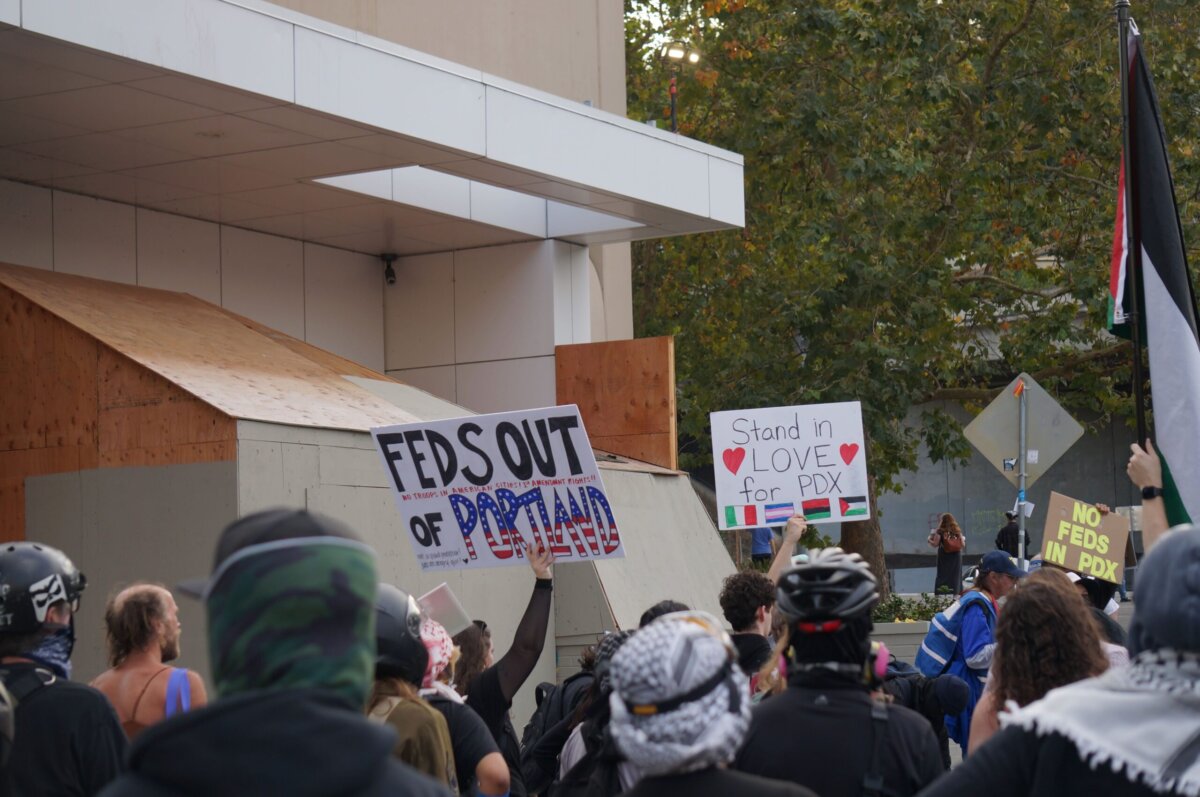
A federal judge Wednesday temporarily blocked the Trump administration from enforcing a regulation that criminalizes “creating a loud or unusual noise” near federal buildings in Oregon, delivering a victory to protesters demonstrating outside immigration detention facilities.
The ruling came after federal agents three times in November arrested or threatened to arrest two protesters on a sidewalk outside an Immigration and Customs Enforcement detention facility in Eugene, Oregon, citing new regulations that expand government authority to arrest people near federal property.
The law previously prohibited “creating a loud or unusual noise, noxious odor or other nuisance” while on federal property. Last month, the noise prohibition was expanded to include “areas outside federal property that affects, threatens or endangers federal property or persons on federal property.”
The two protesters, Chloe Longworth and Anna Lardner, filed a lawsuit challenging their treatment by federal agents. On two occasions, they were using a megaphone while protesting outside the facility. On another occasion, a federal officer threatened to arrest Longworth simply for “yelling.”
Judge Ann Aiken of the U.S. District Court in Oregon ruled that the plaintiffs had “raised serious questions” about whether the rule was unconstitutionally vague and overly broad, and whether federal agents had violated their constitutional right to freedom of speech in a manner that created a chilling effect on their regular protest activities.
In a 10-page ruling, Aiken issued a temporary injunction blocking the Trump administration from enforcing the expanded rule near the ICE detention facility in Oregon while legal arguments over the case proceed.
The decision represents the latest instance of a federal judge expressing concern that Trump administration actions may violate free speech protections, even as the administration claims many of its policies aim to “restore freedom of speech” and end censorship.
In October, a separate case emerged when a Washington, D.C., resident sued over his arrest after playing the “Imperial March” theme from “Star Wars” while protesting National Guard troop deployment in the city. Like the Eugene case, that plaintiff accused officials of wrongful arrest violating constitutional rights.
The expanded regulation’s language creates significant constitutional concerns. The phrase prohibiting noise that “affects, threatens or endangers” federal property or persons lacks clear definition, potentially enabling arbitrary enforcement based on subjective agent judgments rather than objective standards.
What constitutes noise that merely “affects” federal property remains undefined in the regulation. Does any audible sound affect a building? The vagueness leaves protesters uncertain about what conduct crosses legal boundaries.
The three November incidents targeting Longworth and Lardner demonstrate how the expanded rule enables agents to suppress traditional protest activities. Megaphones and raised voices have served as standard protest tools for generations, amplifying messages in outdoor settings where speakers address crowds or distant audiences.
The specific threat to arrest Longworth for “yelling” illustrates the regulation’s potential to criminalize core expressive conduct. Raising one’s voice at protests represents fundamental political speech, protected under the First Amendment absent true threats, incitement to imminent lawless action, or similar narrow exceptions.
Judge Aiken’s identification of “serious questions” about vagueness and overbreadth invokes well-established constitutional doctrine. The void-for-vagueness doctrine requires criminal laws to provide fair notice of prohibited conduct, preventing arbitrary enforcement. The overbreadth doctrine prohibits laws that sweep so broadly they chill substantial amounts of protected speech.
The chilling effect Aiken identified reflects documented reality: when government threatens or carries out arrests for speech activities, even if prosecutions ultimately fail, people self-censor to avoid criminal justice system entanglement. Protesters who witness arrests of fellow demonstrators for megaphone use or yelling may choose silence over risking similar treatment.
The temporary injunction provides immediate relief while the underlying constitutional challenge proceeds through litigation. Preliminary injunctions require plaintiffs to demonstrate both likelihood of success on the merits and irreparable harm absent court intervention. Aiken’s willingness to grant this relief suggests she finds the constitutional claims compelling.
The geographic scope of Aiken’s order limits its effect to the Eugene ICE facility. The regulation remains enforceable at other federal properties in Oregon and nationwide. However, the ruling may influence how federal agents approach enforcement elsewhere, particularly if they anticipate similar legal challenges.
The case will now proceed to full briefing and potentially trial on the constitutional questions. First Amendment challenges to government speech restrictions typically involve extensive analysis of Supreme Court precedents governing public forum doctrine, content-based versus content-neutral restrictions, and the boundaries of protected expression.
The tension between the administration’s rhetoric about “restoring freedom of speech” and simultaneously expanding authority to arrest people for noise near federal property has not escaped critics’ notice. Civil liberties advocates argue that criminalizing common protest methods contradicts claims about protecting expressive freedoms.
The Washington, D.C., “Imperial March” case presents similar constitutional issues in a different context. While playing menacing movie music at National Guard troops might seem provocative, it represents political commentary through cultural reference, a form of symbolic speech courts have protected.
The Eugene ICE facility has served as a focal point for immigration enforcement protests since the facility began operations. Demonstrators regularly gather to oppose detention policies, creating ongoing tension between protest rights and government claims about protecting federal property and personnel.
Longworth and Lardner’s pattern of repeated protests before facing arrest shows they engaged in sustained activism rather than one-time demonstrations. Regular protesters face particular vulnerability under regulations enabling cumulative arrests for continuing the same protected activities.
The lawsuit challenges not just the regulation itself but its application to their specific conduct. Even if some noise restrictions near federal property might pass constitutional muster, the question remains whether megaphone use and yelling on public sidewalks can be criminalized.