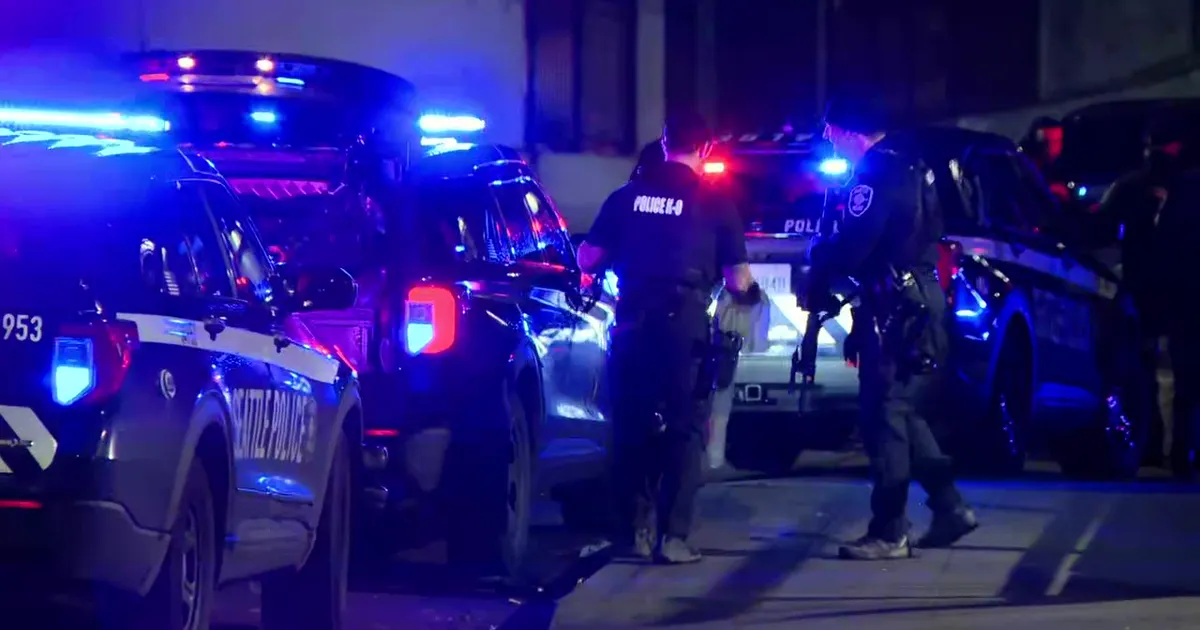
Two men were stabbed during a robbery early Wednesday morning in Freeway Park, the latest violent incident in a public space that has struggled with safety problems for decades despite its location between downtown Seattle and First Hill. At 6:30 a.m., dispatchers received reports of the attack in the park’s underpass near University Street and Hubbell Place, where officers found a 35-year-old man and a 38-year-old man with stab wounds. Both victims were transported to Harborview Medical Center with non-life-threatening injuries.
The mechanics of this incident reveal patterns that make Freeway Park particularly vulnerable to violent crime. The attack occurred in an underpass, one of several subterranean passages that define the park’s brutalist architecture. These concrete tunnels create isolated spaces where visibility is limited, foot traffic is sparse, and potential victims are separated from help by thick walls and multiple elevation changes. Witnesses told police three males wearing black clothing robbed the victims during the assault, then disappeared before officers arrived. A K9 Unit searched the area but did not locate the suspects.
That search failure isn’t surprising given Freeway Park’s design. The 5.2-acre park sits atop Interstate 5, connecting First Hill to downtown across eight lanes of freeway traffic. Its concrete maze of underpasses, stairways, and terraced levels creates dozens of potential escape routes and hiding spots. For suspects fleeing a crime scene, the park’s complexity provides natural cover. For police trying to secure the area, that same complexity makes containment nearly impossible without overwhelming force.
Freeway Park’s safety problems aren’t new. The space has been plagued by violent crime, drug activity, and reports of people experiencing homelessness camping in its hidden corners since it opened in 1976. Various city administrations have attempted interventions over the years, from increased police patrols to lighting improvements to community programming designed to activate the space with legitimate users. None have fundamentally solved the underlying issue: the park’s architecture creates environments where criminal activity can occur with low risk of detection or intervention.
The early morning timing of Wednesday’s attack, 6:30 a.m., is significant. This is when people experiencing homelessness are often still present in the park, having spent the night in sheltered areas. It’s also when early commuters begin cutting through the park to reach bus stops or workplaces. That overlap creates opportunities for robbery, particularly when victims are isolated individuals moving through empty underpasses rather than groups that might deter attack.
For Seattle residents who work in First Hill’s dense cluster of hospitals and medical facilities, Freeway Park represents a daily calculation. The park offers the most direct pedestrian route between downtown and major employers like Swedish Medical Center, Virginia Mason, and Harborview. But that convenience comes with risk, especially during early morning or evening hours when foot traffic is light. Many healthcare workers who finish late shifts or start early ones have developed alternative routes that avoid the park entirely, despite adding time and distance to their commutes.
The Robbery Unit is leading the investigation and working to determine what led to the stabbings, but the basic sequence appears straightforward: three people targeted two victims in an isolated location, used violence to facilitate robbery, and escaped through a park designed in ways that inadvertently favor criminals over law enforcement. What’s harder to determine is how to prevent the next similar incident.
Seattle’s approach to Freeway Park safety has historically oscillated between enforcement-focused interventions and social service-oriented approaches. Increased police presence can deter some criminal activity, but sustaining that presence requires resources and creates tensions with advocates who argue that over-policing public spaces criminalizes poverty and homelessness. Social service outreach aims to connect people in the park with housing and support, reducing the population engaging in survival crimes or creating unsafe conditions. But those services face capacity limits and can’t address robberies committed by people who don’t live in the park but target vulnerable individuals passing through.
The architectural reality compounds these challenges. Freeway Park was designed during a period when urban planners believed elevated parks over freeways could reconnect divided neighborhoods and create valuable public space from otherwise wasted infrastructure corridors. The concept was innovative, but the execution created a space that feels hostile to casual use. The concrete surfaces absorb little sound but amplify freeway noise from below. The multiple levels and dead-end passages disorient visitors unfamiliar with the layout. The limited sight lines prevent natural surveillance, the urban design principle that spaces feel safer when they’re visible to surrounding buildings and passing pedestrians.
Redesigning the park to address these fundamental issues would require massive investment and likely significant demolition of existing structures. Seattle’s Parks Department has limited capital budgets, and prioritizing Freeway Park over neighborhood parks with broader community use presents difficult political choices. Meanwhile, the park remains a known danger zone in the center of the city.
For the two victims stabbed Wednesday, the immediate concern is recovery from their injuries. But the incident raises broader questions about how Seattle manages public spaces that have become persistently unsafe. Freeway Park is city property, maintained with public funds, ostensibly available for all residents to use. In practice, many Seattle residents avoid it entirely, particularly women, people who work irregular hours, and anyone who has heard warnings about its dangers passed along through workplace conversations or neighborhood networks.
That effective privatization of public space, where personal safety concerns restrict access to certain populations, represents a failure of the park’s core purpose. A public space that much of the public avoids out of legitimate safety concerns isn’t truly public. It’s simply dangerous terrain that happens to be owned by the city.
The Seattle Police Department’s Violent Crimes Tip Line is seeking information at (206) 223-5000. But solving this particular robbery won’t solve Freeway Park’s underlying problems. Those require addressing the intersection of architecture, public safety resources, social service capacity, and fundamental questions about what makes urban spaces safe or dangerous. Until Seattle confronts those structural issues, incidents like Wednesday’s stabbing will continue occurring in a park that was supposed to bridge divided neighborhoods but instead created new divisions between those willing to risk using it and those who won’t.