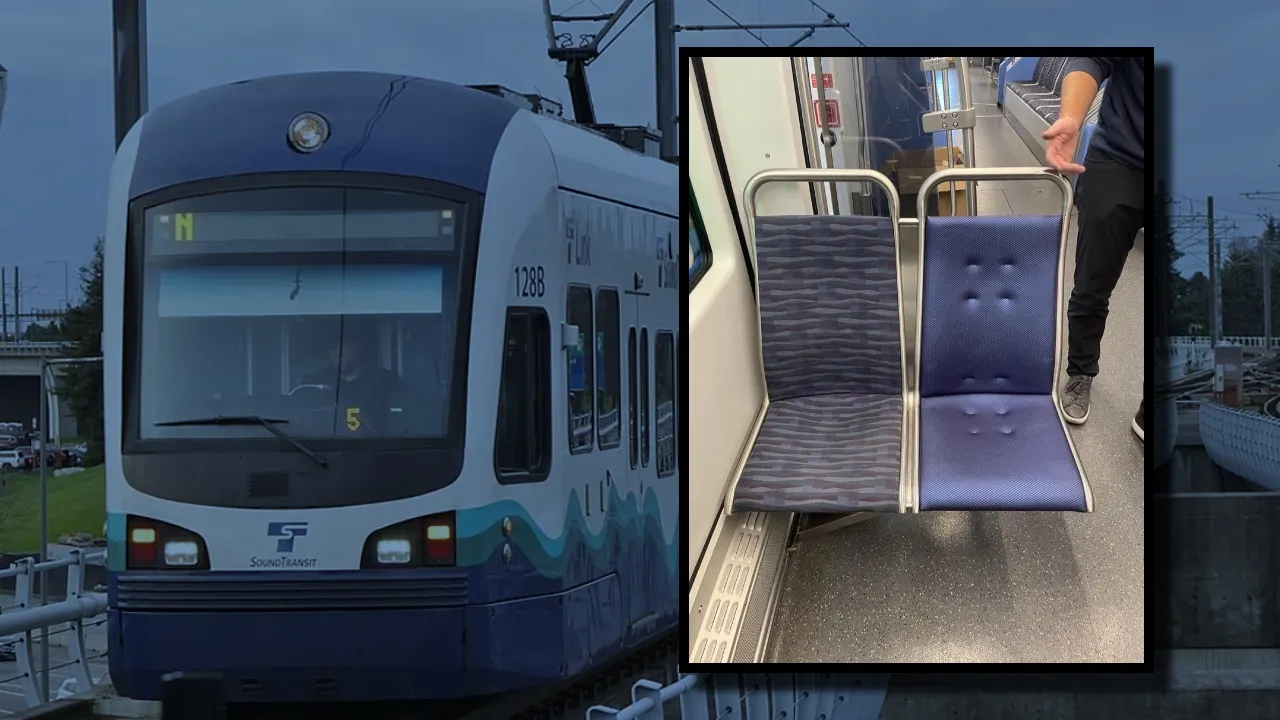
Sound Transit is replacing fabric seats on its Link light rail trains with vinyl after feedback from over 2,300 passengers indicated preference for the change expected to improve cleanliness. Vinyl seats require only disinfectant and cloth for cleaning, unlike fabric seats that need steam cleaning or replacement when heavily soiled, cutting labor time per vehicle by 12.5% according to Sound Transit. “The new seats are comfier, they’re cleaner, they’re easier to manage, and they’re also just gonna be more durable,” said Henry Bendon, a Sound Transit spokesperson. In a Fall 2023 survey, vinyl seats earned average satisfaction score of 4.06 out of 5 compared to 3.08 for cloth seats, with passengers supporting the change as more sanitary and allowing savings to be redirected to other system improvements. The transition comes as Sound Transit faces $30 billion construction budget shortfall due to increased inflation, interest rates, and tariffs.
The 12.5% reduction in labor time per vehicle represents significant operational savings when multiplied across Sound Transit’s entire light rail fleet. With dozens of trains requiring regular cleaning, cutting more than one-eighth of cleaning time per vehicle frees maintenance staff for other tasks or reduces overtime costs. That efficiency gain matters particularly as Sound Transit confronts massive budget challenges requiring cost reductions wherever possible without compromising service quality or safety.
The passenger feedback showing vinyl seats scoring 4.06 out of 5 compared to fabric’s 3.08 suggests riders strongly prefer the new material. That nearly one-point difference on five-point scale indicates substantial satisfaction gap, not marginal preference. Passengers apparently value cleanability and durability enough to prefer vinyl despite fabric seats traditionally being perceived as more comfortable and premium compared to vinyl or plastic seating common on buses and older transit systems.
Syndel Huerta, who rides weekly, captured the financial logic: “I think its great that it will save a lot of money because that can instead be used to maybe other repairs and continuously improve the light rail system.” That perspective reflects rider understanding that transit agencies operate with constrained budgets where savings in one area enable investments elsewhere. Whether saved cleaning costs actually translate to visible service improvements or simply reduce deficits depends on how Sound Transit allocates the savings amid its broader financial challenges.
Allen Applegate, a regular rider, emphasized sanitation: “If it helps them be more sanitary, then that’s great for everyone.” That comment reflects post-pandemic heightened awareness of cleanliness in shared public spaces. Passengers who previously might not have cared much about seat material now consider how easily surfaces can be disinfected, particularly on transit systems where thousands of people sit in the same seats daily and where visible stains or odors create perception of poor maintenance regardless of actual health risks.
The rollout over coming months means passengers will experience mixed fleets with some trains having vinyl and others retaining fabric during the transition period. Some trains already have new seats on the 2-line between Bellevue and Redmond, giving Eastside riders preview of what entire system will eventually feature. That gradual replacement makes sense operationally, allowing Sound Transit to retrofit trains during scheduled maintenance rather than taking entire fleet offline simultaneously for seat replacement.
The contrast between relatively minor seat replacement costs and the $30 billion construction budget shortfall illustrates the scale difference between operational efficiency improvements and major capital project challenges. As Bendon noted, “the cost for seat inserts and the long-term financial outlook of the agency are pretty different paradigms.” Saving thousands or even hundreds of thousands annually on cleaning costs doesn’t address tens of billions in capital funding gaps, but operational savings still matter for day-to-day budget management and demonstrating responsible stewardship of taxpayer funds.
Sound Transit’s financial situation, with revenues not matching expectations and project costs exceeding budgets due to inflation, rising interest rates, and tariffs, creates pressure to find savings wherever possible. The agency faces difficult decisions about which planned expansions to delay, whether to seek additional tax authority, how to restructure debt, and where to cut costs without degrading service quality riders depend on. Seat replacement represents the kind of operational improvement that saves money while potentially improving passenger experience, making it rare win-win during financially constrained period.
The fabric seat challenges Sound Transit cites, requiring steam cleaning or complete replacement when heavily soiled, reflect realities of transit operations where spills, vandalism, and general wear create maintenance burdens. Steam cleaning equipment and labor are expensive, and taking seats out of service for deep cleaning or replacement reduces available capacity during maintenance periods. Vinyl that wipes clean with disinfectant and cloth dramatically simplifies maintenance while allowing quicker turnaround for trains that need cleaning between service runs.
The survey methodology, gathering feedback from over 2,300 passengers, provided statistically significant sample allowing Sound Transit to make data-driven decision rather than relying on assumptions about passenger preferences. Transit agencies increasingly use surveys and pilot programs to test changes before system-wide implementation, learning from past examples where agencies made decisions that passengers disliked and that had to be reversed at additional cost.
The Fall 2023 survey timing suggests Sound Transit has been planning this transition for more than a year, conducting research, evaluating options, procuring materials, and developing implementation timeline. That careful approach contrasts with rushed decisions made under budget pressure without proper evaluation. The fact that passenger feedback supported the change provides political cover for decision that critics might otherwise characterize as cutting corners or cheapening the system.
The description of vinyl seats as “comfier” challenges traditional assumptions that fabric automatically provides more comfortable seating than vinyl or plastic. Modern vinyl materials have evolved significantly from the hard, sticky plastic seats common on older buses and trains. Contemporary vinyl can be padded, textured, and designed to avoid the discomfort and sweating associated with plastic seating in hot weather. Whether passengers actually find new seats more comfortable or whether Bendon’s characterization is optimistic marketing remains to be seen as more riders experience the change.
For Sound Transit’s maintenance crews, the switch to vinyl represents workflow simplification allowing them to clean trains faster and more thoroughly. Instead of deploying steam cleaning equipment and spending significant time on each seat, cleaners can quickly wipe down vinyl surfaces between runs or during brief station layovers. That efficiency means trains spend less time out of service for cleaning and more time available for passenger service, potentially allowing Sound Transit to improve frequency or extend service hours without adding vehicles.
The durability claim matters for long-term cost control. Fabric seats wear out faster than vinyl, developing rips, stains, and odors that require replacement even when underlying padding and structure remain sound. Vinyl seats should last longer before requiring replacement, reducing material costs and labor for installing new seats. Over decades and across entire fleet, durability improvements generate substantial savings even though per-seat replacement costs aren’t enormous.
The implicit contrast with earlier fabric seat selection raises questions about why Sound Transit initially chose fabric if vinyl performs better across multiple dimensions. Possible explanations include that fabric was standard for rail systems and seemed more premium when initial trains were procured, that vinyl technology has improved making current products superior to earlier options, that Sound Transit’s priorities have shifted toward emphasizing cleanliness and cost control over perceived luxury, or that operational experience revealed fabric maintenance challenges that weren’t fully appreciated during initial procurement.
For riders concerned about equity and service quality in lower-income communities compared to wealthier areas, the uniform switch to vinyl across the entire system avoids concerns that some lines receive premium amenities while others get budget options. Everyone gets the same vinyl seats regardless of whether they ride between Northgate and downtown Seattle or between Bellevue and Redmond. That consistency matters for transit agencies serving diverse populations where perceptions of unequal treatment based on neighborhood demographics create political problems.
The COVID-19 pandemic likely accelerated transit agencies’ focus on cleanability and disinfection, with passengers now expecting visible cleaning and materials that obviously can be sanitized. The ability to quickly wipe down vinyl seats with disinfectant and have them dry within minutes addresses passenger concerns about virus transmission and general hygiene in ways that fabric seats couldn’t match. Even as acute pandemic concerns fade, lasting changes in passenger expectations about cleanliness persist and influence transit design decisions.
The $30 billion shortfall context makes even modest savings meaningful as Sound Transit searches for ways to bridge funding gaps without drastically cutting service or abandoning expansion plans that communities have been promised. The agency faces scrutiny about cost overruns and project delays, making operational efficiency improvements like seat replacement important for demonstrating responsible management even as larger financial challenges require more substantial solutions.
The reference to increased inflation, interest rates, and tariffs as drivers of the budget shortfall connects to broader economic conditions affecting infrastructure projects nationwide. Construction costs have risen dramatically post-pandemic as supply chain disruptions, labor shortages, and materials price increases hit projects that were planned and budgeted years earlier based on pre-pandemic cost assumptions. Sound Transit’s challenges aren’t unique but rather exemplify how transit agencies nationwide are grappling with similar problems.
Whether vinyl seats actually deliver promised benefits depends on implementation quality and passenger response over time. If the new seats prove comfortable, stay cleaner, and hold up well with heavy use, the switch will be vindicated as smart decision that improved passenger experience while saving money. If vinyl seats turn out to be uncomfortable in hot weather, show wear more quickly than expected, or generate passenger complaints, Sound Transit might face criticism for prioritizing cost savings over rider comfort. The gradual rollout allows for course corrections if problems emerge before the entire fleet is converted.
For the immediate future, Link light rail passengers will increasingly encounter vinyl seats as Sound Transit retrofits its fleet over coming months. The change represents operational decision driven by passenger feedback, cost considerations, and maintenance efficiency rather than dramatic service transformation. But in aggregate with other operational improvements and cost controls, decisions like seat replacement contribute to Sound Transit’s ability to maintain and expand service despite severe budget constraints. Whether that’s enough to address the agency’s $30 billion shortfall is another question entirely, but every million saved through operational efficiencies is a million that can be directed toward construction, debt service, or service quality improvements that passengers value.