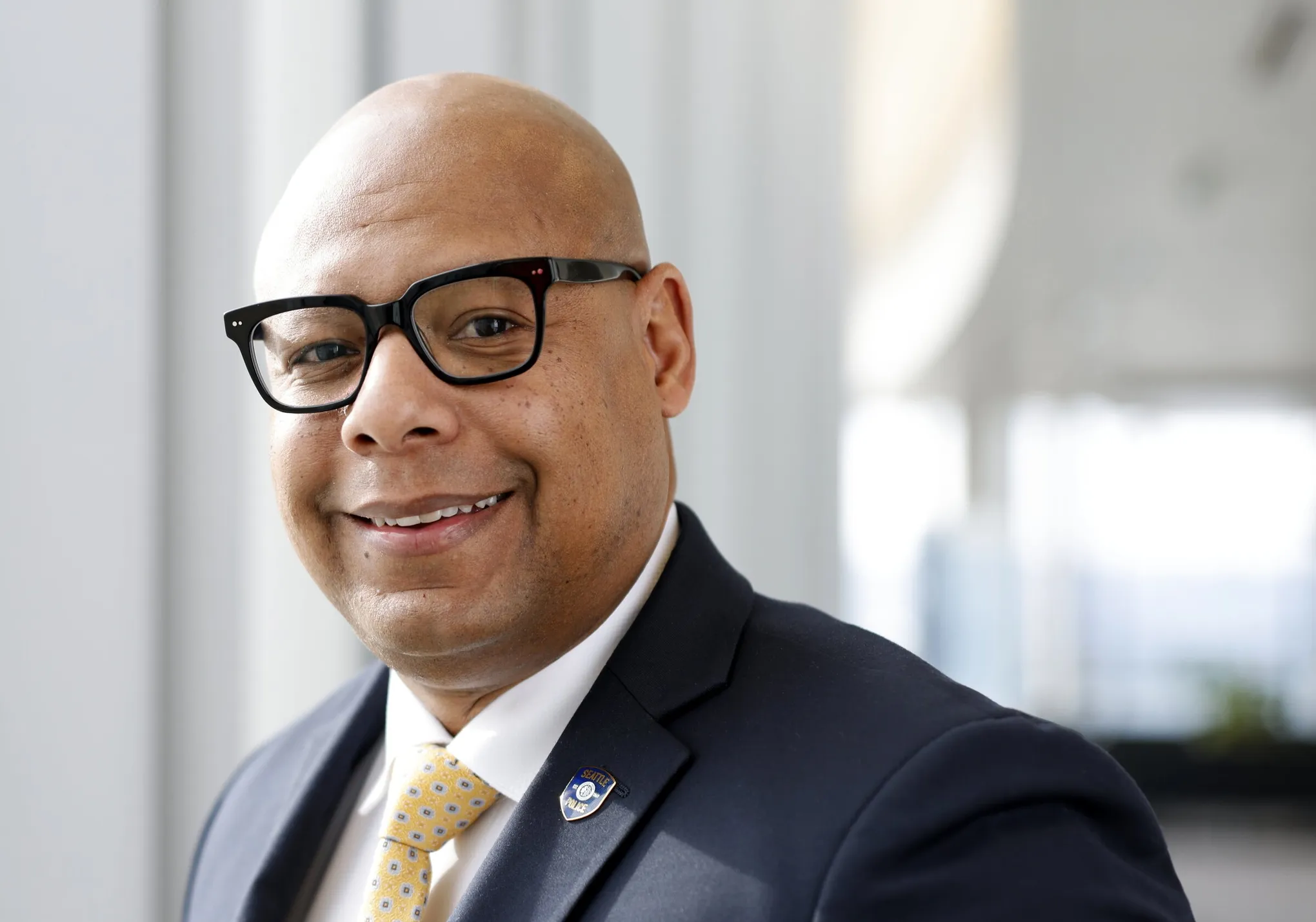
Seattle Mayor-elect Katie Wilson announced Wednesday she will retain Seattle Police Chief Shon Barnes, one day after declining to address his future with the department.
In a statement, Wilson articulated her vision for coordinated public safety leadership:
“I understand public safety as a shared responsibility, requiring police, fire, emergency management, alternative responders, service providers, community leaders, businesses, and residents to work together to get results. It is time to build a coordinated, modern system that reflects that shared responsibility and helps us address our most difficult challenges, including persistent neighborhood-based safety issues, gun violence, behavioral health, and substance abuse.
That’s why I am retaining Seattle Police Department Chief Shon Barnes, Seattle Fire Department Chief Harold Scoggins, Office of Emergency Management Director Curry Mayer, and CARE Chief Dr. Amy Barden. They are each committing to lead their departments in accordance with my vision of community safety.”
On Tuesday, Wilson had declined to discuss Barnes’ future or whether she had confidence in the chief, prompting immediate speculation about leadership changes at the police department.
Wilson’s statement continued:
“My administration will work with Chief Barnes to make SPD a place where professionalism, integrity, compassion, and community partnership are at the center of every action. We will strive for a workplace culture where employees are valued and empowered. Promotions will be rooted in performance, integrity, and good judgment, and every SPD employee will be encouraged to share concerns, experiences, and good-faith feedback with leadership. I am committed to retaining and recruiting officers who represent the diversity and values of Seattle, and to building trust between SPD and communities across the city.”
Barnes has been on the job for less than a year following the termination of Adrian Diaz by Seattle Mayor Bruce Harrell. Replacing Barnes would have represented a risk for Wilson so close to the upcoming World Cup with its multi-jurisdictional security requirements.
Barnes released a statement responding to the announcement:
“I’m extremely honored and grateful to continue in my role as Chief of Police for the Seattle Police Department and for the amazing community that I have come to care for here in Seattle.
Public safety is a shared value, and our priorities remain intact: crime prevention, community engagement, retention and recruitment of a qualified workforce, safety and wellness, and continuous improvement.
These priorities will guide the Seattle Police Department into 2026. They will also position us to become a national model for exceptional policing under the leadership of Mayor Wilson and her dedicated staff. Personally, I consider this a once-in-a-lifetime opportunity and one I do not take lightly or for granted.
I would like to thank the men and women of SPD and our entire community for our continued efforts to keep the city and the region safe.”
Downtown Seattle Association President Jon Scholes, who sits on Wilson’s transition team, also issued a statement commending the decision:
“We commend Mayor-elect Wilson’s decision to retain Chief Shon Barnes, an early and important decision to further strengthen public safety in Seattle. Under his leadership, violent crime in the downtown core has decreased, and the visible, on-the-ground presence of Seattle Police officers has increased. Chief Barnes arrived in Seattle with the department facing a serious deficit of officers and has since led steady progress in raising staffing levels. We look forward to continued progress in public safety guided by Chief Barnes.”
The 24-hour delay between Wilson’s non-committal Tuesday remarks and Wednesday’s announcement created uncertainty within SPD and the broader public safety community. Department morale can suffer when leadership’s future remains unclear.
Wilson’s decision to retain not just Barnes but also Chief Scoggins, Director Mayer, and Dr. Barden signals continuity across multiple public safety agencies rather than wholesale change. This coordinated approach aligns with her stated vision of shared responsibility.
The emphasis on professionalism, integrity, compassion, and community partnership establishes clear expectations for SPD culture under Wilson’s administration. These values represent areas where the department has faced criticism.
The reference to empowering employees and encouraging feedback suggests Wilson wants to address internal department issues. SPD has experienced challenges with officer morale, retention, and internal complaints processes.
The commitment to performance-based promotions rather than seniority-based advancement could represent a cultural shift within SPD. Merit-based promotion systems can improve organizational effectiveness but require careful implementation.
Wilson’s focus on recruiting officers who represent Seattle’s diversity acknowledges the department’s ongoing challenges achieving a workforce that reflects the city’s demographics. SPD has struggled to attract and retain officers from underrepresented communities.
Barnes’s less-than-one-year tenure means he has limited track record for Wilson to evaluate. His predecessor Diaz’s termination after controversies made Barnes’s appointment relatively recent.
The World Cup security requirements create practical constraints on leadership changes. Planning for major events requires continuity and established relationships with federal, state, and other local law enforcement agencies.
Scholes’s statement provides political cover for Wilson’s decision by highlighting crime reductions and increased officer presence downtown. Business community support for Barnes helps Wilson navigate progressive activists who may have preferred a different choice.
The downtown violent crime decrease Scholes cited represents tangible results Wilson can point to when defending the retention decision. Measurable improvements in public safety provide justification beyond avoiding World Cup disruption.