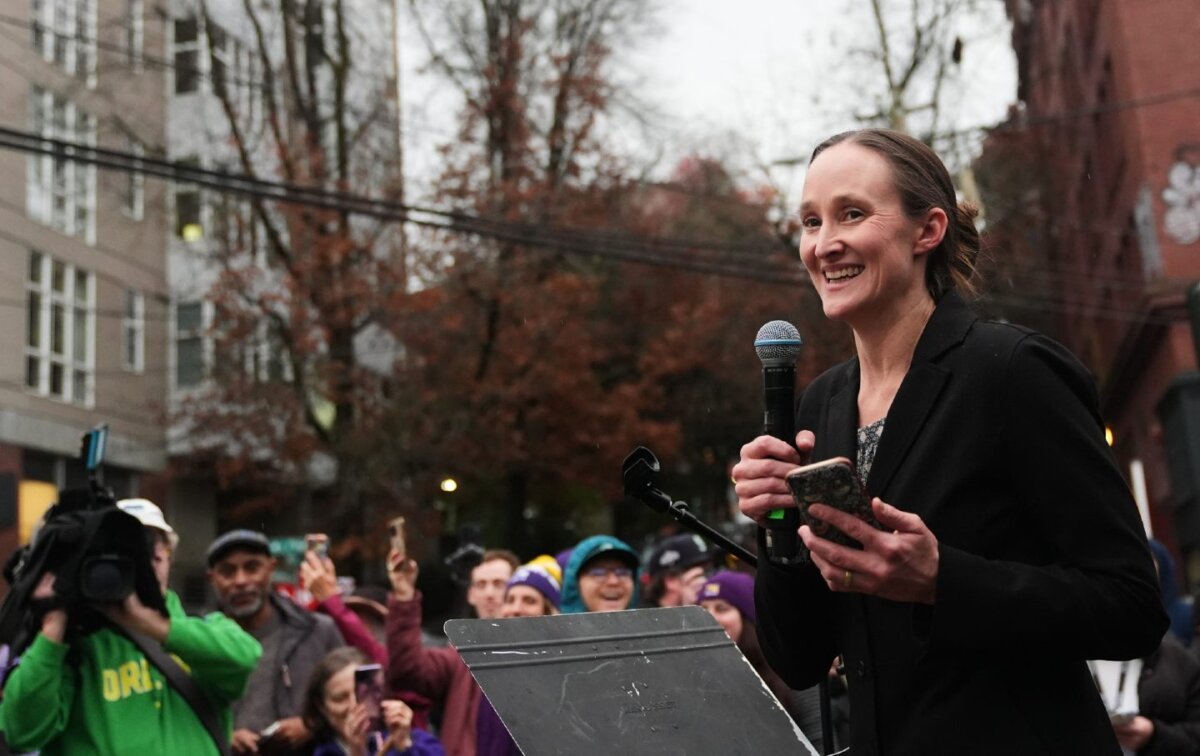
Seattle’s Mayor-elect Katie Wilson conducted her first transition team meeting Tuesday and indicated that personnel changes are forthcoming at Seattle City Hall, with some department heads facing replacement.
Leadership turnover during mayoral transitions represents standard practice in local government. New King County Executive Girmay Zahilay has already notified certain longtime employees they would not continue in his administration, following a similar pattern.
However, Wilson, addressing reporters following the meeting, declined to commit to retaining Seattle Police Chief Shon Barnes, whose position has become a subject of speculation.
“We’re going through a departmental review process right now where I’m meeting with every single department head, and we’re doing our due diligence to really try to understand how things are going in each department,” Wilson explained. “We’re going to be making some decisions coming up about department leadership. There are definitely department heads that will be retaining, there will probably be some changes.”
Wilson, who has moved away from earlier calls during her activist period to “defund the police,” faced direct questions about Barnes, who assumed SPD leadership earlier this year.
“We’ll be probably making some announcements soon on that front,” she responded when asked specifically about the chief.
Pressed for clarification about the timeline, Wilson replied: “That means you’ve got to wait.”
When asked directly whether she had confidence in Barnes, Wilson refused to elaborate on her assessment.
“I’m not going to be answering specific questions about departmental leadership right now,” she stated, maintaining her position throughout the exchange.
The mayor-elect also addressed questions about her selection of Brian Surratt as deputy mayor, an appointment that surprised some political observers given his background and previous associations.
Surratt previously worked at City Hall as Economic Development Director, where he negotiated the more than $1 billion agreement to construct Climate Pledge Arena. He subsequently departed for the private sector, building extensive business community relationships, most recently leading Greater Seattle Partners.
“Brian’s been around. He’s got a long history at the city, deep city experience, and also, obviously, has had a long career also in the private sector,” Wilson said. “Brian comes very, very highly recommended by many people across the political spectrum. Lots of people have worked with him over the years and have a huge amount of respect for his work and his approach. We had a few meetings and I’m thrilled that he’s on the team.”
Surratt, who previously supported outgoing Mayor Bruce Harrell, described his motivation for accepting the deputy mayor position.
“I’m a servant at heart, and I believe in government. I believe that government can do good things in many ways,” Surratt said. “She was tapping into, I think, a frustration, frankly, across the political spectrum, that when things aren’t working and we’ve got to figure out a better way to do this.”
Addressing perceptions of himself as a pro-business figure within City Hall, Surratt outlined his governing philosophy and approach to the deputy mayor role.
“We have so many parts of this community that want to see government work, the business community, which is not a monolith, and wants government to work too,” Surratt explained. “When Mayor-elect Wilson asked me to join, she really earnestly said, I need to build out a team that understands government, that understands the business community and other parts of this community.”
Surratt referenced his track record on progressive policies while defending his business relationships.
“When I reflect back on my career, I was the policy lead on $15 minimum wage right at that time. I was the business guy, but I understand fundamentally what it means to have a healthy, dynamic, robust economy, and in order to do some of the really important things that we want to do, we need to have the private sector as partners, and that’s what we’re going to do. That is not lip service. My role is not the business guy. My role is Deputy Mayor for this city.”
Wilson also explained her decision to appoint only one deputy mayor rather than multiple deputies as previous administrations, including Harrell’s, have done.
“I did not find one person who thought it was a good idea to have four deputy mayors,” Wilson said. “In fact, several people told me that the effectiveness of your Mayor’s office will probably be inversely proportional to the number of deputy mayors that you have. So we took that advice seriously.”
She elaborated on the organizational structure she envisions for her administration.
“We’re going for a model where the lines of communication and responsibility are very clear, so that we have a very clear process for decision making, and so the external stakeholders have a really clear idea of who they should be talking to make sure that their voice is heard.”
Wilson’s refusal to endorse Barnes creates significant uncertainty about the police chief’s tenure. Barnes assumed SPD leadership earlier this year following an extensive national search process that required substantial city investment in recruitment, vetting, and transition.
The departmental review Wilson described represents due diligence any incoming mayor conducts, assessing whether existing leadership aligns with new administration priorities and approaches. However, her specific avoidance of commenting on Barnes stands out given his recent appointment.