
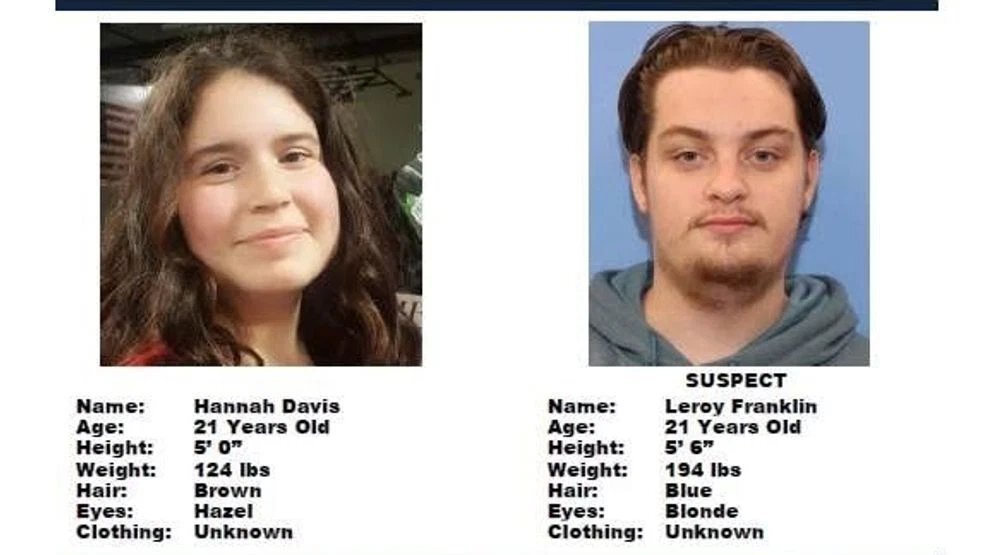
A missing autistic woman has been found safe, and Kitsap County Sheriff’s Office has arrested the transient sex offender believed to have lured her over the internet. The 21-year-old woman was last seen at her Bremerton home around 11 p.m. Saturday, January 17. The sheriff’s office said the victim is a dependent adult on the autism spectrum with the mental capacity of a 10-year-old who doesn’t know her own address, can’t navigate home, and doesn’t know how to use public transportation.
She was believed to be with 21-year-old Leroy Franklin Nickols, a registered sex offender with a 2022 conviction for second-degree rape and two felony assault convictions in 2024 and 2025. Authorities suspected Nickols lured the victim away after communicating with her online for about a month and had attempted to meet her at least once before at a local mall. Family members told law enforcement that Nickols was aware of the victim’s dependent status but refused to disclose their whereabouts or ensure her safety.
The victim was found safe in the Olympia area shortly after 1 p.m. on January 19. Nickols has been arrested and is in custody, with authorities investigating the incident as a kidnapping.
The case demonstrates how registered sex offenders can exploit vulnerable adults through online platforms despite monitoring requirements designed to prevent such predation. The month-long online communication before the disappearance reveals grooming pattern where Nickols built trust before attempting physical contact. Whether Nickols complied with sex offender registration reporting his internet accounts, or whether he evaded those requirements using unregistered profiles, affects assessment of whether current monitoring systems adequately protect potential victims.
The victim’s family telling law enforcement that Nickols knew about her dependent status but refused to disclose their whereabouts creates aggravating factor showing deliberate exploitation rather than relationship between peers with equal capacity. Whether Nickols faces enhanced charges reflecting his knowledge of her vulnerability and his status as registered sex offender affects potential penalties. The kidnapping investigation suggests prosecutors view this as forcible abduction rather than voluntary departure, though the fact that she packed belongings complicates legal questions of consent when the victim has limited mental capacity.
Nickols being transient in Thurston and Lewis counties, using public transit, and last residing at an Olympia shelter demonstrates challenges of monitoring sex offenders who lack stable housing. Whether his transient status represents homelessness creating difficulty maintaining registration compliance, or deliberate evasion making him harder to track, affects how authorities supervise offenders. The safe recovery after roughly 36 hours prevents worst outcomes but doesn’t eliminate trauma or potential exploitation that may have occurred during that time.