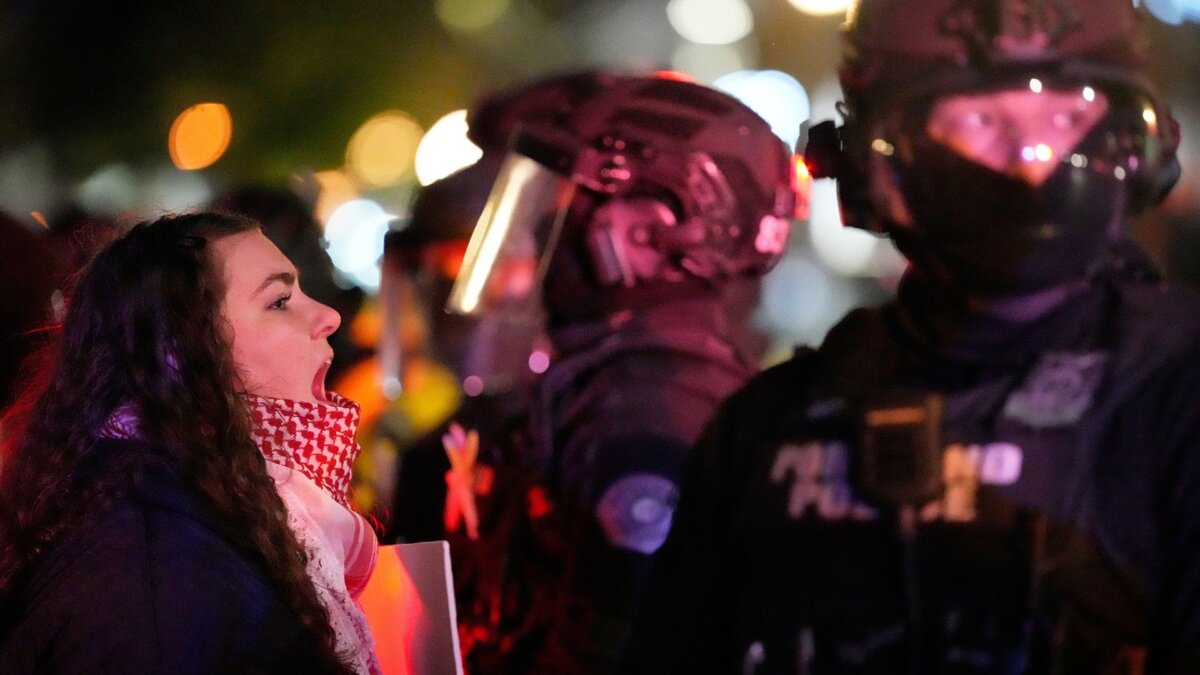
Protests erupted in Minneapolis, Houston, Cincinnati, Washington DC, Philadelphia, and other US cities for a second night following the killing of 37-year-old Renee Nicole Good, who was shot by an ICE agent in Minneapolis on Wednesday. The geographic spread of demonstrations, from Texas to Pennsylvania to the nation’s capital, indicates that Good’s death has become a rallying point for opposition to Trump administration immigration enforcement that extends far beyond the single incident or the single city where it occurred. When protesters in multiple states take to the streets over a killing in Minnesota, they’re responding not just to Good’s death but to a pattern of federal enforcement they view as dangerous and unaccountable.
People laid flowers where Good’s car crashed after the shooting, just blocks from where George Floyd was killed in 2020. That proximity is symbolically powerful and practically significant. The same Minneapolis neighborhood that experienced national protests and weeks of unrest following Floyd’s murder by police is now the site of another killing by federal agents, creating geographic continuity between two incidents that activists frame as related manifestations of state violence. The comparison isn’t accidental. Protesters are explicitly connecting ICE’s killing of Good to police killings that sparked the 2020 protests, framing both as abuses of government power against vulnerable people.
Meanwhile, the second shooting involving federal agents occurred in Portland on Thursday afternoon, where Customs and Border Protection agents shot and wounded two people during what the Department of Homeland Security characterized as a traffic stop of a Venezuelan gang member who “attempted to run over” agents. Portland’s Democratic mayor cast doubt on that account, and protesters gathered Thursday night at the city’s ICE facility, resulting in six arrests. The Portland shooting, occurring less than 48 hours after the Minneapolis killing, creates a pattern that sanctuary cities interpret as federal enforcement spinning out of control.
The investigation into Good’s killing has become a jurisdictional battle that reveals how federal and state authorities are working at cross purposes. Minnesota’s Bureau of Criminal Apprehension says the FBI initially agreed to a joint investigation with state officials, then reversed course and denied the state access to materials and evidence. Without that access, BCA Superintendent Drew Evans said the state has “reluctantly withdrawn” from the investigation. Governor Tim Walz accused the Trump administration of blocking state involvement, while Vice President JD Vance said the investigation is a federal issue.
That exclusion of state authorities from investigating a killing that occurred on state soil, by federal agents operating in a state jurisdiction, represents an extraordinary assertion of federal control. Typically, when law enforcement officers kill civilians, state or local agencies investigate whether criminal charges are warranted. By blocking state involvement, federal authorities are ensuring that only federal investigators, answerable to the Trump administration, determine whether the ICE agent who killed Good faces any consequences.
Edward Maguire, a criminology professor at Arizona State University, framed the jurisdictional dispute as political rather than legal: “From a criminological perspective, jurisdictional claims in cases like this are often less about legal requirements and more about political efforts to control the investigation and shape its outcome.” That assessment suggests federal authorities are excluding state investigators specifically to control what conclusions the investigation reaches and what information becomes public.
However, Bryna Godar, a staff attorney with the State Democracy Research Initiative at the University of Wisconsin Law School, noted that the state could still file criminal charges later against the federal officer who killed Good. That possibility keeps open the option of state prosecution even if federal investigators decline to pursue charges, though it would require state prosecutors to build a case without access to the evidence federal authorities collected immediately after the shooting.
Videos of the incident show ICE agents approaching Good’s car, which was in the middle of the street, and telling her to get out. One agent tugs at the driver’s side door handle. As the vehicle attempts to drive away, one agent at the front of the car points their gun at the driver and several shots are heard. The car continues driving and crashes into the side of the street. That video evidence is what local officials point to when they dispute federal claims about what happened.
Homeland Security Secretary Kristi Noem claims the ICE agent shot Good multiple times because she was trying to run over the officer. But Minneapolis Mayor Jacob Frey called that a false narrative, saying it was clear Good was trying to leave the scene, not attack an agent. The disagreement hinges on interpretation of the same video. Federal authorities see a driver weaponizing her vehicle against agents. Local officials see a terrified woman trying to escape a threatening situation. Both sides point to the video as evidence supporting their interpretation.
The fact that blood from the shooting could still be seen in the snow days later, that people set up vigils with candles and roses, that hundreds showed up throughout Thursday offering neighbors coffee while shouting insults at ICE, creates a physical memorial space that keeps the incident present in the community. This is the same neighborhood where George Floyd’s death sparked the construction of George Floyd Square, a community-controlled memorial and protest site. The proximity of Good’s killing to that location means the community has recent experience transforming sites of state violence into spaces of resistance and remembrance.
Good’s mother, Donna Ganger, told the Minnesota Star Tribune her daughter was “probably terrified” during the confrontation. “She was extremely compassionate. She’s taken care of people all her life. She was loving, forgiving and affectionate. She was an amazing human being.” Friends described Good as a poet and guitarist who had just moved to Minneapolis. Those personal details, the artistic pursuits and recent relocation and caring personality, humanize someone that federal authorities are characterizing as a threat who tried to weaponize a vehicle against law enforcement.
Nimco Ahmad, a Somali immigrant who grew up blocks from the incident, said “Renee was everything that was good about our community,” framing Good as representing community values rather than as an individual victim. That collective identification with Good, particularly from an immigrant expressing solidarity with a US citizen killed during immigration enforcement, reflects how the incident has united different constituencies in opposition to federal tactics.
The New York Times reports that 100 additional federal agents are being deployed to Minneapolis, which Mayor Frey characterized as the Trump administration using chaos as an opportunity to “occupy” the city. That framing, occupation by federal forces, describes immigration enforcement as hostile military action against an American city. Governor Walz activated the state’s National Guard to help with protest security, creating a situation where state and federal forces are both operating in Minneapolis but answering to different authorities with fundamentally opposed views of what’s happening.
Protests at a federal building in Minneapolis Thursday morning were met with armed officers but remained largely peaceful as residents expressed anger over Good’s killing. “They cannot get away with killing someone. There has to be consequences for actions,” said one protester named Gavin. That demand for accountability reflects the core issue protesters are raising: when federal agents kill civilians during enforcement operations, who determines whether the killing was justified and what consequences follow?
For Seattle, the implications are direct. If Minneapolis, a sanctuary city with Democratic leadership opposed to aggressive immigration enforcement, can experience an ICE killing followed by federal exclusion of state investigators and deployment of 100 additional federal agents, Seattle faces the same potential trajectory. The protests spreading to multiple cities indicate national networks prepared to mobilize when incidents occur in any sanctuary jurisdiction. Seattle already experienced demonstrations in solidarity with Minneapolis. If a similar shooting occurs here, the response would likely be immediate and significant.
The simultaneous Portland shooting, where CBP agents shot two people during a traffic stop federal authorities describe as involving a gang member trying to run over agents, creates a disturbing pattern. In both Minneapolis and Portland within 48 hours, federal immigration agents shot people in vehicles, and in both cases federal authorities claim the drivers tried to run over agents while local officials dispute those accounts. Either federal agents are repeatedly facing drivers who try to kill them with vehicles, or federal agents are using vehicle movement as justification for shootings that local officials view as unjustified.
The protests demanding ICE abolition, visible on placards at demonstrations in multiple cities, reflect how these incidents are radicalizing opposition to immigration enforcement. Protesters aren’t calling for reformed ICE policies or better training or independent investigations. They’re demanding the agency be eliminated entirely. That abolitionist framing, similar to “defund the police” demands that emerged from 2020 protests, indicates protesters view the problem as structural rather than about individual bad actors or specific policy failures.
Good’s killing has become a catalyst for confrontation between sanctuary cities and federal immigration enforcement that was building but hadn’t yet reached crisis point. The jurisdictional battle over who investigates, the deployment of additional federal agents, the activation of state National Guard, the protests spreading to multiple cities, and the second shooting in Portland all indicate this situation is escalating rather than resolving. Whether it continues escalating or whether federal and local authorities find ways to de-escalate depends on decisions both sides make in coming days, but the current trajectory is toward increased conflict.