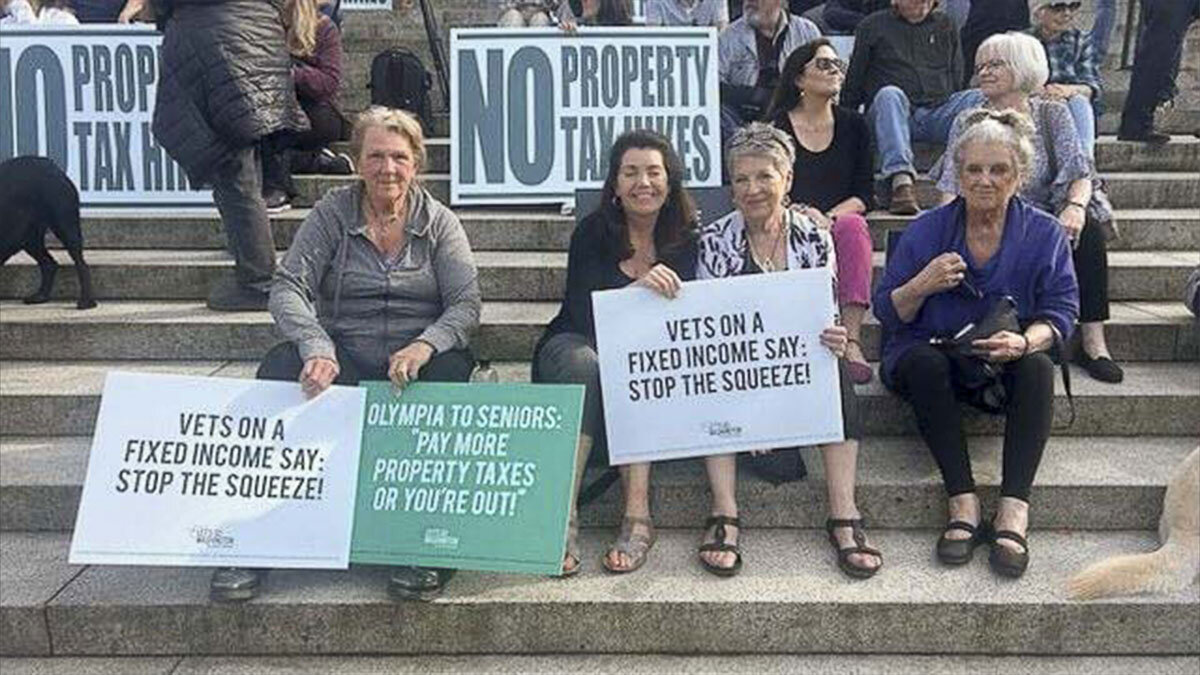
Bruce Martin saw a flyer online about a tax protest at the state capitol building in Olympia and decided Saturday was the day to show up.
“I wanted to support the people because we are overtaxed,” the Shelton resident said, standing amongst a crowd gathered outside the capitol to voice frustration about Washington’s tax burden.
Martin didn’t hold back when talking about lawmakers.
“Politicians get raises all the time, and they keep taxing us, but it’s not going to what we need. It’s very unfair, so I came to show my support,” he said.
The rally attracted people saying high taxes make it especially hard for individuals living on tight budgets or fixed incomes.
At one point during the gathering, a man grabbed the megaphone and told the crowd that he and his wife are planning to move to Florida, saying they’ve been “taxed out” of the state of Washington.
State Rep. Jim Walsh also attended and told reporters that the rally wasn’t tied to any political party.
“This event is not sponsored by any party; this is a grassroots gathering of people who are concerned taxes are too high, and fraud, and corruption in Washington state,” Walsh said.
He emphasised that the event wasn’t politically organised, but rather made up of everyday people voicing their frustration with what they see happening inside the Capitol dome.
The rally comes as Washington lawmakers prepare for the 2026 legislative session beginning January 12, where tax policy will feature prominently in budget debates.
Washington’s tax structure relies heavily on sales taxes and business taxes rather than income tax, creating what critics call a regressive system where lower-income people pay a higher percentage of their earnings than wealthy residents.
The state’s combined state and local sales tax rates rank amongst the highest in the nation, with Seattle’s rate reaching 10.35 per cent when city, county, and state levies combine.
Recent tax increases include the capital gains tax on investment profits over $250,000 approved in 2021, a new payroll tax funding long-term care insurance, and various local levies for transportation, education, and services.
The “taxed out” comment about moving to Florida reflects a broader migration pattern. Florida has no state income tax and relies on sales taxes, property taxes on non-homestead properties, and tourism revenue. However, Florida’s property insurance costs and hurricane risks create different financial burdens.
Martin’s complaint that tax revenue isn’t “going to what we need” echoes frustrations many taxpayers feel about seeing tax increases without corresponding improvements in roads, schools, or public safety.
Walsh characterising the rally as grassroots rather than party-organised distances it from traditional Republican anti-tax messaging, though Walsh himself chairs the Washington State Republican Party, creating some tension with his claim of non-partisan grassroots organisation.
The mention of “fraud and corruption” alongside high taxes suggests protesters believe mismanagement compounds the burden, not just the tax rates themselves.
The fixed-income concern Martin raised affects retirees and disabled people particularly hard. When sales taxes increase or property taxes rise, people on Social Security or disability payments see their purchasing power decline without corresponding income increases.