A Russian general died in a car bombing in Moscow Monday morning, marking the third military official killed in explosive attacks in the Russian capital over the past year.
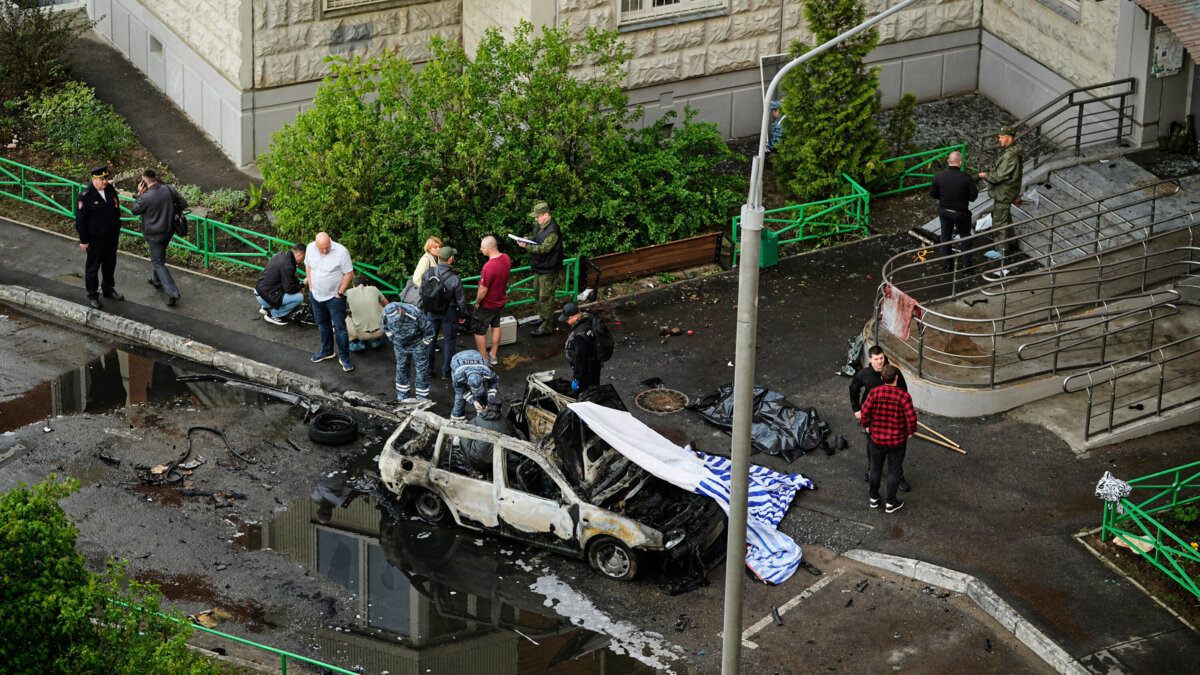
Russia’s Investigative Committee said Lieutenant General Fanil Sarvarov died after an explosive device planted under a car detonated in a parking lot near an apartment block in south Moscow.
Sarvarov, 56, served as head of the armed forces’ operational training department, the committee said.
Investigators stated they are exploring the theory that the bomb was planted with the involvement of Ukrainian intelligence services, though Ukraine has not commented on the attack.
Sarvarov died in hospital from his injuries, the committee said, adding it has opened an investigation into murder and illegal trafficking of explosives.
Investigators were dispatched to the scene in the parking area near a residential building in southern Moscow.
Images from the location show a badly damaged white Kia Sorento with the doors blown out, surrounded by other vehicles in the parking lot.
According to Russian media, Sarvarov previously participated in combat operations during the Ossetian-Ingush conflict and the Chechen wars in the 1990s and early 2000s. He also led military operations in Syria between 2015 and 2016.
President Vladimir Putin was informed of Sarvarov’s death immediately, Kremlin spokesman Dmitry Peskov said.
Since Russia launched its full-scale invasion of Ukraine in February 2022, a number of military officials and high-profile individuals have been targeted in the Russian capital.
Darya Dugina, the 29-year-old daughter of a prominent nationalist figure and Putin ally, was killed in a suspected car bombing in 2022.
General Yaroslav Moskalik was killed in a car bomb attack last April, while General Igor Kirillov died in December 2024 when a device hidden in a scooter was detonated remotely.
A Ukrainian source later indicated that Kirillov was killed by Ukraine’s security service, though this was never confirmed officially. As a matter of policy, Ukraine never officially admits or claims responsibility for targeted attacks inside Russia.
The pattern of assassinations targeting Russian military officials in Moscow demonstrates a sophisticated intelligence operation capable of identifying targets, tracking their movements, and placing explosive devices without detection by Russian security services.
The parking lot location near an apartment block suggests the bomb was placed either overnight or early morning when fewer people were present. Car bombs typically require time to install properly, making the bomber’s ability to work undetected notable.
The white Kia Sorento with doors blown out indicates a powerful explosive designed to ensure the target’s death. The surrounding vehicles suggest the blast radius could have injured or killed bystanders, though reports don’t mention other casualties.
Sarvarov’s background leading operations in Chechnya, Ossetia-Ingushetia, and Syria suggests a military career spanning multiple conflicts. His role heading operational training would have made him responsible for preparing Russian forces for combat.
The immediate notification of Putin demonstrates the seriousness with which the Kremlin views these attacks. The Russian president being informed immediately suggests either Sarvarov’s importance or the broader concern about security failures allowing repeated assassinations in the capital.
The theory about Ukrainian intelligence involvement represents Russia’s consistent narrative attributing attacks to Ukraine, though Ukrainian officials maintain their policy of never officially claiming such operations.
The three generals killed in a year, plus Dugina’s death, indicates either a coordinated campaign or multiple actors targeting Russian military and nationalist figures. The sophistication required for repeated successful attacks suggests state-level resources and intelligence.