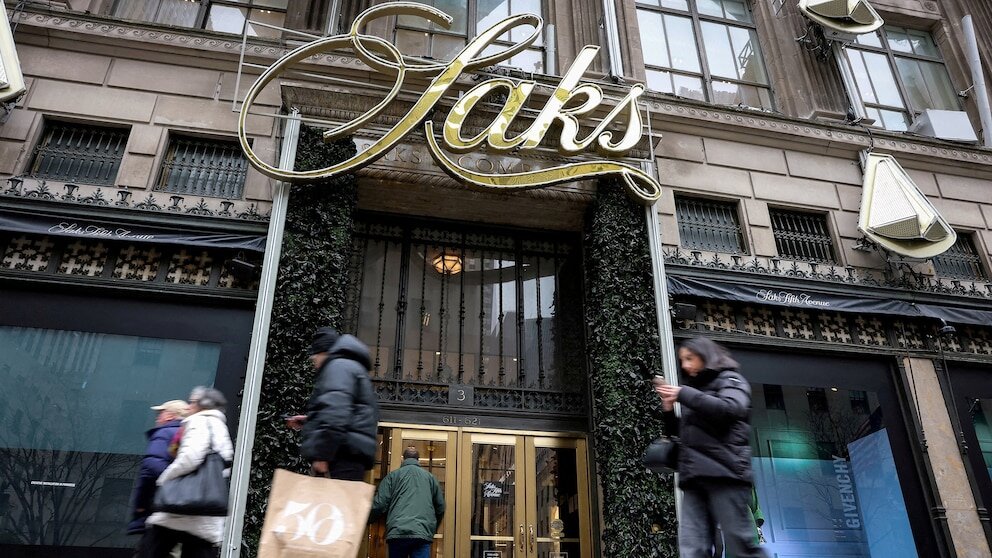
Saks Global, owner of Saks Fifth Avenue, Neiman Marcus, and Bergdorf Goodman, filed for bankruptcy protection Tuesday, crumbling under billions of dollars in debt, fraying vendor relationships, and lagging sales in the latest sign that America’s luxury department stores are becoming an endangered species. The 2024 acquisition of Neiman Marcus Group by Saks for $2.7 billion, intended to create the ultimate luxury department store group with unrivaled reach and power, instead proved what Moody’s Ratings called “a recipe for disaster” and “the fastest failure of an acquisition of this magnitude” the analyst had seen. The roughly $2 billion in debt used to fund the deal quickly proved unsustainable as revenue fell more than 13% in one quarter, vendors stopped shipping over payment delays, major brands including Chanel pulled out, and critical employees defected to competitors, leaving three of America’s oldest luxury department stores fighting for survival in a retail landscape irrevocably changed by e-commerce, direct-to-consumer brands, and shifting consumer behavior.
Former Neiman Marcus CEO Geoffroy van Raemdonck will return as Saks Global’s CEO, replacing Richard Baker who orchestrated the 2024 acquisition. Saks secured roughly $1.75 billion from bondholders to finance operations through bankruptcy and expects to emerge later this year while honoring customer programs, paying vendors, and continuing employee paychecks. Baker told The New York Times “I am proud of what we did, though sorry we unintentionally created pain for our partners in the process,” adding that once Saks Global emerges from bankruptcy “this will be a very successful company.” That optimism contrasts sharply with the financial reality that the acquisition’s success hinged on dramatically improving profitability while servicing massive debt, a combination that proved impossible as department stores lost their gatekeeper role between consumers and brands.
The department store landscape fundamentally changed over the prior decade. Once controlling access between U.S. consumers and luxury brands, large stores became simply one option among many as e-commerce growth during COVID altered shopping patterns, social media storefronts emerged, secondhand buying gained popularity, and luxury brands increasingly opened their own stores. “Now many of Saks and Neiman’s biggest suppliers are also their biggest competitors,” said Andrew Rosen, investor and adviser to brands including Frame Denim and Alice & Olivia. That transformation, where brands like Gucci, Louis Vuitton, and Chanel that once depended on department stores to reach customers now compete directly through their own retail channels and websites, eliminated the competitive moat that made department stores valuable.
The debt-financed acquisition timing couldn’t have been worse. Luxury goods came under pressure over the past year as U.S. shoppers managed households in an economy troubled by inflation, slowing job growth, and trade tensions. High-end consumers who might typically spend freely on designer goods became more cautious, particularly affecting luxury department stores whose business model depends on aspirational spending rather than necessity purchases. When Saks warned vendors in early 2025 that payments would be delayed or made in installments as sales continued sliding, it antagonized designer brands whose products drew customers to stores, creating vicious cycle where reduced inventory made stores less attractive while vendors withheld shipments over payment concerns.
Major fashion brands including Oscar de la Renta and Altuzarra stopped shipping to Saks worried about payment. In December, Hilldun, a firm that bought unpaid invoices from vendors, told them to halt shipments. Chanel, one of Saks’ most valuable brands, pulled out of seven department stores. Joseph Sarachek, managing partner of Sarachek Law Firm representing about 30 Saks vendors seeking payment, said most received compensation “dribbled in, in some way, but everybody is still owed money,” characterizing it as “a very rough situation.” That vendor crisis reflects how retail bankruptcies cascade beyond the company filing, affecting suppliers who extended credit for inventory that might not be paid for and who face difficult choices between continuing shipments hoping to eventually receive payment or cutting off supply and guaranteeing they won’t be paid.
Critical employees defected to competitors, with Catherine Bloom, a superstar Neiman Marcus personal shopper, and Yumi Shin, Bergdorf Goodman’s merchandising director, leaving for top jobs at Nordstrom. Saks sued to block Shin’s move claiming noncompete violation, though Shin asked courts to dismiss the lawsuit. Those departures of key talent who maintain relationships with high-net-worth customers and curate merchandise selections represent loss of institutional knowledge and customer connections that take years to develop. When personal shoppers who’ve worked with wealthy clients for decades leave for competitors, those clients often follow, eroding the customer base that department stores depend on.
For Seattle, the Saks bankruptcy affects the local retail landscape where Nordstrom, based in Seattle, remains the last major department store company not in bankruptcy or liquidation. Nordstrom has struggled with its own challenges, declining mall traffic and competition from online retailers, but avoided the leveraged acquisition strategy that doomed Saks. Whether Nordstrom can survive where Saks, Neiman Marcus, Bergdorf, Barneys, Lord & Taylor, Henri Bendel, and Bonwit Teller failed depends on whether it can adapt its business model faster than consumer behavior shifts away from department store shopping.
The history of these stores makes their potential demise particularly poignant. Saks Fifth Avenue was founded in 1924 as a jewel of American retail, with its neo-Renaissance flagship across from Rockefeller Center making its name by sending a silk top hat to President Calvin Coolidge and bringing bob haircuts to New York City. Bergdorf Goodman, founded in 1899 as a tailor, moved to its landmark Fifth Avenue home in 1928. Together they framed New York as the beating heart of gilded American consumption. Neiman Marcus served the same purpose for Dallas and wealthy Texans, exporting luxury to the rest of the country. As stores spread to malls coast to coast, they sold suburban America access to uptown Manhattan chic, with Saks’ flagship shoe floor granted vanity ZIP code 10022-SHOE.
That cultural significance, department stores as institutions representing aspiration and American prosperity, makes their decline about more than retail economics. These stores were immersive fantasy worlds where shopping wasn’t simply purchasing goods but experiencing curated environments that promised entry into glamorous lifestyles. The elaborate window displays, personal shopping services, restaurant dining, and brand exclusives created experiences that online shopping can’t replicate. But experience alone doesn’t sustain businesses when consumers can buy the same products cheaper and more conveniently online, when brands offer superior experiences in their own stores, and when secondhand luxury markets provide access to designer goods at fraction of retail prices.
Neiman Marcus previously filed for bankruptcy in 2020 during pandemic lockdowns, with executives saying the process would alleviate debt and allow restructuring. That earlier bankruptcy apparently didn’t solve underlying problems, given that four years later the company was acquired by Saks using debt that quickly proved unsustainable. The pattern suggests bankruptcy as process doesn’t fix business models that are fundamentally broken by structural changes in retail. Eliminating some debt through bankruptcy provides temporary relief but doesn’t address why customers are shopping elsewhere or why vendors are wary of extending credit.
Baker’s 2021 strategy of splitting Saks’ e-commerce operation into separate entity to attract investment for the more attractive online business, then reversing that in 2024 by reintegrating businesses when acquiring Neiman Marcus, reflects strategic confusion about whether department stores should be primarily physical or digital retailers. The back-and-forth created organizational disruption without solving fundamental problems. As part of the 2024 deal, Saks spun out Canadian retail and real estate business including Hudson’s Bay department store, which later filed for bankruptcy and liquidated assets, foreshadowing Saks Global’s own bankruptcy filing.
The cost-cutting measures that preceded bankruptcy, including canceling the annual holiday light show at Fifth Avenue store for first time in two decades, sent signals to customers and industry that Saks was struggling. Department stores depend on maintaining perceptions of luxury and success; visible cutbacks to iconic traditions undermine the fantasy and aspiration that justify premium pricing. When customers see a luxury retailer cutting costs, they question whether the store will continue existing and whether purchases will be supported with returns, alterations, and services that department stores traditionally provided.
The 10% revenue drop in fiscal 2024 compared to the previous year, on a pro forma basis combining Saks and Neiman Marcus, suggests the merger didn’t produce promised synergies of increased buying power and shared inventory. Instead of leverage over brands, Saks faced vendors refusing to ship and major brands pulling out entirely. Instead of better customer experience through shared loyalty programs, the company faced operational integration challenges while customers defected to competitors. The theory that combining Saks and Neiman would create unbeatable luxury department store group assumed that scale and breadth mattered more than profitability and financial stability, a miscalculation that ignored how debt service consumes cash flow that should fund operations and improvements.
Mickey Chadha, Moody’s Ratings vice president, characterized the acquisition as “recipe for disaster” and “the fastest failure of an acquisition of this magnitude” he’d seen, suggesting the problems were obvious to industry observers even if not to Saks leadership. That analysts could identify fatal flaws in the deal structure yet the acquisition proceeded anyway raises questions about whether Baker and executives were so committed to creating luxury retail empire that they ignored warning signs, or whether they believed they could execute strategy that would overcome structural challenges that ultimately proved insurmountable.
Van Raemdonck’s return as CEO after previously leading Neiman Marcus brings someone with department store experience but whose tenure at Neiman ended before bankruptcy in 2020, raising questions about whether he can successfully restructure an industry facing secular decline. His statement calling this “a defining moment for Saks Global” and seeing “meaningful opportunity to strengthen the foundation of our business and position it for the future” uses language typical of bankruptcy announcements but doesn’t articulate specific vision for how luxury department stores can compete in retail environment where they’ve lost their advantages.
Additional executives including Darcy Penick, former Bergdorf Goodman president, as president and chief commercial officer, bring institutional knowledge but face challenge of executing turnaround when underlying business model may be obsolete. Can department stores survive by becoming experiences rather than primarily retail channels? Can they differentiate enough from brands’ own stores to justify their existence? Can they build online businesses competitive with specialized e-tailers? These strategic questions don’t have obvious answers, which is why so many department stores have failed despite talented executives and storied histories.
For luxury brands, Saks bankruptcy creates decisions about whether to continue wholesale partnerships with department stores or focus resources on owned retail and e-commerce. Brands like Chanel pulling out of stores suggest some luxury houses view department stores as dilutive to brand value rather than valuable distribution. If premium brands increasingly view department stores as inferior channel compared to their own stores, the stores lose access to products that attract customers, accelerating decline. The financial risk of extending credit to troubled retailers makes vendors cautious even if they want to maintain wholesale relationships, creating inventory problems that make stores less attractive to shoppers.
The $1.75 billion in financing secured from bondholders provides runway to restructure but doesn’t guarantee successful emergence from bankruptcy. Financing allows company to continue operations while developing reorganization plan, but that plan must address fundamental questions about whether luxury department stores have viable future or whether they’re industry in terminal decline. Bondholders providing financing likely have significant influence over restructuring strategy and expect their investment to be protected through asset sales, operational changes, or eventual sale of company.
The expectation that Saks will honor customer programs, pay vendors, and continue employee paychecks during bankruptcy provides some stability but doesn’t eliminate uncertainty. Customers worry whether gift cards will be honored, whether returns will be accepted, whether loyalty program benefits will continue. Vendors worry whether they’ll be paid for goods already shipped. Employees worry whether their jobs are secure. That uncertainty affects behavior in ways that can become self-fulfilling prophecies, with customers shopping elsewhere, vendors refusing shipments, and top employees leaving for stable employers.
Whether Saks Global successfully emerges from bankruptcy later this year or whether bankruptcy becomes prelude to liquidation depends on execution of restructuring plan and broader retail environment. If luxury spending rebounds as economy improves and inflation moderates, restructured Saks with reduced debt might survive. If retail continues shifting toward e-commerce and direct-to-consumer, even debt-free Saks might struggle to attract customers and vendors. The bankruptcy filing represents potential turning point where company either adapts to changed retail landscape or joins the list of storied department stores that couldn’t survive transformation of how Americans shop for luxury goods.