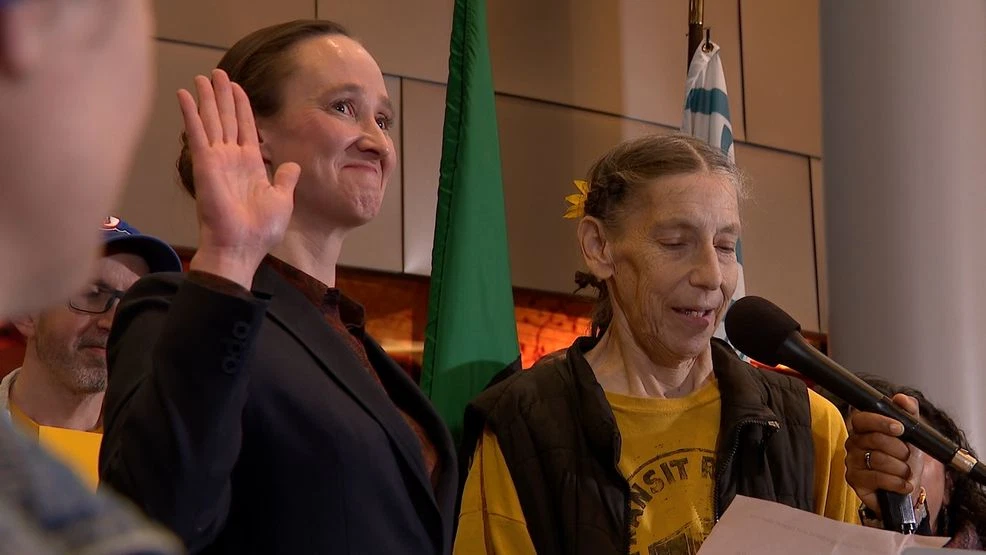
Katie Wilson sat in a seventh-floor City Hall office where workers had just finished shampooing the carpets and scrubbing the walls, discussing her first week as Seattle’s mayor and the challenges that await.
“I think we’ve done what I promised to do right, which is to build a team that has that combination of deep experience at City Hall and also bringing in some fresh faces, new ideas,” Wilson said Wednesday.
The new mayor is assembling her team whilst focusing on homelessness, public safety, and small business survival in her first 100 days. She’s also navigating relationships with Amazon and said she’s open to meeting with President Trump if invited.
Wilson acknowledged hiring progressive voices including longtime criminal justice reform activist Lisa Daugaard as interim homelessness adviser, along with Jon Grant of the Low Income Housing Institute and Alison Holcomb of the ACLU as senior policy advisers on homelessness.
“I think their experience is very valuable, and I think especially when we look at homelessness and public safety. These are issues, and specifically homelessness and unsheltered homelessness, where progress has really eluded the city for a very long time,” she said.
Wilson pointed back nearly a decade to illustrate the scope of the problem.
“I remember back in 2015 when we first declared a state of civil emergency on the homelessness crisis, and our unsheltered homelessness crisis has just gotten worse and worse, and public safety, there are some overlapping issues,” she said.
The admission that Seattle’s visible homelessness has worsened over nine years despite declaring an emergency represents candid acknowledgement that previous approaches haven’t worked. The city has spent hundreds of millions on services and shelter since 2015, yet encampments remain visible throughout Seattle.
Wilson’s choice of advisers signals her approach. Daugaard founded LEAD, Law Enforcement Assisted Diversion, which diverts low-level offenders to social services rather than jail. Grant and Holcomb come from organisations that prioritise housing and civil liberties over enforcement.
The mayor reiterated that she’s not asking for changes in drug possession laws, addressing controversy around her city attorney’s emphasis on treatment over prosecution for public drug use. Critics argue this approach enables open-air drug markets, whilst supporters say incarceration doesn’t address addiction.
Wilson also acknowledged the Seattle Police Department remains understaffed, a challenge that has plagued the city for years as departures outpace hiring despite signing bonuses and recruitment efforts.
When asked about her biggest campaign pledge to build more housing, Wilson declined to provide specific targets.
“I’m going to disappoint you. I’m not giving you a number, but I will say that there’s going to be additional work this year on the comprehensive plan,” she said.
The comprehensive plan is Seattle’s long-range planning document that guides development. Updating it could enable more housing construction by allowing greater density or removing barriers, though Wilson’s refusal to provide concrete numbers makes her progress difficult to measure.
President Trump called Wilson a “very liberal slash communist Mayor” after her election. Asked about the comment, Wilson was dismissive.
“I don’t react to that,” she said.
But when asked if she was willing to meet with the president, Wilson left the door open.
“We haven’t received that meeting invitation yet,” she said, neither refusing a potential meeting nor appearing eager for one.
Wilson also confirmed she has met with Amazon leaders and wants to maintain good relations with the company that employs tens of thousands in Seattle.
“Obviously we want Amazon jobs here,” she said, calling the initial conversation “good.”
The statement represents pragmatic business engagement. Amazon provides massive tax revenue and employs roughly 50,000 people in the Seattle area, making good relations essential regardless of political differences. However, the company has clashed with Seattle over taxes and regulation, creating a complex relationship.
Wilson also addressed Seattle’s budget challenges, indicating tax increases are likely coming.
“I do think that we are going to need to look at new progressive revenue, given the size of Seattle’s budget shortfall. Of course, our first thing is to make sure that we’re using the existing revenue as effectively and efficiently as possible,” she said.
“Progressive revenue” typically means taxes on wealthy individuals or large corporations rather than regressive sales taxes that hit everyone equally. Wilson’s qualifier about first maximising efficiency with existing revenue provides political cover, but Seattle’s budget deficit likely requires both spending cuts and new taxes.
The freshly cleaned office where Wilson conducted the interview symbolised her fresh start, literally cleaning house as she takes over. But the challenges she faces, from a homelessness crisis that’s worsened for nine years to budget deficits requiring new taxes, suggest the clean office may be the easiest part of her transition.