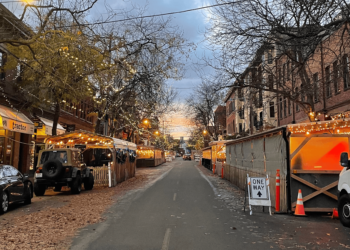
Jen Barnes opened a second location of her Rough & Tumble Pub in Seattle’s Columbia City neighbourhood this year, becoming what she calls “the first place in the world to prioritize playing women’s and men’s sports equally.”
But as she looks toward January 1 when Seattle’s minimum wage jumps to $21.30 per hour, she’s watching restaurants around the city close their doors and wondering how much longer small businesses can absorb rising costs.
“We’ve seen an unprecedented number of restaurants around the city that are not making it,” Barnes said. “We’re dealing with things like tariffs, we’re dealing with sugar tax increases, business tax increases.”
The boosted minimum wage will apply to all Seattle businesses starting January 1, regardless of size, and employers cannot count tips or medical benefit payments toward that compensation. Proponents call the increase critical to support workers as the cost of housing, groceries, and general living expenses continues climbing.
“The minimum wage in Seattle is probably still not high enough to meet the cost of living here in the city,” Barnes explained. “Prices have to increase and things like that in order to just make ends meet, if you will.”
Barnes said the rate increase won’t force her to reassess staffing and operating hours, noting that the minimum wage jump that went into effect on January 1, 2025, was much greater, rising from $17.25 to $20.76 per hour.
“We’ve met some of those challenges this last year,” she explained.
The next increase comes as many businesses face severe financial strains. In November, the restaurant Skillet shuttered multiple locations, with the owner blaming higher minimum wages, food costs, inflation, and the inability to keep raising menu prices.
In Greenlake, Wooden City Tavern posted a notice letting customers know it would be closing permanently the week of Christmas. In a website post, staff wrote they’ve been unable to make the numbers work, adding: “We’ve seen how other cities are helping small businesses thrive, and we love Seattle, so we are looking forward to the day it gets back to supporting restaurants in a real and meaningful way.”
Incoming mayor Katie Wilson’s office was asked how it might address businesses’ concerns about added costs in the New Year and what support might be coming. The grassroots activist has advocated for and led campaigns for higher wages to support working families in Tukwila, Burien, and King County.
As of publication and during the holiday week, Wilson’s office had not responded. The Seattle Restaurant Alliance and Greater Seattle Business Association were also not available on Friday for input.
Barnes’ two locations, in Columbia City and Ballard, employ more than 30 people. She emphasised the need for people to be able to make a living wage.
“If we could all make food and experiences accessible to our customers at affordable prices, and ensure small business owners are able to maintain really strong, fabulous, employee-focused work environments, that would be the magic,” she said.
In 2014, Seattle passed an ordinance ensuring the minimum wage would adjust every year to account for inflation.
Washington state’s minimum wage will rise to $17.13 per hour on January 1, according to the state Department of Labour and Industries. The change reflects the annual adjustment tied to inflation and state law requirements. Washington and Washington, D.C., will have the highest minimum wage in the country.
The $4.17 difference between the state minimum wage and Seattle’s creates a significant cost disparity for businesses operating in the city versus surrounding areas. A restaurant in Tukwila pays $17.13 per hour whilst the same restaurant a few miles away in Seattle pays $21.30, a difference of $4.17 per hour per employee.
For a restaurant employing 15 people working 30 hours per week, that $4.17 hourly difference equals roughly $32,500 in additional annual labour costs just from the geographic location. That’s before accounting for payroll taxes, workers’ compensation, and other employment costs calculated as percentages of wages.
Barnes’s acknowledgement that “the minimum wage in Seattle is probably still not high enough to meet the cost of living” whilst also noting unprecedented restaurant closures captures the impossible mathematics facing the industry. Workers can’t afford to live on lower wages, but businesses can’t afford to pay higher wages without raising prices that customers increasingly resist.
The sugar tax Barnes mentioned adds another layer. Seattle’s sweetened beverage tax, implemented in 2018, charges 1.75 cents per ounce on drinks with added sugar. For restaurants serving sodas, sweet teas, and other beverages, this creates additional costs passed along in prices.
Skillet’s closure of multiple locations represents a high-profile casualty. The local restaurant group had been a Seattle staple, making its failure particularly notable as a warning sign about industry sustainability.
Wooden City Tavern’s pointed reference to “how other cities are helping small businesses thrive” and looking forward to Seattle “supporting restaurants in a real and meaningful way” suggests frustration that the city implements cost increases without corresponding support programmes.
Katie Wilson becoming mayor whilst having led campaigns for higher minimum wages creates an interesting dynamic. She understands the worker perspective intimately but will now face business owners asking for relief from cumulative costs.