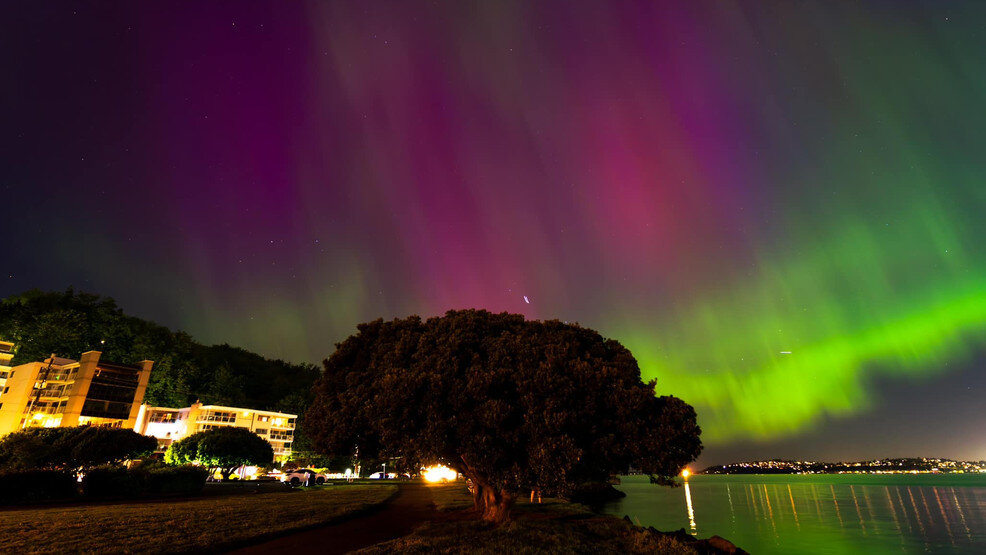
A geomagnetic storm could deliver the Northern Lights to the Pacific Northwest late Tuesday and early Wednesday, though cloud cover may obstruct viewing opportunities.
NOAA’s Space Weather Prediction Page indicates a G4 (Severe) Watch is in effect for 12 November.
“A coronal mass ejection is an eruption of solar material and magnetic fields. When they arrive at Earth, a geomagnetic storm can result,” NOAA/NWS Space Weather Prediction Center stated on its website.
Officials report the CME is expected to arrive at and partially impact Earth around midday on 12 November. “The potential for elevated geomagnetic response and dependent upon the orientation of the embedded magnetic field, potential exists for Severe Storm levels,” NWSSPWC indicated.
The geomagnetic response is likely to create an expanded viewing area for the Aurora Borealis, also known as the Northern Lights.
“The intensity of the CME will not be known with better certainty until it arrives 1 million miles from Earth and is observed by the solar wind observatories at that location,” NWSSPWC stated. “It is at that point that any needed Warning decisions can be made by SWPC forecasters.”
Several forecasts suggest the Northern Lights could be visible as far south as northern California. However, viewing prospects do not appear favourable for the west side of the Cascades as clouds are gradually moving south to north, though a possibility remains.
The G4 (Severe) classification represents the second-highest level on the five-tier geomagnetic storm scale, indicating this event carries substantial potential for both spectacular auroral displays and technological disruptions. Only G5 (Extreme) events surpass this severity level, making Tuesday’s anticipated storm a significant space weather occurrence.
Coronal mass ejections occur when the sun’s magnetic field lines become twisted and tangled, suddenly releasing enormous quantities of plasma and electromagnetic radiation into space. When these charged particles intersect Earth’s magnetic field, they create the phenomenon known as geomagnetic storms that can produce auroras whilst also affecting technological systems.
The timing of the CME’s arrival around midday Tuesday suggests the most intense auroral activity may occur during evening and overnight hours Tuesday into Wednesday, coinciding with optimal viewing darkness for North American observers. However, the precise timing and intensity remain uncertain until the CME reaches the L1 Lagrange point approximately one million miles from Earth where solar wind monitoring satellites can measure its characteristics.
The orientation of the embedded magnetic field within the CME proves crucial in determining storm severity. When the CME’s magnetic field aligns southward, opposite to Earth’s northward-pointing magnetic field, the interaction produces the most intense geomagnetic disturbances. This southward orientation allows more efficient transfer of energy from the solar wind into Earth’s magnetosphere.
The expanded Aurora Borealis viewing area during severe geomagnetic storms reflects increased energy injection into Earth’s upper atmosphere at lower latitudes than typical auroral zones. Under normal conditions, auroras remain confined to regions near the Arctic and Antarctic circles. During severe storms, the auroral oval expands equatorward, potentially bringing displays to latitudes that rarely experience them.
Forecasts suggesting visibility as far south as northern California represent an exceptional auroral opportunity for millions of people who typically never witness this phenomenon. Such southern extensions of aurora visibility occur only during the most intense geomagnetic storms, making these events memorable for observers fortunate enough to experience clear skies.
The unfavourable cloud forecast for western Washington and Oregon particularly frustrates aurora enthusiasts in Seattle, Portland, and other major population centres west of the Cascades. The marine influence that moderates temperatures in these regions also frequently produces cloud cover that obscures celestial phenomena including auroras, meteor showers, and eclipses.
The south-to-north cloud movement pattern suggests that southern portions of western Washington and Oregon may clear earlier than northern areas, potentially offering brief viewing windows for observers willing to monitor conditions throughout the evening. Aurora activity typically fluctuates in intensity over hours-long periods, meaning clouds that temporarily obscure displays may clear during subsequent activity peaks.
Observers east of the Cascades in places like Spokane, Bend, and eastern Washington’s Columbia Basin typically enjoy clearer skies and darker locations ideal for aurora viewing. The rain shadow effect created by the Cascade Range produces drier, clearer conditions that significantly improve celestial observation opportunities compared to western locations.
Beyond the visual spectacle, G4 geomagnetic storms can affect technological infrastructure. Power grid operators prepare for potential voltage fluctuations, satellite operators may need to adjust spacecraft orientations, airlines may reroute polar flights to avoid communication disruptions and radiation exposure, and GPS accuracy can degrade during intense geomagnetic activity.