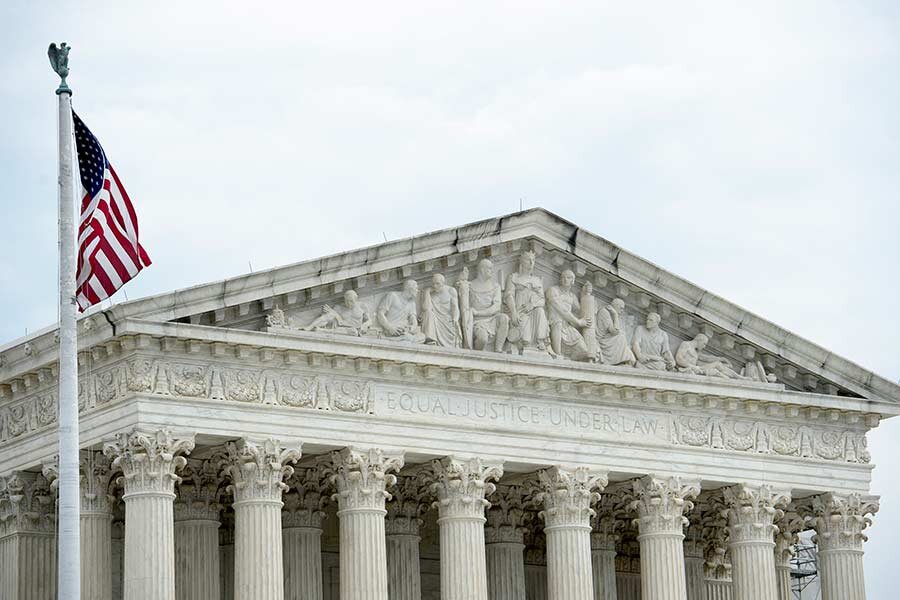
Conservative Supreme Court justices Tuesday appeared to support a Republican-led effort that would eliminate limits on how much political parties can spend in coordination with candidates for Congress and president, potentially overturning a quarter-century-old decision.
A day after the justices indicated they would reverse a 90-year-old precedent limiting the president’s power to fire independent agency heads, the court took up a 2001 decision that upheld a provision of federal election law that is more than 50 years old.
The lawsuit, which originated in Ohio, includes Vice President JD Vance, who joined the Republican challenge to the limits when he was a senator from Ohio. The arguments touched on whether Vance would run for president in 2028, and whether his plans should figure in the outcome.
The case represents the latest opportunity for the conservative majority to upend congressionally enacted limits on raising and spending money to influence elections. The court’s 2010 Citizens United decision opened the door to unlimited independent spending in federal elections.
Two hours of arguments revealed entrenched divisions between the liberal and conservative justices over campaign finance restrictions.
“Every time we interfere with the congressional design, we make matters worse,” said Justice Sonia Sotomayor, a dissenter in Citizens United and the court’s other campaign money cases.
By contrast, Justice Samuel Alito, a member of the Citizens United majority, described the decision as “much maligned, I think unfairly maligned.” The effect of the decision was to “level the playing field,” Alito said, by expanding the right to spend freely that had previously belonged only to media companies.
The limits on party spending stem from a desire to prevent large donors from skirting caps on individual contributions to candidates by directing unlimited sums to parties, with the understanding that the money will be spent on behalf of specific candidates.
The Republican committees for House and Senate candidates filed the lawsuit in Ohio in 2022, joined by Vance and then-Representative Steve Chabot.
The court should cast a skeptical eye on the limits because they are “at war” with recent high court decisions, lawyer Noel Francisco said, representing Republican interests. The Federal Election Commission, which changed its view on the issue after Trump took office, also argued that the limits should be struck down.
Democrats are calling on the court to uphold the law, even though there is wide agreement that the spending limits have hurt political parties in an era of unlimited spending by other organizations.
“That’s the real source of the disadvantage, right?” Justice Brett Kavanaugh said. “You can give huge money to the outside group, but you can’t give huge money to the party. And so the parties are very much weakened compared to the outside group.”
Alito, Kavanaugh, and Justice Clarence Thomas all voiced skepticism about the limits, while the three liberal justices signaled they would vote to uphold them. The other three members of the court, Chief Justice John Roberts and Justices Amy Coney Barrett and Neil Gorsuch, either said nothing during the arguments or not enough to indicate how they might vote.
After the Trump administration joined with Republicans to ask the court to strike down the campaign finance law, the justices appointed a lawyer to defend it.
Roman Martinez, an experienced Supreme Court advocate, offered the justices a way to dismiss the case without deciding the underlying issue. Among the reasons, Martinez told the court, is that Vance’s claim is moot because the vice president has “repeatedly denied having any concrete plan to run for office in 2028.”
The justices did not seem to be looking for the procedural exit that Martinez was offering.
In 2025, the coordinated party spending for Senate races ranges from $127,200 in several states with small populations to nearly $4 million in California. For House races, the limits are $127,200 in states with only one representative and $63,600 everywhere else.
The spending limits were established as part of broader campaign finance reforms intended to prevent corruption or the appearance of corruption in federal elections. Reformers worried that unlimited party spending coordinated with candidates would effectively allow wealthy donors to evade contribution limits.
The Citizens United precedent fundamentally changed campaign finance law by treating independent political spending as protected speech under the First Amendment. The decision allowed corporations, unions, and individuals to spend unlimited amounts on political communications, provided they do not coordinate directly with candidates.
The current case challenges whether the coordination restriction itself violates the First Amendment. Republicans argue that political parties should have the same rights as outside groups to spend unlimited amounts supporting their candidates.
Democrats counter that eliminating coordination limits would create new corruption risks. Large donors could funnel unlimited money through parties directly to candidates, undermining the individual contribution limits that remain on the books.
The practical effect of the current limits has been to shift political spending away from parties toward super PACs and other outside groups. These organizations can raise and spend unlimited amounts but theoretically operate independently of candidates.
However, the “independence” of these groups is often questionable. Many are run by former campaign staff or allies of candidates, and they can coordinate messaging even if they cannot legally coordinate strategy with campaigns.