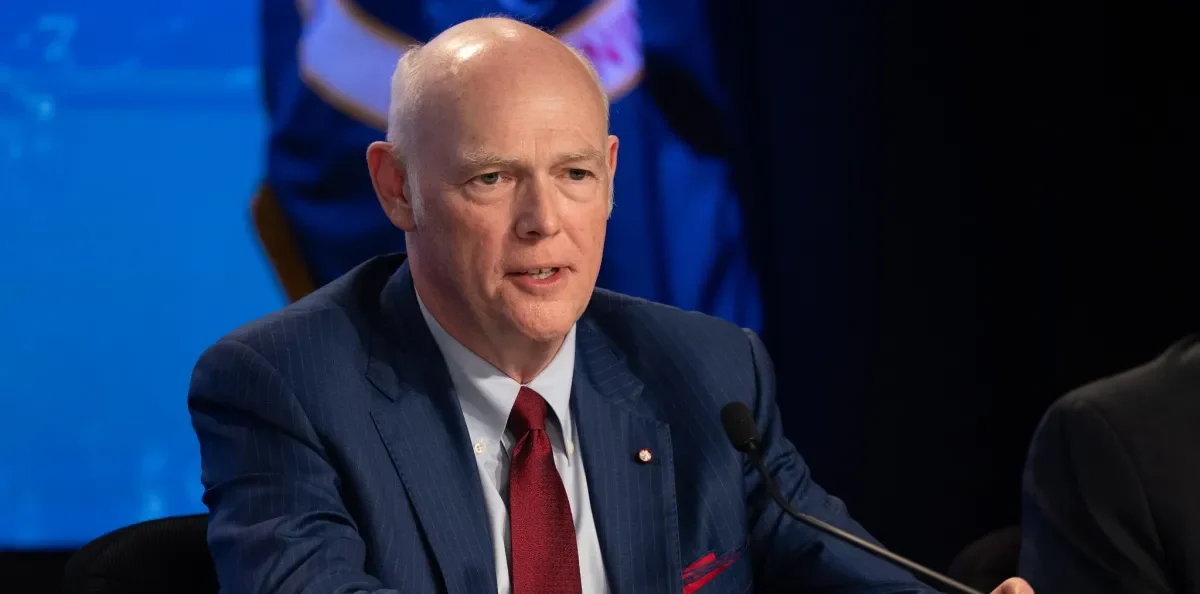
Tory Bruno sat beside Jeff Bezos in 2014 to announce a partnership that would put Blue Origin’s engines on United Launch Alliance rockets. Now, eleven years later, he’s leaving ULA to work for Bezos.
Blue Origin announced Friday that Bruno, 64, will lead the company’s newly created National Security Group as president, reporting directly to CEO Dave Limp.
“We share a deep belief in supporting our nation with the best technology we can build,” Limp said in a post on X. “Tory brings unmatched experience, and I’m confident he’ll accelerate our ability to deliver on that mission.”
Bezos welcomed Bruno on social media, and Bruno responded that “we are going to do important work together.” Even NASA Administrator Jared Isaacman chimed in with congratulations.
The move represents a stunning shift in the commercial space industry. Bruno led ULA for 11 years, navigating the company through a period when SpaceX transformed from scrappy upstart to absolute market dominance.
The numbers tell the story. When Bruno took over ULA in 2014, his company launched 14 missions whilst SpaceX launched six. This year, SpaceX has launched 165 times. ULA has launched six.
Bruno is leaving an established aerospace giant that’s shrinking to join a company still trying to prove its rocket works reliably. Blue Origin’s New Glenn rocket has flown only twice, and the company needs two more successful launches to complete the Space Systems Command’s certification process for national security missions.
That certification represents the prize Bruno was hired to win. National security launches for the Department of Defence and intelligence agencies command premium prices and provide stable, long-term revenue. SpaceX dominates this market currently, with ULA holding a smaller share.
In 2024, Blue Origin finally joined ULA and SpaceX on the list of approved providers for national security launches. But approval means little without the track record and relationships needed to actually win contracts worth hundreds of millions of dollars.
Bruno brings both. He spent 30 years at Lockheed Martin before leading ULA, giving him decades of experience navigating the complex world of government space contracts, security requirements, and military customer relationships.
Those relationships matter enormously. Military and intelligence agencies award contracts based partly on technical capability but also on trust, experience, and understanding of classified mission requirements. Bruno has all three.
The BE-4 engine connection makes the move less surprising than it might otherwise seem. Not long after Bruno took the reins at ULA in 2014, he announced a close collaboration with Blue Origin on development of the BE-4 engine.
That engine now powers both ULA’s Vulcan rocket and Blue Origin’s New Glenn. Bruno knows Blue Origin’s technology intimately. He’s worked with key personnel for years. The partnership created relationships that apparently survived ULA’s market share collapse.
United Launch Alliance is a joint venture between Boeing and Lockheed Martin, two aerospace giants that created ULA in 2006 to combine their launch operations. Last year, rumours circulated that ULA was the subject of acquisition talks, perhaps involving Blue Origin or Sierra Space.
Those rumours haven’t materialised into anything concrete. But Bruno joining Blue Origin could facilitate a future acquisition if he helps Blue Origin understand ULA’s operations and value.
Earlier this week, before Blue Origin’s announcement, Lockheed Martin’s Robert Lightfoot and Boeing’s Kay Sears announced that Bruno was leaving ULA “to pursue another opportunity.” They named John Elbon as the joint venture’s interim CEO.
Elbon previously served as ULA’s chief operating officer. He joined ULA in 2018 after a 35-year career at Boeing.
The “interim” designation suggests ULA’s owners haven’t decided on permanent leadership. They’re either conducting a search or they’re uncertain about ULA’s future direction given the company’s diminished market position.
Bruno’s departure creates challenges for ULA beyond just losing an experienced leader. He’s the public face who’s defended the company’s higher prices and slower launch cadence against SpaceX’s aggressive competition. Finding someone willing to take that role won’t be easy.
For Blue Origin, the hire represents a statement of ambition. The company has long operated in SpaceX’s shadow, launching tourists on suborbital flights whilst SpaceX sends astronauts to the International Space Station and deploys thousands of Starlink satellites.
New Glenn finally gives Blue Origin an orbital-class rocket to compete for the lucrative satellite launch and national security markets. But flying twice doesn’t make you competitive. SpaceX’s Falcon 9 has launched more than 300 times, building a reliability record that makes it the default choice for most missions.
Bruno’s job is to change that calculation, at least for national security launches where relationships, security clearances, and understanding of classified requirements matter as much as launch reliability.
Whether he can do that depends on New Glenn proving itself through multiple successful flights and Blue Origin demonstrating the operational tempo needed to compete with SpaceX’s relentless launch schedule.
The Kent, Washington, company has the resources. Bezos has invested billions in Blue Origin over two decades. But money alone doesn’t win launch contracts. You need the rocket, the operations, and the relationships.
Bruno brings the relationships. New Glenn provides the rocket. Now Blue Origin has to prove it can execute.