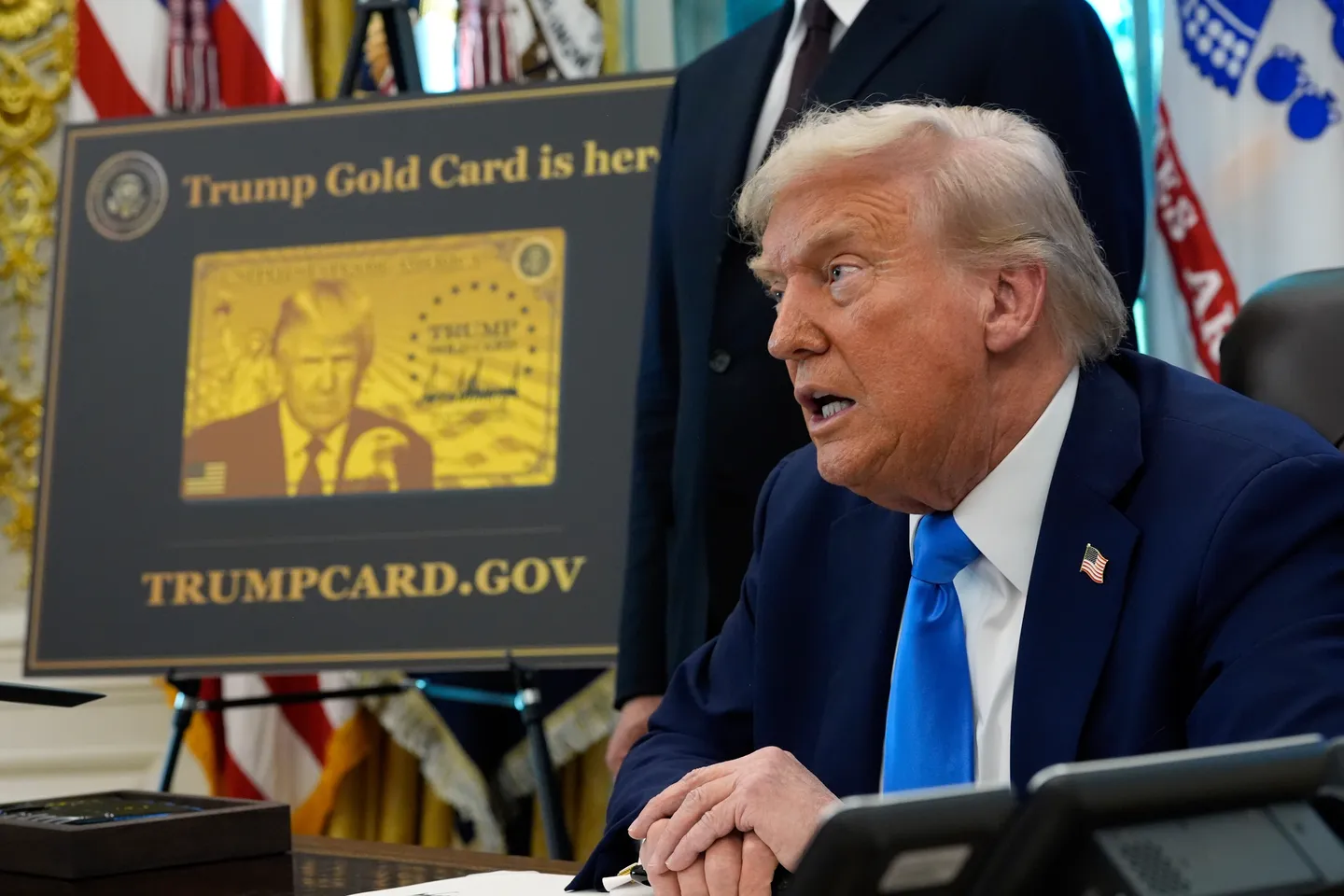
President Donald Trump unveiled a program Wednesday offering expedited U.S. visas to wealthy foreigners who can invest at least $1 million in exchange for a pathway to American citizenship.
The initiative, branded as the Trump Gold Card, provides buyers with a “direct path to Citizenship for all qualified and vetted people,” Trump announced on social media. “SO EXCITING! Our Great American Companies can finally keep their invaluable Talent.”
The program, first announced earlier this year, awards U.S. visas to individuals who can demonstrate they will provide a “substantial benefit” to the country, according to the official website for the scheme.
The launch comes as the Trump administration intensifies its immigration enforcement efforts, including raising work visa fees and accelerating deportations of undocumented migrants.
The Gold Card program promises U.S. residency in “record time” and requires a $1 million payment that serves as “evidence that the individual will substantially benefit the United States,” according to the program’s website.
Businesses sponsoring employees must pay $2 million, along with additional processing fees. A “platinum” version of the card offering special tax breaks will become available soon for $5 million, the website indicates.
Additional government fees may apply depending on each applicant’s individual circumstances. All applicants must also pay a non-refundable $15,000 processing fee before their application receives review.
The gold card initiative has drawn criticism since its February announcement, with Democratic lawmakers arguing it unfairly favors wealthy individuals over other prospective immigrants.
When Trump initially revealed the plan, he described the visas as similar to green cards, which allow immigrants of various income levels to live and work permanently in the United States. Green card holders typically become eligible to apply for citizenship after five years of permanent residency.
However, the Gold Card targets specifically “high-level” professionals, Trump emphasized, stating “we want people that are productive.”
“The people that can pay $5 million, they’re going to create jobs,” Trump said during the announcement. “It’s going to sell like crazy. It’s a bargain.”
The program’s rollout occurs as the Trump administration dedicates substantial resources to immigration enforcement and deportation operations targeting undocumented residents.
The administration has also paused immigration applications from individuals in 19 countries, predominantly located in Africa and the Middle East, which are subject to the president’s travel ban executive order.
The government has additionally halted all decisions on asylum applications and announced it would review thousands of cases that received approval under President Joe Biden’s administration.
In September, Trump signed an order imposing a $100,000 fee for new applicants to the H-1B visa program for skilled foreign workers, a decision that created anxiety among international students studying in the United States and technology companies that rely heavily on foreign talent.
The White House later clarified that the H-1B fee would apply only to new applicants currently residing abroad, not to workers already in the United States seeking visa renewals or status changes.
The Gold Card program represents a stark contrast in the administration’s approach to immigration, creating a premium pathway for wealthy individuals while simultaneously restricting other immigration channels. Critics argue this two-tiered system prioritizes wealth over skills, family connections, or humanitarian concerns.
The $1 million minimum investment significantly exceeds the existing EB-5 immigrant investor program, which requires $800,000 in targeted employment areas or $1.05 million in other locations. However, the Gold Card promises faster processing than the EB-5 program, which often involves years-long waits.
The “record time” residency promise remains undefined in specifics. Traditional immigration pathways can take years or even decades depending on visa category and country of origin, particularly for employment-based green cards from countries with high demand.
The $15,000 non-refundable processing fee creates financial risk for applicants who may not ultimately receive approval. This upfront cost prevents refunds even if applications are denied after review.
The business sponsorship option at $2 million allows companies to effectively purchase residency for key employees, though at double the individual rate. This provision could appeal to corporations seeking to retain foreign executives or specialists.
The platinum card’s $5 million price point with special tax breaks suggests additional benefits beyond expedited residency. The nature of these tax advantages has not been publicly detailed, though they likely involve favorable treatment of foreign income or investments.
Trump’s characterization of the $5 million option as a “bargain” reflects the administration’s view that wealthy immigrants will generate economic activity justifying the preferential treatment. The job creation assumption underlies the policy rationale.
The Democratic criticism highlights concerns about economic inequality in immigration policy. While the United States has long operated investor visa programs, the Gold Card’s explicit branding and premium pricing amplify questions about fairness.
The timing creates apparent contradictions. As the administration restricts asylum seekers, bans travelers from Muslim-majority countries, and increases deportations, it simultaneously opens a fast lane for millionaires.
The travel ban affecting 19 countries means nationals from those regions cannot access most immigration pathways but theoretically could purchase Gold Cards if they possess sufficient wealth, creating an economic exception to geographic restrictions.
The asylum application freeze leaves thousands of vulnerable individuals in limbo while the Gold Card offers immediate pathways for the wealthy. This juxtaposition underscores the administration’s prioritization of economic benefit over humanitarian protection.
The review of Biden-era asylum approvals signals potential revocations, adding uncertainty for people who believed they had achieved safety. Meanwhile, Gold Card purchasers receive promises of expedited certainty.
The H-1B fee increase to $100,000 targets the same skilled worker category that Gold Card platinum tier aims to attract, suggesting the administration wants wealthy individuals to bypass work visas entirely through investment.
Technology companies’ concerns about the H-1B fee reflect how American businesses depend on foreign talent. The Gold Card offers an alternative for companies willing to pay even higher premiums for key personnel.