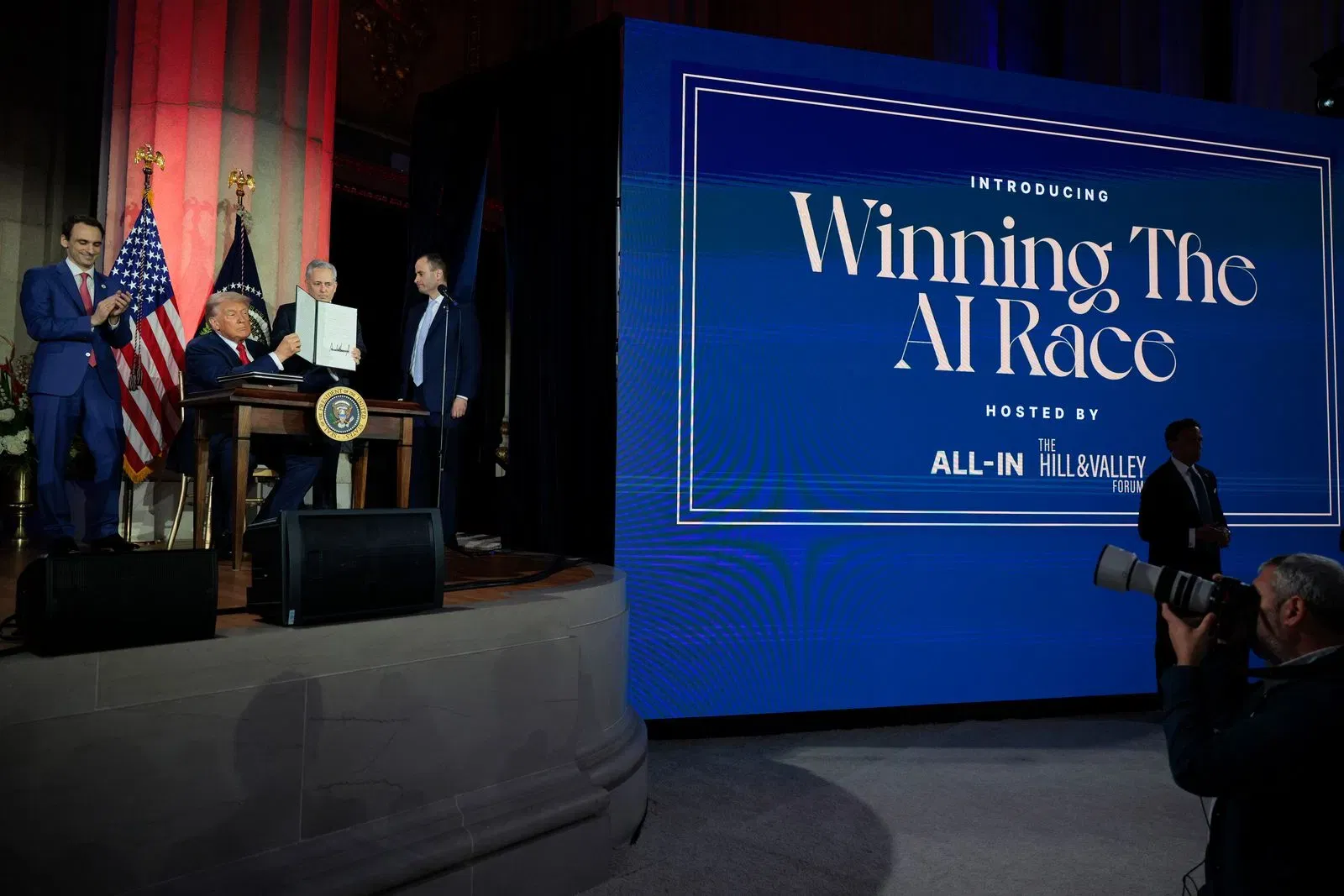
The Trump administration on Friday issued a legislative framework for a single national policy on artificial intelligence, aiming to create uniform federal safety and security guardrails and prevent states from enacting their own AI rules in an effort to position the U.S. as the global leader in the technology.
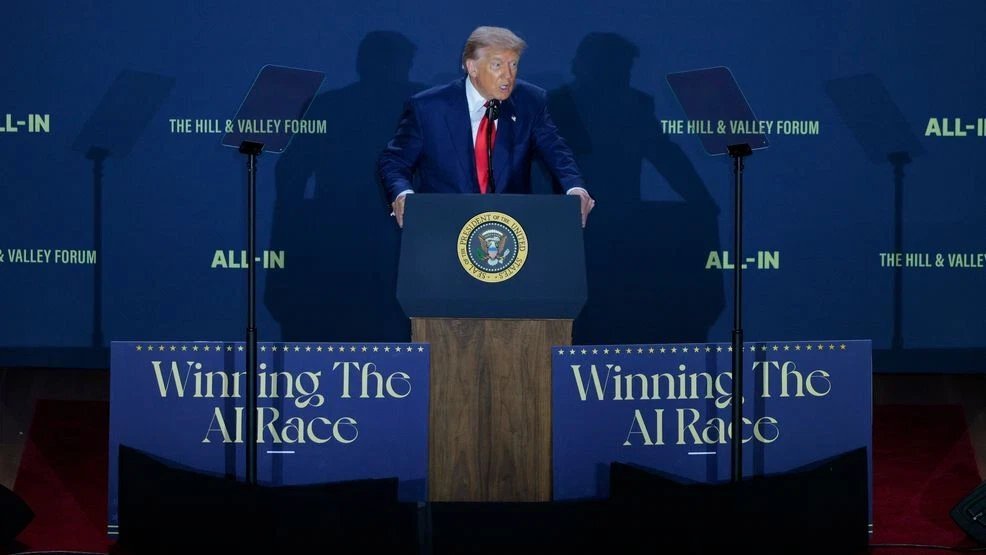
President Trump has repeatedly emphasized the urgency of American AI dominance. “America is the country that started the AI race and as President of the U.S. I’m here today to declare that America is going to win it. We’re going to work hard, we’re going to win it,” Trump said in July 2025.
The new framework is broken up into six pillars: protecting children and empowering parents, preventing censorship and protecting free speech, enabling innovation, and educating Americans and developing an AI-ready workforce. Science Advisor to the President Michael Kratsios told news outlets in January, “The President has been very forward leaning on this. He signed an EO in April that created an AI education task force and the key is, how can we bring young people to be able to leverage this technology wherever they go in the future.”
The framework builds on the broader “America’s AI Action Plan,” which was released in July. The plan originally focused on three pillars: accelerating innovation, building AI infrastructure, and leading in international AI diplomacy. In its press release Friday, the administration said it wants to work with Congress in the coming months to convert the framework into a bill that Trump can sign.
Mark Beall, President of the AI Policy Network, said the administration wants to “establish one national standard that guides all AI developers across the country so that these developers are not subjected to a whole host of different rules from 50 different states.” Beall said the administration believes AI is pivotal for the future of the country and they’re doing everything possible to accelerate it. But he noted something absent is discussion on national security, including AI chips, pointing to Thursday’s indictment of three people allegedly involved in a $2.5 billion conspiracy to smuggle Nvidia chips and servers to China.
“When we’re thinking about American AI dominance and we know that these AI chips are like the oil of the AI economy, the fact that these chips continue to flow to China, the fact that this framework doesn’t directly address that, is something worth noting,” Beall said.
Reaction to the framework is mixed across party lines, leading many to believe it won’t be easy to move forward. Democratic Senator Richard Blumenthal wrote on X, “The White House’s AI legislative framework is pathetic and a non-starter, a wish list for Meta and OpenAI with little to protect families worried about how AI will impact their livelihoods and safety.” Meanwhile, Republican Senator Dan Sullivan said, “Today, the Trump administration took a critical and commonsense step forward by releasing a framework that gives Congress a clear roadmap to capitalize on AI’s potential.”
According to advocacy group Enough Abuse, as of 2026, every state has introduced some type of AI-related legislation, including 45 states with current laws criminalizing AI-generated child sexual abuse material, the most common form of legislation. The administration’s push for federal preemption would override those state laws and establish a single national standard.