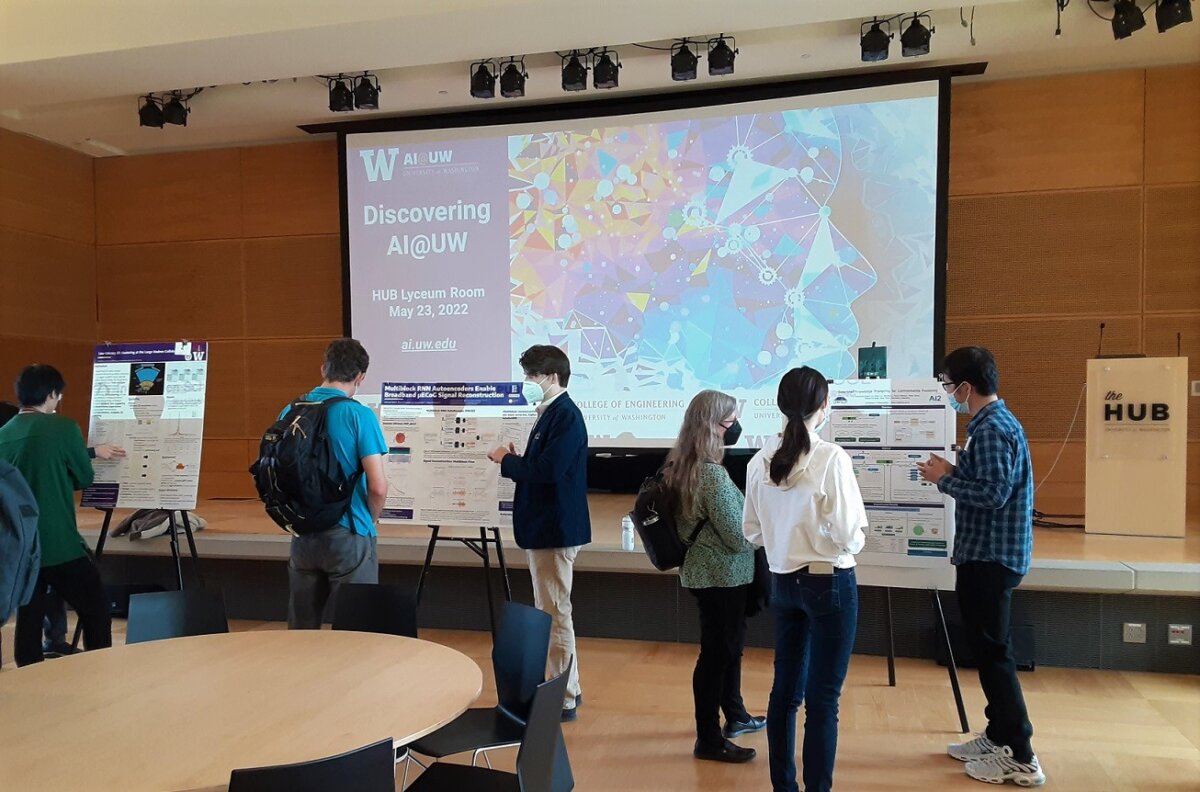
Washington Senator Patty Murray believes the future of artificial intelligence shouldn’t be dictated solely by billionaires and shareholders. The longtime lawmaker toured University of Washington research facilities Friday after securing $10 million in federal funding that will allow UW to expand infrastructure needed for data-intensive AI workloads. Murray said the funding will help provide counterweight to AI development driven primarily by private capital. “If just billionaires are creating and using AI for their own projects that make money, then we lose out on most of the benefits of AI,” Murray told GeekWire. Universities play a critical role in ensuring AI advances serve public needs, Murray said, pointing to applications ranging from healthcare and environmental research to workforce training and job creation.
The new funding, which comes through Congressionally Directed Spending in the Commerce-Justice-Science appropriations bill, will support Tillicum, UW’s next-generation computing platform that launched in October. University leaders say the investment will enable faster research cycles and broader access while reducing reliance on commercial cloud providers. “This allows us to stay at the cutting edge of AI and AI research,” said Andrew Connolly, director of the eScience Institute. Unlike private companies that ultimately answer to shareholders, public universities answer to taxpayers, said Magdalena Balazinska, director of the Paul G. Allen School of Computer Science and Engineering. “That means our goal is to do what’s best for society,” she said.
The framing of university AI research as counterweight to billionaire-driven development reflects political positioning about who controls transformative technology and whose interests it serves. Murray’s emphasis that “if just billionaires are creating and using AI for their own projects that make money, then we lose out on most of the benefits” creates narrative where private sector AI serves narrow profit motives while public university research serves broader social good. Whether that distinction holds up in practice, given that universities often commercialize research through tech transfer and faculty frequently have industry ties, affects whether the public versus private framing represents meaningful difference or rhetorical positioning.
The $10 million funding through Congressionally Directed Spending, formerly known as earmarks, represents targeted allocation where individual lawmakers direct federal funds to specific projects in their districts or states. Such spending was banned for years due to corruption concerns but was restored with new transparency requirements. Whether this represents good use of federal resources supporting critical research infrastructure or whether it represents parochial spending prioritizing Murray’s home state over more competitive merit-based allocation affects assessment of appropriations process.
The support for Tillicum, UW’s next-generation computing platform launched in October, suggests the $10 million represents expansion of recently established infrastructure rather than building entirely new capabilities. Whether Tillicum had sufficient initial funding and this represents enhancement, or whether October launch proceeded with known funding gaps that this federal money fills, affects interpretation of financial planning and reliance on uncertain federal appropriations. The reduction of “reliance on commercial cloud providers” that university leaders cite as benefit represents both cost savings from not paying cloud computing fees and control over sensitive data and research.
Balazinska’s statement that unlike private companies answering to shareholders, public universities answer to taxpayers and therefore aim to “do what’s best for society” creates idealized view of university governance that doesn’t fully account for how universities compete for rankings, prestige, grants, and top faculty in ways that might not always align with broad public benefit. Whether UW’s AI research actually serves societal needs better than private sector work, or whether both contribute valuable but different innovations, affects whether the public funding justification holds scrutiny beyond political rhetoric.
The acknowledgment that “universities nationwide have struggled to keep pace with the rapid growth of AI computing demands, as private companies dominate access to large-scale infrastructure” reflects real resource disparity where companies like Google, Microsoft, Meta, and OpenAI invest billions in computing infrastructure that universities can’t match with typical research budgets. Whether $10 million makes meaningful difference in that context, or whether it’s modest improvement that doesn’t fundamentally change competitive disadvantage universities face, affects expectations about research outcomes enabled by funding.
Balazinska’s characterization of the funding as “very significant amount” that can be “transformative in an academic setting” suggests the scale differs between what’s meaningful for universities versus private companies. While $10 million might represent rounding error for major tech companies’ AI investments, it could fund substantial university infrastructure purchases and operational costs. Whether transformation comes from raw computing power acquired or from removing constraints that currently limit research affects what success looks like.
The recurring theme during Murray’s tour about “importance of keeping sensitive data on campus” reflects legitimate concerns about research involving protected health information, personally identifiable data, or proprietary scientific information that can’t legally or ethically be sent to third-party cloud providers. Whether on-campus computing truly solves those concerns or whether data security challenges exist regardless of physical location affects whether geographic control provides meaningful protection. The health-focused system students demonstrated using voice input and AI to track symptoms for doctors exemplifies research that handles sensitive medical data requiring careful protection.
Murray’s statement that “if you don’t have the computers, if you don’t have the basic infrastructure, you’re stymied” frames computing resources as fundamental enabler similar to roads, electricity, or internet connectivity. Whether AI computing represents legitimate public infrastructure warranting government investment comparable to traditional infrastructure, or whether it’s specialized research tool that should compete for merit-based funding, affects whether taxpayer-funded computing expansion is appropriate. The benefits Murray cites including “creating jobs, creating better healthcare, creating more innovators” attempts to justify spending through economic and social returns.
The additional $3 million for fan blades at UW’s Kirsten Wind Tunnel and $1.5 million for Radiocarbon Lab improvements represent separate earmarks supporting different research facilities, demonstrating Murray’s broader support for UW research infrastructure beyond just AI. Whether those allocations represent similar Congressionally Directed Spending or different funding mechanisms affects total amount Murray secured for UW. The wind tunnel and radiocarbon lab, serving aerospace and climate science research respectively, represent traditional scientific infrastructure less politically controversial than AI investments.
The context that “broader federal spending bill boosts funding for other scientific agencies such as the National Institute of Standards and Technology, pushing back on proposals from President Trump to sharply cut federal research spending” positions Murray’s UW funding as part of broader defense of science funding against administration priorities emphasizing cuts. Whether that framing represents accurate characterization of competing budget priorities or politically motivated contrast depends on actual Trump administration proposals and congressional alternatives. The tension between congressional Democrats defending research spending and Republican administration proposing cuts creates budget battles affecting science funding broadly.
The question of whether prospective faculty ask about computing resources “when considering whether they can be successful at the UW” that Balazinska cited reflects competitive dynamics where top AI researchers have multiple options including industry positions with virtually unlimited computing resources. Whether adequate computing represents threshold requirement for recruitment or whether UW can compete through other advantages like academic freedom, graduate student talent, and research mission affects faculty hiring success. The investment in computing infrastructure serves recruitment and retention goals beyond just enabling specific research projects.
The emphasis on faster research iteration cycles enabled by on-campus computing versus cloud providers suggests current reliance on commercial services creates delays from requesting resources, waiting for allocation, transferring data, and navigating administrative processes. Whether those delays are significant enough to meaningfully slow research or whether they’re minor inconveniences affects return on investment from local computing. The ability to quickly experiment, fail, and iterate represents important advantage in rapidly evolving AI research where methodologies change frequently.
The broader context includes federal AI policy debates about whether government should actively shape AI development through funding, regulation, and infrastructure investment, or whether private sector innovation should proceed with minimal intervention. Murray’s position that billionaire-driven AI development risks missing societal benefits represents interventionist view that government funding can direct technology toward public good. Whether that’s effective strategy or whether government funding creates inefficiencies and political influence distorting research priorities affects philosophical assessment of approach.
For Seattle and Washington State’s technology ecosystem, federal investment in UW AI infrastructure supports region’s competitiveness in attracting talent, companies, and investment. Whether UW research directly spins out into local startups, whether trained students and faculty join regional tech companies, or whether research advances benefit national technology sector affects whether Washington State captures economic returns from federal investment. The proximity to Microsoft, Amazon, and numerous AI startups creates potential for research translation and talent pipeline that benefits local economy.
The students demonstrating AI projects during Murray’s tour, including health tracking system generating doctor summaries, represent next generation of AI researchers and practitioners who will lead development in academia, industry, and government. Whether UW computing investment enables them to pursue more ambitious projects, attracts better students, or simply maintains competitive standing with peer universities affects educational mission success beyond pure research outputs.
The timing as Trump administration considers research spending cuts creates political urgency for Murray to demonstrate value of federal science investment and build support for continued funding. Whether this represents defensive posture against anticipated cuts or proactive expansion during favorable political moment affects strategic context. The fact that Murray secured funding through appropriations bill that passed suggests she had sufficient political capital and committee influence to direct resources to UW despite broader budget pressures.
For UW’s long-term research strategy, whether $10 million represents one-time boost or beginning of sustained federal support affects planning and whether university can rely on continued funding or must treat this as temporary windfall to be leveraged while available. The investment in physical infrastructure like computing systems has multi-year useful life, making one-time funding more valuable than if it funded ongoing operational costs requiring annual renewals.
The University of Washington’s $10 million federal funding for AI computing infrastructure, secured by Senator Murray as counterweight to billionaire-driven development, represents both tangible resource expansion enabling research and political statement about public role in shaping transformative technology. Whether the investment produces research breakthroughs, attracts top faculty, trains skilled graduates, keeps sensitive data secure, and demonstrates societal benefits justifying public funding affects both immediate research success and longer-term political sustainability of government investment in university AI capabilities that can’t match private sector scale but aim to serve public interest that profit-driven development might neglect.