A proposed student housing development at the University of Washington has ignited community opposition after plans revealed removal of significantly more mature trees than initially presented, despite earlier assurances that many would be preserved.
Community members characterise the situation as deceptive practices. Many are demanding construction be halted on Blakeley Village and Laurel Village whilst alternative plans are evaluated.
“A year ago, there was a series of community meetings where Greystar, the developer, along with UW, presented plans to the community showing specific trees that would be removed and ones that wouldn’t be removed. Most of the trees along the perimeter were not slated for removal, as well as some of the interior trees,” stated Gabriel Kennedy-Gibbens, a UW senior majoring in environmental science. “A week ago, we got new plans showing a high number of trees being removed, so we’re confused why those plans changed.”
The construction projects occupy two locations near the UW campus, just a couple of blocks apart. Blakeley Village is situated at 4747 30th Ave NE, and Laurel Village is located at 4200 Mary Gates Memorial Dr NE. The university hired real estate developer Greystar to construct the student housing.
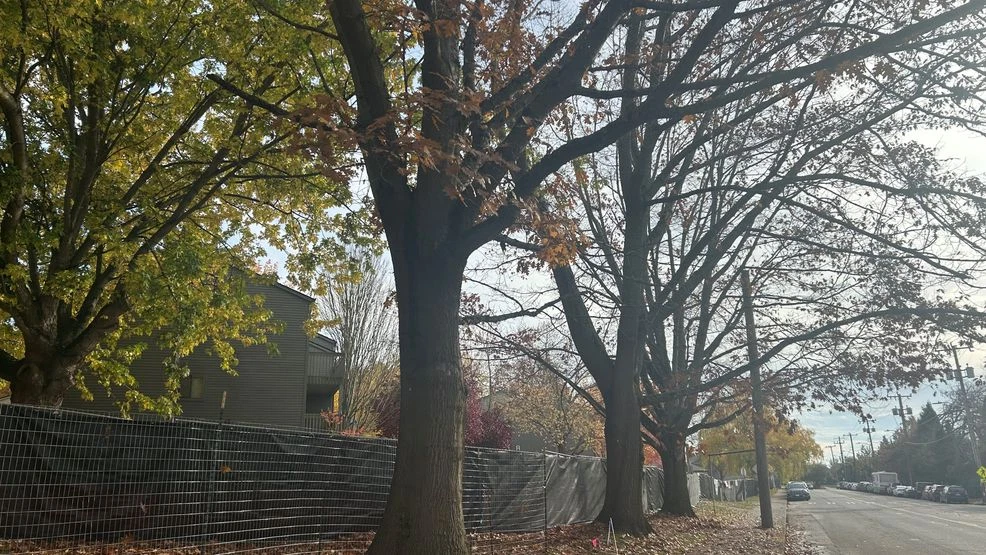
Both sites contain established, mature trees. Early on, Greystar representatives informed community members that many of these trees would be retained and incorporated into the project, according to Grayson Badgley, who lives in the neighbourhood.
“I was really encouraged by what sounded like a lot of sensitivity being taken around the neighbourhood. There were some trees that were going to be lost, and that makes sense,” Badgley stated. “Then it comes to the day when the fences go up and the tape comes out and there’s even more trees that are slated for removal, so what consideration was given to try and minimise the impact?”
In the most recent version of the construction plans, 76 trees will be removed at Blakeley Village and another 90 at Laurel Village.
People working to preserve these trees argue they contribute to the livability and climate resilience of the areas. They also contend the same quantity of housing can still be achieved whilst pursuing alternative design plans that build around the existing trees.
Campus officials indicated many of the trees will remain. Blakeley will retain 76 existing trees, and for every one removed, two more will be planted. Another 50 trees will be spared at Laurel, with the same number of new plantings for those cut down.
The concern among preservationists is that young saplings won’t provide the same benefits as fully grown trees for several decades.
“A large, mature tree is about 70 times as effective at removing carbon from the atmosphere as a small, new planting,” Kennedy-Gibbens stated.
Beyond improved air quality, neighbours said mature trees make places more walkable, keep the area cooler in summer, and handle stormwater better, making it less prone to flooding.
“We’re talking about a community that will have to wait 50 to 100 years to have trees that look exactly like this again,” Badgley said.
When the housing projects are complete, Blakeley Village will provide 1,000 student apartments, and Laurel Village will have 320 apartments for students with families. Additionally, 43 of the apartments will be maintained as affordable units, and childcare capacity will gain an additional 54 slots at the Laurel Village childcare centre.
A UW spokesperson provided a statement indicating they strove for “a reasonable mix of mature and newer trees at each site, whilst allowing progress toward providing more housing that our students and their families can afford.”
The spokesperson also stated the housing projects are needed for the university to offer additional opportunities for students to live in housing they can afford in Seattle’s expensive rental market.
“I’m absolutely supportive of housing, especially increasing urban density. I think that’s really needed, especially for students,” stated Kennedy-Gibbens. “The two things can co-exist because there were plans to build this high-density housing and also retain these very important, larger urban trees, instead of replacing them with small ones down the road.”
The controversy exemplifies tensions between urgent housing needs and environmental preservation that characterise development debates in cities experiencing growth pressures. University of Washington faces particular challenges balancing its educational mission with community environmental values whilst addressing student housing affordability in one of America’s most expensive rental markets.
The perception among community members that Greystar and UW engaged in “bait-and-switch tactics” reflects erosion of trust that occurs when development plans shift substantially between community presentation and implementation. Initial community meetings where specific trees were identified for preservation created expectations that subsequent plan revisions violated, generating feelings of betrayal among residents who participated in good faith.
The 166 total trees slated for removal, 76 at Blakeley Village and 90 at Laurel Village, represents substantial loss of established urban forest canopy. Mature trees provide ecosystem services that young replacements cannot replicate for decades, creating temporal gaps in environmental benefits even when replacement ratios exceed removals on a numerical basis.
Kennedy-Gibbens’ citation that mature trees prove 70 times more effective at carbon removal than new plantings illustrates the functional disparity between established and replacement trees. This differential extends beyond carbon sequestration to encompass cooling effects, stormwater absorption, air quality improvement, and wildlife habitat provision that mature trees deliver at scales young trees cannot match.