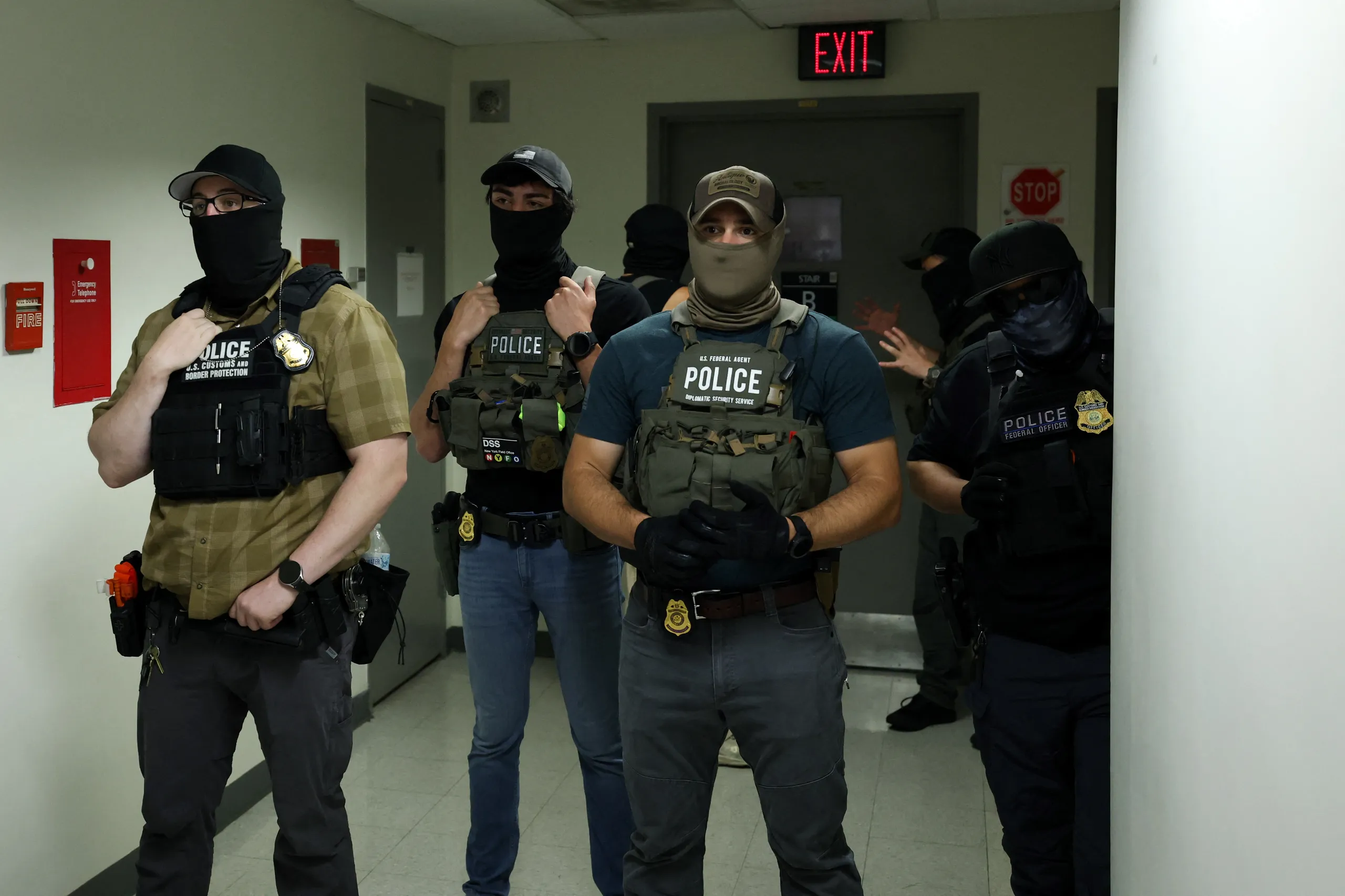
A proposal to bar law enforcement officers from wearing face-concealing masks during public interactions drew significant attention Tuesday during its first hearing before the Washington Senate Law & Justice Committee. Senate Bill 5855 would prohibit local, state, and federal officers, including Immigration and Customs Enforcement agents, from wearing masks that obscure their identities, with limited exceptions for undercover work and certain tactical operations. The bill’s sponsor, Senator Javier Valdez of Seattle, says the measure is needed to ensure accountability and public trust following reports of masked immigration enforcement actions, but opponents warn it “recklessly endangers the lives of the members of our law enforcement Community and their family members” by making officers vulnerable to doxing and retaliation. The debate reveals tensions between transparency demands and officer safety concerns, with underlying question of whether states can regulate federal law enforcement conduct remaining legally unresolved.
The committee held a public hearing Tuesday morning with 22 people signing up to testify, with feedback split for and against the measure. But written testimony showed dramatic imbalance: 14,705 signed in supporting the bill while 2,160 opposed it, roughly a 7-to-1 ratio in favor. That disparity between oral testimony split and written support suggests organized advocacy from groups supporting immigrant rights and police accountability mobilized thousands to submit written testimony, while opposition came primarily from law enforcement community and their supporters who were more likely to testify in person or simply register opposition without extensive written statements.
Valdez told the committee the measure was introduced in response to reports of ICE agents wearing masks during immigration enforcement operations, including an incident last summer in Bellingham and another last week at a Seattle cemetery. “Obviously, I think we’re all aware of incidents that started occurring last year where we started seeing law enforcement officers throughout the country, where they were bringing intimidation tactics and causing fear in neighborhoods and our families and our communities,” Valdez said. “Senate Bill 5855 will help build that trust, continue to help build trust with our law enforcement.” That framing positions masked officers as creating fear rather than safety, particularly in immigrant communities where federal agents covering their faces while conducting arrests generates associations with authoritarian enforcement tactics.
Nathan Olson, public safety policy advisor for Governor Bob Ferguson, said Ferguson supports the measure and urged committee members to pass it. “It will assist in continuing to improve trust in law enforcement personnel by ensuring that they are visibly Identifiable,” Olson said. That gubernatorial backing provides significant political weight, though Ferguson’s support might reflect his political base’s priorities around immigrant rights and police accountability rather than law enforcement community consensus. The tension between elected officials representing constituents who want accountability and law enforcement personnel concerned about safety affects how such proposals advance through legislative processes.
First Assistant U.S. Attorney for the Eastern District of Washington voiced strong opposition, warning the bill “recklessly endangers the lives of the members of our law enforcement Community and their family members. We’re seeing instances of increasing doxing members. The United States put out a position in the DHS that as of last fall doxing increased by a thousand percent.” That statistic about thousand-percent increases in doxing, while dramatic, requires context about baseline numbers and what qualifies as doxing. If doxing incidents increased from 10 to 100, that’s thousand-percent increase but still relatively rare occurrence. If it increased from 1,000 to 10,000, that represents far more serious threat. Without knowing baseline and absolute numbers, the percentage increase alone doesn’t clarify actual risk levels.
Citizen Christian Bianes-Del Rosario told the committee he is in “firm opposition to this bill,” warning: “If this bill goes through and that first officer and their family are threatened or attacked They will know it’s because Their legislators that they elected allowed it to happen So I’m urging each and every single one of you today to please stand in firm opposition to this bill.” That argument holds legislators responsible for consequences of requiring face visibility, framing any future attacks on officers or their families as directly caused by the law. Whether that attribution is fair depends on whether face visibility actually enables attacks that wouldn’t otherwise occur, or whether officers face risks regardless of whether their faces are visible during public interactions.
The exceptions for undercover work and certain tactical operations acknowledge that some law enforcement contexts genuinely require face concealment. Undercover officers investigating organized crime, gangs, or drug networks can’t maintain effectiveness if their identities become public. Tactical operations involving SWAT teams entering dangerous situations might require face protection for both safety and operational security. The question is whether those narrow exceptions adequately address legitimate law enforcement needs, or whether they’re insufficient for situations like serving high-risk warrants, conducting raids in hostile environments, or operating in contexts where officer identity disclosure creates genuine danger.
The legal question of whether states can regulate federal law enforcement conduct remains unresolved and could determine the bill’s fate even if it passes. States generally can’t directly regulate how federal officers conduct their duties because federal supremacy means federal law enforcement operates under federal authority that state laws can’t override. However, states might argue they’re regulating conduct on state soil that affects state residents’ rights, creating jurisdictional questions courts would need to resolve. If Washington passes this law and federal officers ignore it claiming federal supremacy, enforcement becomes complicated and might require litigation to establish whether the state law applies to federal agents.
For ICE operations specifically, the incidents Valdez referenced that prompted the bill, federal agents could argue that their enforcement of immigration law under federal authority exempts them from state regulations about face covering. That would create situation where the law applies to state and local officers but not federal agents, potentially undermining the bill’s effectiveness for its stated purpose of ensuring accountability during ICE operations that generate the most community concern. Whether legislators would accept a law that only affects state and local police while leaving federal agents unconstrained, or whether they’d view partial coverage as better than no coverage, affects political calculations about whether to advance the measure.
The balance between transparency and officer safety reflects genuine tension without easy resolution. Transparency advocates correctly note that officers exercising government power should be identifiable so they can be held accountable for their actions. If officers conducting arrests, searches, or using force can’t be identified because their faces are covered, it becomes difficult or impossible to investigate misconduct complaints, file lawsuits for rights violations, or even verify that people presenting themselves as officers are actually law enforcement rather than criminals impersonating police. That accountability argument is strongest in routine public interactions where transparency is essential to democratic policing.
Officer safety concerns are also legitimate. Law enforcement personnel increasingly face threats from individuals who identify them through photos or videos, research their personal information including home addresses and family members, and either threaten or in some cases actually attack officers or their families. Social media and online databases make doxing easier than in past decades when identifying officers required significant effort. If officers’ faces are visible during enforcement actions that generate video shared online, motivated individuals can use facial recognition technology or crowd-sourced identification to determine officers’ names and personal information, potentially creating danger that wouldn’t exist if faces were covered.
The question is whether the safety risks from requiring face visibility outweigh the accountability benefits, or vice versa. Reasonable people disagree based on their assessments of relative risks and their priorities between officer safety and community accountability. That disagreement drives the split testimony the committee heard, with some viewing masked officers as unacceptable authoritarian imagery incompatible with democratic policing, while others view face covering as reasonable officer protection in dangerous environment where anti-police sentiment creates genuine threats.
For immigrant communities in Washington, particularly those in Seattle, the Bellingham incident, and areas with significant ICE enforcement activity, masked federal agents conducting arrests creates fear that Valdez referenced. When armed individuals with covered faces appear in neighborhoods and take community members into custody, even if they identify themselves verbally as federal agents, the imagery recalls authoritarian enforcement that many immigrants fled in their home countries. Whether officers are actually safer wearing masks during these operations, or whether masks primarily serve to prevent identification and accountability for enforcement tactics that might violate rights or use excessive force, depends on one’s assessment of federal immigration enforcement and officer motivations.
The Seattle cemetery incident last week that Valdez mentioned, where masked agents reportedly conducted immigration enforcement at a cemetery, generated particular controversy because cemeteries are places where people go to grieve and pay respects to deceased loved ones. The use of masked agents in that setting struck many as especially inappropriate, combining lack of transparency with intrusion on sacred space for vulnerable moment. Whether agents wore masks for legitimate safety reasons or to avoid identification is disputed, but the optics of masked enforcement at a cemetery provided political momentum for legislation requiring face visibility.
The executive session scheduled for Thursday at 10:30 a.m. is where committee members will debate the bill and vote on whether to advance it. Executive sessions are closed to public but allow legislators to discuss bills candidly before voting. The 7-to-1 ratio of written testimony supporting versus opposing the bill suggests significant public pressure for passage, though whether committee members view written testimony quantity as more important than law enforcement warnings about safety risks affects their votes. If the committee advances the bill, it would move to full Senate consideration where similar debates would recur.
For Washington’s approach to law enforcement accountability and immigrant rights, this bill represents attempt to use state law to regulate enforcement practices that generate community concern but which state officials can’t directly control when conducted by federal agents. If the bill becomes law and federal agents ignore it claiming federal supremacy, Washington might seek enforcement through courts, creating test case about state authority to regulate federal officer conduct on state soil. Alternatively, federal government might challenge the law preemptively, seeking judicial declaration that it’s unconstitutional under federal supremacy doctrines.
The limited exceptions for undercover work and tactical operations create implementation questions about who decides whether a given situation qualifies for exceptions. If officers claim particular enforcement action required face covering for tactical reasons, does that self-certification satisfy the exception, or must they justify that determination to supervisors, courts, or oversight bodies? If exceptions are broadly interpreted, the law could have minimal practical impact. If narrowly interpreted, it could restrict legitimate law enforcement operations where officer safety genuinely requires face protection.
The thousand-percent increase in doxing that the First Assistant U.S. Attorney cited reflects broader trends of online harassment and threats targeting public officials and law enforcement. Whether requiring face visibility during public interactions significantly increases doxing risk depends on whether motivated individuals can already identify officers through other means like name badges, public records, or previous identifications, or whether face covering provides meaningful protection. If most doxing occurs through methods other than identifying officers from video of enforcement actions, then requiring face visibility might not substantially increase risks that already exist.
The bill’s advancement depends on committee members weighing testimony about accountability versus safety, assessing whether exceptions adequately address legitimate law enforcement needs, considering political pressure from constituents who supported the measure through overwhelming written testimony, and evaluating legal questions about state authority to regulate federal officers. Whether those factors combine to produce committee approval and eventual passage, or whether officer safety concerns and federalism questions derail the measure, will become clear through upcoming executive session vote and potential floor debate if the bill advances. For now, SB 5855 represents Washington’s attempt to address community concerns about masked immigration enforcement through state legislation that might or might not survive legal challenges about whether states can regulate federal law enforcement conduct.