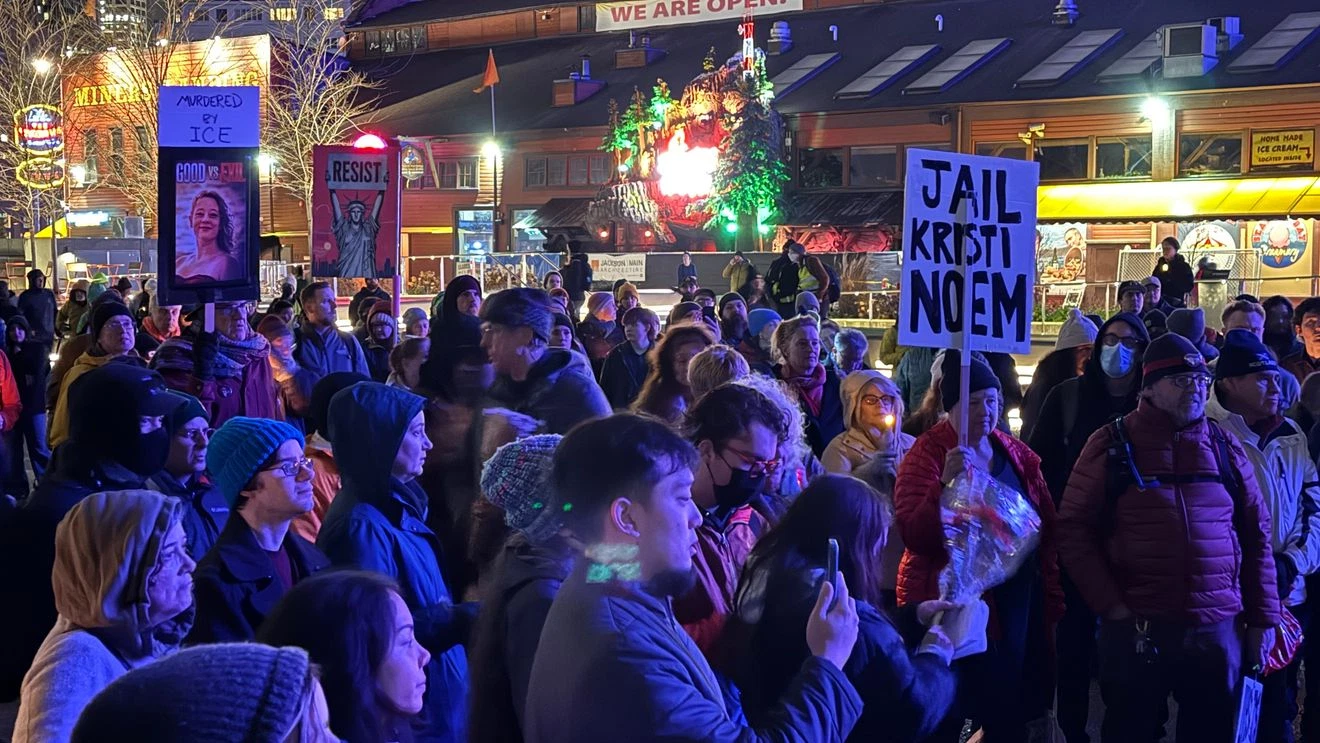
Several hundred people gathered at Pier 58 on Seattle’s waterfront to honor Renee Good, the 37-year-old Minneapolis woman shot by an Immigration and Customs Enforcement agent, bringing flowers, candles, and photos to remember someone they described as a caring person and loving mother. But the vigil revealed something more significant than collective grief over a single death. It exposed growing recognition among Seattle residents that expanded ICE operations don’t respect the boundaries between immigrants and citizens, between people with documentation and people born here, between “them” and “us.”
That realization drove the crowd’s energy from somber remembrance to active protest against the Department of Homeland Security and ICE. Multiple speakers emphasized that Good was a U.S. citizen, framing her death not as immigration enforcement gone wrong but as evidence that aggressive federal operations threaten everyone regardless of legal status. “When they come for one group of us, they’re eventually going to come for all of us, and I think what happened with Renee Good really shows that,” said Tyna Ek, a Seattle resident.
The distinction matters because it challenges the narrative some Americans use to support aggressive immigration enforcement: that if you’re here legally, if you’re a citizen, you have nothing to fear. Good’s death contradicts that assumption. She was shot after an ICE agent alleged she attempted to run him over with her car, a claim Minneapolis officials have disputed after reviewing video footage. Whether that allegation is accurate or fabricated, the outcome is the same. A federal immigration agent killed an American citizen during an operation in a city whose mayor has publicly demanded ICE leave.
For the Scheffer family who attended the vigil, the speed of events and the size of the crowd reflected how quickly this issue has escalated. “This is just happening so fast, so I think this crowd tonight shows there’s a lot of people listening in and [who] care about this,” said Jonathan Scheffer, who brought his wife and daughter. His 13-year-old daughter Mari expressed bewilderment at public support for current enforcement: “It’s crazy to know that this many people, and even more believe that this stuff that’s happening is good and okay.”
That generational perspective is notable. For teenagers growing up in Seattle, a city that has consistently positioned itself as welcoming to immigrants and critical of aggressive federal enforcement, watching an ICE agent kill a citizen in another sanctuary city creates cognitive dissonance. The enforcement they’ve been taught to critique as targeting vulnerable immigrant communities is now killing people who should be beyond its reach.
The memorial at the pier expanded beyond Good to acknowledge “numerous other lives that were lost while in or out of ICE custody since the start of 2025.” That language, “in or out of ICE custody,” reflects the breadth of how people are dying in connection with immigration enforcement. Some die in detention facilities from medical neglect or violence. Others die during enforcement operations, like Good. The common thread is federal immigration authority as the mechanism that brought these people into fatal situations.
Mary Jo, who attended the vigil but declined to share her last name, framed the issue in personal terms: “At my age, this could be my daughter, you know, it could be a cousin, an aunt, it could be any one of us, and this is just completely unacceptable.” That “any one of us” framing represents a shift in how Seattle residents are conceptualizing ICE operations. It’s no longer about protecting immigrant neighbors, though that remains important. It’s about recognizing that expanded enforcement creates dangerous situations for everyone who comes into contact with heavily armed federal agents operating with limited local oversight.
The vigil’s location at Pier 58, right on Seattle’s tourist-heavy waterfront, places this protest in one of the city’s most visible public spaces. The choice suggests organizers wanted maximum exposure, making the event impossible for downtown workers, shoppers, or visitors to ignore. Seattle’s waterfront has been a traditional gathering point for protests precisely because it concentrates foot traffic and media attention in ways that neighborhood demonstrations don’t.
The emotional range participants described, “anger, rage, disappointment, devastation,” reflects how quickly this issue has moved from abstract federal policy debate to concrete local concern. Seattle doesn’t yet have the 2,000-plus ICE agents that have been deployed to Minneapolis and St. Paul. But the city’s sanctuary policies and Democratic political leadership make it a likely target for similar federal enforcement surges, particularly given Trump administration statements about forcing compliance from resistant cities.
That anticipatory anxiety is driving organizing efforts. If Minneapolis can have ICE kill a citizen on its streets despite mayoral opposition, Seattle can too. The protests happening now, before Seattle experiences the same level of enforcement that Minneapolis is navigating, represent an attempt to build political pressure that might prevent escalation rather than simply respond to it after people have already died.
The photos of Good that circulated through the crowd and online media have become symbols of something larger than her individual death. She represents the cost of expanding enforcement operations beyond their stated targets. ICE agents are supposed to be identifying and removing people in the country illegally. When they’re shooting citizens instead, the justification for their presence collapses. That’s the argument protesters are making, using Good’s image to personalize abstract debates about immigration policy.
For Seattle’s immigrant communities, particularly those in South Seattle neighborhoods with large populations of people who are undocumented or have mixed-status families, Good’s death carries a different message. If ICE agents will shoot a citizen based on an allegation she tried to run them over, what might they do to someone who actually lacks legal status? The calculus of risk that immigrant families make daily, whether it’s safe to go to work or take children to school, has to account for enforcement that doesn’t carefully verify legal status before using lethal force.
The organizers who spread word of the vigil through local organizations brought together several hundred people on short notice, suggesting this issue has activated networks beyond the usual protest constituencies. Immigration rights groups are obviously involved, but so are parents like the Scheffers and people like Mary Jo who frame their attendance in terms of protecting “any one of us” rather than specifically protecting immigrants.
That coalition building matters for sustained resistance. If opposition to aggressive ICE operations remains confined to immigrant rights groups and their traditional allies, it’s easier for federal authorities to dismiss or ignore. When broader segments of the public, including citizens with no personal immigration concerns, start viewing federal enforcement as threatening their own safety, the political dynamics shift.
Seattle’s history of protest, from the WTO demonstrations in 1999 to Black Lives Matter marches to numerous immigrant rights actions, creates both infrastructure and experience for this kind of rapid mobilization. The city has organizations, communication networks, and a population accustomed to public demonstration as a legitimate response to perceived injustice. Whether these protests translate into policy changes or simply document opposition to federal actions that will continue regardless is the question protesters are trying to answer through their presence.
The vigil for Renee Good at Pier 58 memorialized one woman killed 1,500 miles away. But it also marked Seattle residents grappling with the recognition that expanded immigration enforcement creates risks that extend beyond the populations it ostensibly targets. When ICE agents are shooting citizens, everyone becomes a potential target. That realization is what brought several hundred people to the waterfront with candles and photos and signs, trying to prevent Minneapolis’s present from becoming Seattle’s future.