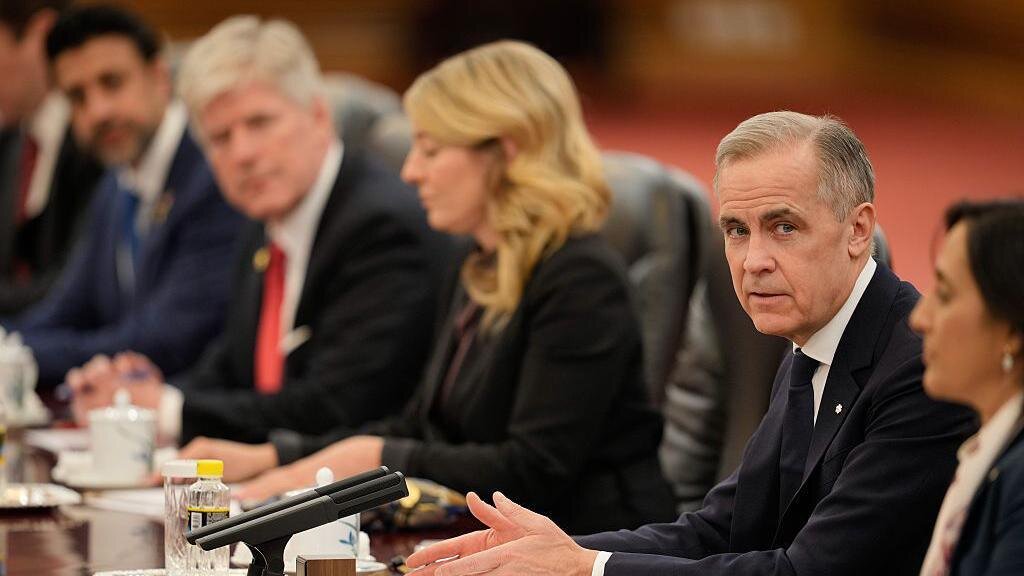
Chinese leader Xi Jinping and Canadian Prime Minister Mark Carney announced lower tariffs signaling a reset in their countries’ relationship after a key meeting in Beijing. China will lower levies on Canadian canola oil from 85% to 15% by March 1, while Ottawa agreed to tax Chinese electric vehicles at the most-favored-nation rate of 6.1%, Carney told reporters. The deal represents a breakthrough after years of strained ties and tit-for-tat levies, with Xi hailing the “turnaround” in their relationship. The agreement marks a win for Carney, the first Canadian leader to visit China in nearly a decade, as he tries to diversify Canadian trade away from the US following uncertainty caused by Trump’s on-again-off-again tariffs. The deal could also see more Chinese investments in Canada, right on America’s doorstep.
Carney alluded to Trump’s tariffs pushing one of the US’s key allies toward its biggest rival, telling reporters that Canada’s relationship with China had been more “predictable” in recent months and that he found talks with Beijing “realistic and respectful.” He made clear Ottawa doesn’t agree with Beijing on everything, saying he emphasized Canada’s “red lines” including human rights, election interference concerns, and need for “guardrails.” When asked about China’s human rights record, Carney said “we take the world as it is, not as we wish it to be.” That pragmatic framing reflects difficult position Carney faces balancing economic interests against values-based foreign policy that characterized previous Canadian approaches to China.
The tariff relief addresses key sticking point between the countries. In 2024, Canada imposed 100% tariffs on Chinese electric vehicles following similar US curbs. Beijing retaliated with tariffs on more than $2 billion of Canadian farm and food products like canola seed and oil, causing Chinese imports of Canadian goods to fall 10% in 2025. The Friday deal allows only 49,000 Chinese electric vehicles into Canada at the 6.1% tariff rate, responding to Canadian automakers’ fears of an influx of affordable Chinese EVs. Beyond canola producer relief, reduced tariffs will apply to Canadian lobsters, crabs, and peas.
The cap of 49,000 Chinese EVs at preferential tariff rate represents compromise between opening markets and protecting domestic auto industry. Canada’s automotive sector, concentrated in Ontario and historically integrated with US manufacturers, faces existential questions about transition to electric vehicles and whether Chinese manufacturers’ cost advantages make competition impossible without tariff protection. The 6.1% rate represents massive reduction from 100%, but the volume cap prevents Chinese manufacturers from flooding Canadian market in ways that could devastate domestic production.
The canola tariff reduction from 85% to 15% provides critical relief for Prairie farmers who saw Chinese market effectively closed by retaliatory measures. Canola represents major Canadian agricultural export, and loss of Chinese market created economic hardship for farming communities while forcing farmers to find alternative markets or reduce plantings. Whether the 15% rate allows Canadian canola to compete effectively against other suppliers in Chinese market, or whether it remains effectively prohibitive compared to tariff-free alternatives, affects how much relief farmers actually receive.
Observers believe Carney’s visit could set example for other countries feeling pain from Washington’s tariffs. Xi has been trying to show China is stable global partner, urging more pragmatic ties that Beijing characterizes as “win-win” for all. The South Korean president and Irish prime minister have both visited Beijing in recent weeks, with UK prime minister and German chancellor expected soon. That pattern suggests Carney’s outreach represents broader trend of traditional US allies hedging their relationships and seeking economic opportunities with China despite American objections.
Carney’s statement that the “world has changed dramatically” and how Canada positions itself “will shape our future for decades to come” frames the China engagement as strategic necessity rather than preference. Earlier in his three-day visit, he said the Canada-China partnership sets the countries up for a “new world order,” later adding that the multilateral system had been “eroded, to use a polite term, or undercut.” That language directly criticizes US approach under Trump while positioning China as alternative partner for rules-based international cooperation, remarkable shift for Canadian leader whose country has historically aligned closely with Washington.
The economic context matters because China is Canada’s second-largest trading partner but still far behind the US in volume. Trade with US dwarfs all other Canadian relationships combined, making any diversification effort symbolic more than transformative in near term. But Carney’s meeting with senior Chinese business executives including electric vehicle battery maker and energy giant representatives suggests interest in expanding beyond traditional commodity trade toward technology and industrial partnerships that could create longer-term economic integration.
The agreements on energy and trade cooperation signed Thursday provide framework for expanded relationship beyond immediate tariff relief. Whether those agreements produce substantial new business or remain largely aspirational depends on follow-through from both governments and whether private sector actors see profitable opportunities. Canadian energy resources, including oil, gas, and critical minerals, interest China as it seeks supply security. Chinese manufacturing capacity and capital interest Canadian policymakers seeking investment and economic growth.
The frosty history between the countries complicates relationship building. The last Canadian PM to visit China was Justin Trudeau in 2017, before relations soured in 2018 following Canada’s arrest of Huawei CFO Meng Wanzhou at US request. China detained Canadian citizens Michael Kovrig and Michael Spavor on espionage charges in apparent retaliation, though China denied the connection. All three were released in 2021, but the “hostage diplomacy” episode created lasting distrust and political sensitivity in Canada about engagement with Beijing.
Michael Kovrig’s statement ahead of the meeting that the visit should focus on “managing leverage” rather than just warming ties reflects skepticism among China hawks about whether engagement produces benefits or simply allows Beijing to exploit Canadian goodwill. Kovrig described Chinese negotiators as “extremely adroit, calculating, and always looking for leverage,” warning that “engagement has to be handled with discipline.” His advocacy for approximately 100 Canadians imprisoned in China according to Canadian media highlights human rights concerns that complicate economic engagement.
Carney’s acknowledgment that with countries not sharing the same values, Ottawa will engage in “narrower, more specific” manner attempts to square circle of economic cooperation with authoritarian government whose values conflict with Canadian democratic principles. His statement that Chinese claims over Taiwan and Hong Kong’s jailed pro-democracy figure Jimmy Lai came up in “broad discussions” provides minimal reassurance to critics who view economic engagement as legitimizing Chinese repression. Whether that balance satisfies domestic constituencies demanding both economic opportunities and values-based foreign policy remains politically contentious.
The phrase “we don’t grab a megaphone and have the conversations that way” represents implicit criticism of previous Canadian approaches that emphasized public criticism of Chinese human rights abuses. Carney’s preference for direct private conversations reflects pragmatic calculation that public denunciations don’t change Chinese behavior but do jeopardize economic opportunities. Whether that quiet diplomacy proves more effective at advancing Canadian interests, or whether it represents abandonment of principled foreign policy in favor of commercial considerations, depends on outcomes and one’s priorities.
For the United States, Carney’s Beijing visit represents concerning development where traditional ally pursues closer ties with strategic competitor in direct response to American tariff policies. The irony that Trump’s tariffs intended to pressure allies into alignment instead pushed Canada toward China won’t be lost on observers. Whether Washington responds by moderating tariffs to keep allies aligned, doubles down on pressure to force choice between US and China, or simply accepts that unilateral tariff policies create space for competitors to peel away American partners affects broader alliance dynamics.
The potential for increased Chinese investment in Canada “right on America’s doorstep” creates security concerns in Washington about critical infrastructure, technology transfer, and strategic assets potentially falling under Chinese control or influence. Previous Chinese investments in Canadian mining, energy, and technology sectors faced scrutiny and sometimes rejection on national security grounds. Whether Carney’s government facilitates increased Chinese investment despite those concerns, or whether security reviews continue limiting such deals, affects how much the tariff relief translates into broader economic integration.
Colin Robertson’s characterization of the visit as a “reset of a relationship” that may be “modest in ambition” but “much more realistic about what we can reasonably obtain” reflects tempered expectations among experts. The relationship won’t return to warm partnership, but it might evolve into functional economic relationship where both sides pursue mutual interests while managing disagreements. Whether that proves sustainable or whether inevitable tensions over values, security, and geopolitics eventually undermine economic cooperation depends on both countries’ ability to compartmentalize issues and maintain engagement despite conflicts.
For global trade dynamics, the Canada-China tariff deal represents test case for whether countries can successfully hedge between US and Chinese economic spheres, maintaining relationships with both despite their rivalry. If Canada benefits economically without suffering significant American retaliation or Chinese exploitation, other middle powers might follow similar paths. If Canada faces pressure or consequences that make the diversification costly, it might deter others from similar strategies. The next months and years will clarify whether Carney’s bet on pragmatic engagement with China while maintaining US alliance proves viable or whether geopolitical realities force starker choices between the world’s two largest economies.