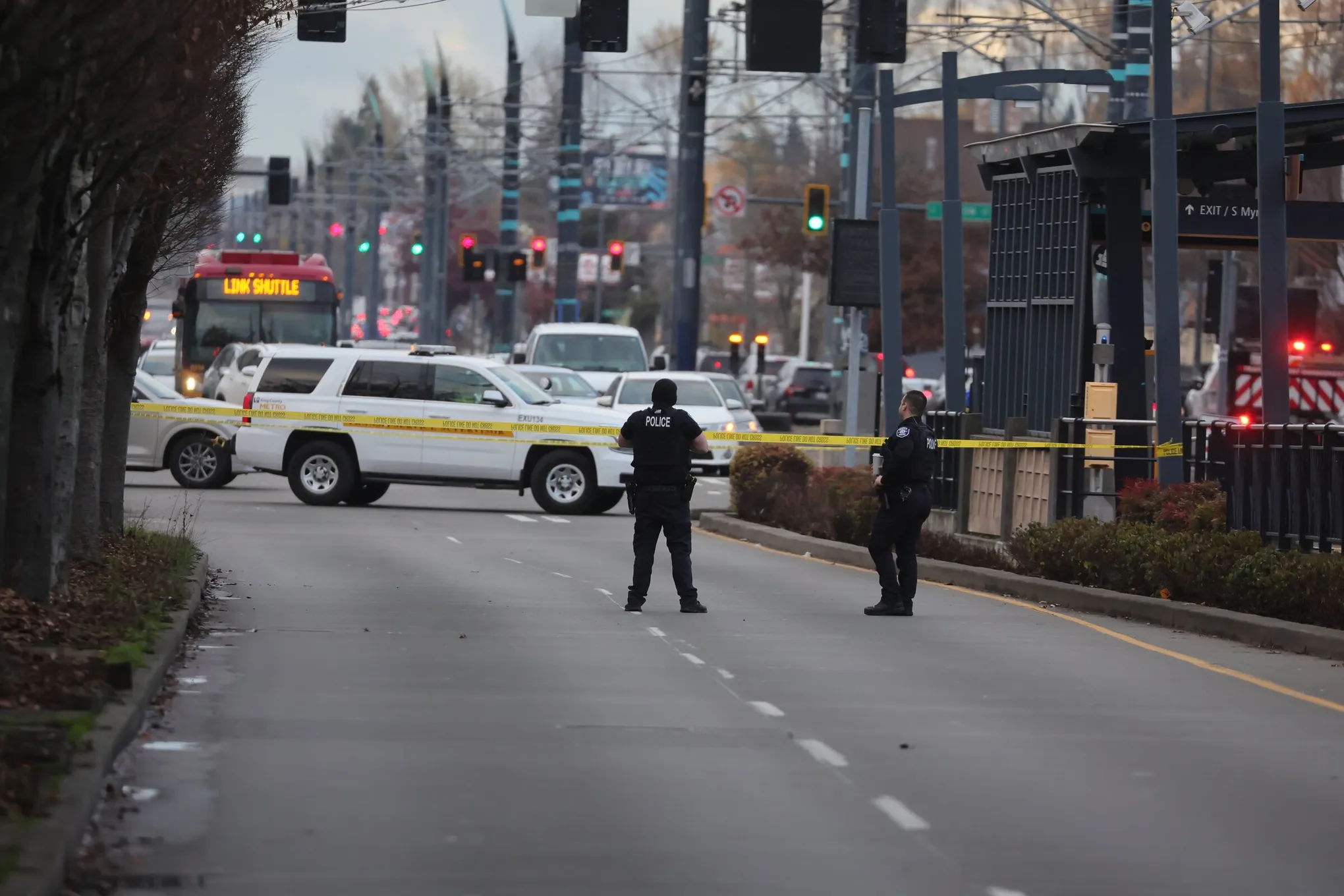
Seattle police shot and killed a man Tuesday afternoon after he reportedly waved a gun in a south Seattle neighborhood and pointed the weapon at responding officers near a light rail station.
Multiple 911 callers reported a man carrying a gun walking on South Othello Street near 42nd Avenue South around 1:30 p.m., according to Police Chief Shon Barnes.
Barnes said officers encountered the man near the Othello light rail station at Martin Luther King Jr. Way South, where he pointed the firearm at them.
“Sometimes you don’t have the benefit of time when someone is carrying a firearm and they’re walking toward you and they’re walking toward innocent people,” Barnes explained. “Obviously if someone is brandishing a firearm, walking toward an elementary school, walking toward an area of commerce, you want that person to put the weapon down as soon as possible.”
The shooting occurred approximately 75 yards from the front entrance of Salish Sea Elementary School. Police placed the school under brief lockdown as a precautionary measure during the incident.
Authorities have not released the identity of the deceased man. Barnes indicated the man was still holding his gun when officers fired, and they subsequently used a 40mm less-lethal round to dislodge the weapon from his hand before beginning CPR.
No officers sustained injuries during the confrontation. However, a bystander inside a nearby apartment building was struck by shattered glass and transported to a hospital with minor injuries, Barnes said.
The King County Force Investigation Team is now reviewing the shooting, standard procedure for officer-involved incidents resulting in death or serious injury. The independent investigation will examine the circumstances leading to the use of lethal force.
During the investigation, authorities closed the intersection at northbound Martin Luther King Jr. Way South and South Othello Street along with the adjacent light rail station. Sound Transit suspended 1 Line service between Columbia City and Rainier Beach stations, disrupting transit for commuters during the afternoon rush period.
The intersection reopened and light rail service resumed around 5:30 a.m. Wednesday morning. However, as of 6:45 a.m., an area at the corner of the intersection remained cordoned off with crime scene tape as investigators continued processing evidence.
The incident unfolded in a busy commercial and residential area that includes the light rail station, elementary school, shops, and apartment buildings. The proximity to multiple public spaces heightened concerns about public safety during the initial reports of an armed individual.
The timeline from initial 911 calls to the shooting suggests officers responded quickly to reports of the armed man. The brief period between calls reporting the gun and the confrontation near the light rail station indicates the situation developed rapidly.
Barnes’s comments about the proximity to an elementary school highlight the threat assessment officers made when deciding to confront the armed individual. The potential danger to children, transit riders, and pedestrians in the area factored into the response.
The use of a 40mm less-lethal round after the shooting to remove the gun from the man’s hand represents an additional safety measure. These rounds, often called “foam baton rounds,” can incapacitate or disarm individuals from a distance with reduced risk of fatal injury compared to standard ammunition.
Officers began CPR following the shooting, indicating they attempted life-saving measures despite the lethal force employed moments earlier. This sequence reflects police training that requires officers to provide medical aid to injured individuals once the threat has been neutralized.
The bystander injury from shattered glass demonstrates the risks to uninvolved individuals during police shootings in urban environments. Bullets striking buildings or vehicles can create secondary hazards beyond the direct line of fire.
The Force Investigation Team’s review will examine multiple aspects of the incident including the initial threat assessment, verbal commands given to the subject, the decision to use lethal force, and whether the response complied with department policies and legal standards.
Sound Transit’s service suspension affected thousands of riders during the evening commute. The 1 Line represents a critical transit artery connecting south Seattle neighborhoods to downtown and the University of Washington, making disruptions significant for those dependent on light rail.
The overnight closure of the intersection and extended crime scene processing reflect the comprehensive nature of investigations into officer-involved shootings. Detectives photograph the scene, collect evidence including shell casings, document positions of involved parties, and interview witnesses to reconstruct events.